In the vast, ever-evolving universe of manga, manhwa, and manhua, few names surface as frequently in reader discussions as Olympus Scanlation. For global fans navigating language barriers, delayed official releases, and hard-to-find niche series, scanlation groups like Olympus have become cultural bridges—delivering fast, community-driven English translations that keep stories alive across borders.
Yet Olympus Scanlation is more than a place to read free chapters. It represents a complex intersection of fandom, volunteer craftsmanship, legal gray zones, and digital safety concerns. This in-depth guide explores what Olympus Scanlation is, how it works, what you can read, whether it’s legal, and how to stay safe—all while examining its role in today’s rapidly professionalizing manga industry.
1. What Is Olympus Scanlation?
More Than Just Translation: A Global Bridge for Manga Fans
Olympus Scanlation is a volunteer-run fan translation group dedicated to converting manga, manhwa, and manhua into English for international readers. Like many scanlation collectives, it operates as a non-profit, community-driven initiative rather than a commercial publisher.
At its core, scanlation exists to:
- Bridge the language gap between creators and global audiences
- Provide access to unlicensed or niche series unavailable in English
- Deliver faster chapter releases than traditional publishing timelines
- Foster fan communities around shared storytelling
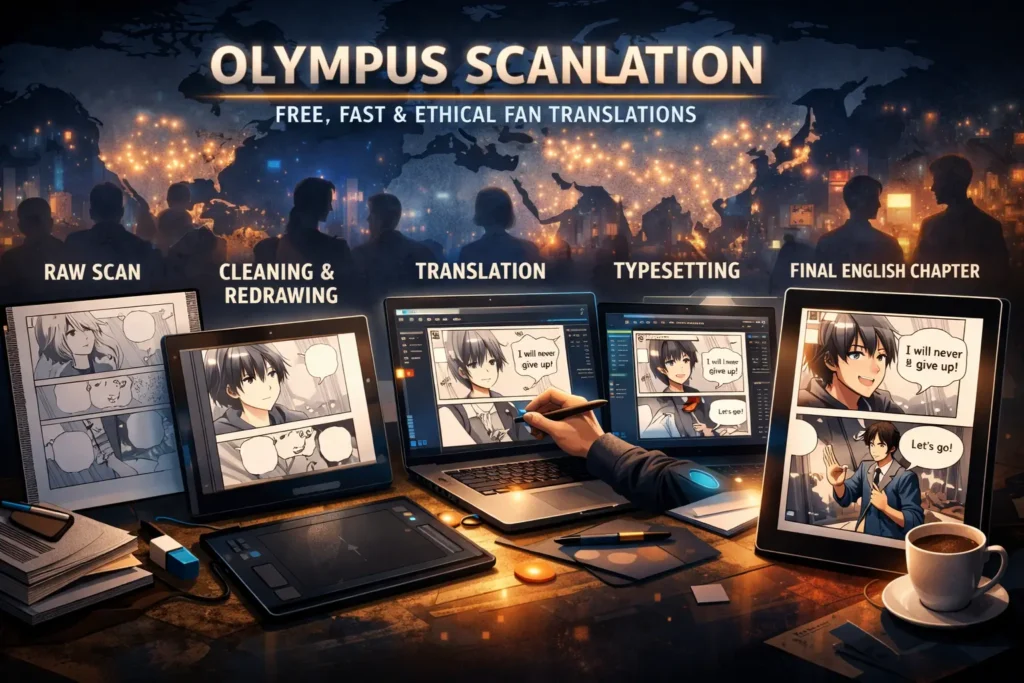
The term scanlation itself blends “scan” + “translation.” Raw pages are scanned, cleaned, translated, typeset, and released digitally—often within 24 to 72 hours of the original publication.
Why Readers Choose Olympus Over Official Releases
Despite the growth of legal simul-release platforms, readers still turn to Olympus Scanlation for three main reasons:
1. Speed
Official translations can lag behind by months—or never appear at all. Scanlation groups often release chapters within days.
2. Selection
Olympus frequently focuses on underrated, niche, or unlicensed titles overlooked by major publishers.
3. Community Experience
Volunteer teams interact directly with readers through Discord servers, feedback channels, and recruitment drives, creating a participatory fandom rather than a passive reading app.
This blend of accessibility, immediacy, and fandom culture explains Olympus’s continued relevance—even as official platforms expand.
2. Inside the Scanlation Workflow: From Raw Pages to English Chapters
Behind every polished chapter lies a multi-stage production pipeline powered entirely by volunteers across time zones.
Stage 1: Raw Acquisition & Cleaning
- High-resolution raw scans are sourced from magazines or digital releases
- Image editors remove dust, text, and compression artifacts
- Pages are prepared for translation while preserving original artwork
This foundational step determines visual clarity and readability.
Stage 2: Art Restoration (Redrawing) — The Unsung Hero
Redrawers reconstruct artwork hidden behind Japanese or Korean text:
- Recreating background textures and line art
- Matching shading, gradients, and motion effects
- Ensuring the final page looks indistinguishable from the original
High-quality redraw work is often what separates elite scanlation groups from low-effort aggregators.
Stage 3: Literary Translation vs. Literal Translation
Translators face a crucial balance:
- Literal translation preserves wording but may sound unnatural
- Literary localization adapts jokes, idioms, and tone for English readers
Olympus typically prioritizes readability while maintaining author intent, a hallmark of respected fan groups.
Stage 4: Typesetting & Font Psychology
Typesetters insert translated dialogue using:
- Carefully chosen fonts that match genre and mood
- Proper right-to-left flow and speech-bubble spacing
- Stylized sound effects (SFX) integrated into artwork
Good typesetting is invisible craftsmanship—noticed only when done poorly.
Stage 5: Final Quality Check
Before release, proofreaders verify:
- Grammar, tone, and character voice consistency
- Visual alignment and page sequencing
- Overall reading experience across devices
Only after passing QA does a chapter reach readers.
3. The Olympus Scanlation Library: What Can You Read Right Now?
One of the biggest gaps in competitor content is specific reading recommendations. Readers searching for Olympus usually want a simple answer:
“What series are worth reading?”
Trending Titles in the Olympus Catalog (2026 Snapshot)
While catalogs shift as licensing changes, Olympus commonly focuses on:
Action / Murim / Fantasy
- Fast-paced cultivation and martial-arts sagas
- Regression and leveling narratives
- Long-form world-building arcs
These genres dominate modern manhwa popularity.
Romance & Drama
- Character-driven emotional storytelling
- Historical fantasy relationships
- Slice-of-life interpersonal conflicts
Romance titles often attract consistent weekly readership.
Isekai & Adventure
- Reincarnation power fantasies
- Game-system mechanics
- Exploration-focused narratives
These remain among the most globally consumed webtoon genres.
Genres With the Deepest Catalogs
Olympus Scanlation frequently emphasizes:
- Manhwa (Korean webtoons)
- Manhua (Chinese fantasy epics)
- Shonen-style action manga
- Slice-of-life and romance hybrids
This diversity allows readers to discover stories unavailable on mainstream apps.
How to Discover New Series
Typical platform navigation includes:
- Search bar filtering by title or genre
- Latest update feeds showing newly released chapters
- Popularity sorting based on reader engagement
- Direct Discord announcements for fresh projects
For newcomers, these tools transform Olympus from a simple site into a curated discovery hub.
4. Is Olympus Scanlation Legal? Understanding the Copyright Gray Area
Legality is the most searched demonstrated concern around scanlation.
The Core Reality: A Legal Gray Zone
Scanlation operates without official licensing, meaning:
- Translations are technically unauthorized reproductions
- Copyright holders can issue DMCA takedowns or cease-and-desist orders
- Sites may remove content without warning
However, ethical scanlation groups follow an unspoken industry rule.
Dropping Titles Once Licensed
Responsible groups—including Olympus—typically:
- Stop translating when a series gains an official English license
- Encourage readers to support official releases
- Avoid monetizing translations beyond minimal hosting costs
This behavior helps maintain a fragile coexistence with publishers.
Supporting the Official Manga Ecosystem
Readers are often directed toward legal platforms for:
- Simultaneous global chapters
- Higher production quality
- Direct creator compensation
Scanlation thus functions less as piracy and more as a temporary access bridge—especially for unlicensed works.
5. Safety Guide: How to Read Olympus Scanlation Without Malware
Safety is where Olympus-focused content can truly outperform competitors.
Official vs. Mirror Sites
Major risks come not from scanlation groups themselves but from aggregator mirrors filled with:
- Fake download buttons
- Aggressive pop-ups and redirects
- Hidden malware scripts
Always verify:
- Correct domain spelling
- Links shared via official Discord announcements
- Absence of suspicious forced downloads
Five Essential Security Tools
Before reading on any unofficial site, use:
- Ad blocker to prevent malicious scripts
- Updated antivirus software
- Secure DNS filtering
- Privacy-focused browser settings
- Optional VPN for network protection
These steps dramatically reduce infection and phishing risk.
Is the Olympus Discord Safe?
Community servers are generally safer but still require caution:
- Trust only verified announcement channels
- Ignore unsolicited download links
- Report suspicious direct messages or scams
Digital literacy is the best defense.
6. How to Join the Olympus Scanlation Team
Scanlation thrives on new volunteers.
Common Recruitment Roles
Olympus regularly seeks:
- Translators (Japanese, Korean, or Chinese → English)
- Cleaners & redrawers skilled in image editing
- Typesetters with font and layout experience
- Proofreaders for natural English flow
- Quality checkers ensuring final polish
Applications usually occur through Discord submissions and skill tests.
No Japanese Required? Yes.
Many roles need only:
- Strong English grammar
- Basic Photoshop or editing skills
- Attention to detail and deadlines
This openness makes scanlation a global collaborative hobby.
7. Frequently Asked Questions
Is Olympus Scanlation shutting down?
No confirmed shutdown exists, though the expanding official market continually reshapes scanlation’s role.
Does Olympus Scanlation have an app?
Typically no. Reading occurs via mobile or desktop web browsers.
Why is Olympus so fast?
Because volunteer teams work in parallel stages across time zones.
Can chapters be downloaded offline?
Availability varies and often depends on reader platform policies.
Is Olympus only for manga?
No—many projects include manhwa and manhua.
Do readers need to pay?
Most scanlation releases remain free to access.
What if I click an ad on a mirror site?
Immediately close the tab and run a security scan to prevent malware issues.
8. The Future of Olympus Scanlation in an Official-First Industry
The global manga and webtoon market is rapidly shifting toward:
- Simultaneous multilingual releases
- Expanding legal subscription platforms
- Stronger copyright enforcement
These trends shrink the window where scanlation thrives.
Yet Olympus Scanlation—and groups like it—continue serving a vital cultural function:
- Preserving unlicensed niche stories
- Introducing readers to future officially licensed hits
- Sustaining fan-driven translation communities
Rather than disappearing overnight, scanlation is evolving into a transitional layer between creators and globalization.
Final Thoughts
Olympus Scanlation stands at the crossroads of fandom passion, ethical ambiguity, and digital accessibility. For readers, it offers speed, variety, and community. For the industry, it represents both a challenge and a proving ground for global demand.
Understanding Olympus isn’t just about finding free chapters—it’s about recognizing how stories travel across languages, cultures, and technologies in the modern age.
And in that journey, scanlation remains one of fandom’s most fascinating—and controversial—art forms.

Adrian Cole is a seasoned content creator specializing in artificial intelligence, emerging technologies, and digital innovation. With a strong passion for breaking down complex technical concepts into clear, practical insights, Adrian helps readers understand how AI is shaping businesses, products, and everyday life. His work focuses on real-world applications of machine learning, automation, SaaS tools, and future tech trends, making advanced technology accessible to both professionals and curious learners. Adrian is known for his balanced, experience-driven approach that blends technical accuracy with human-centered storytelling.