
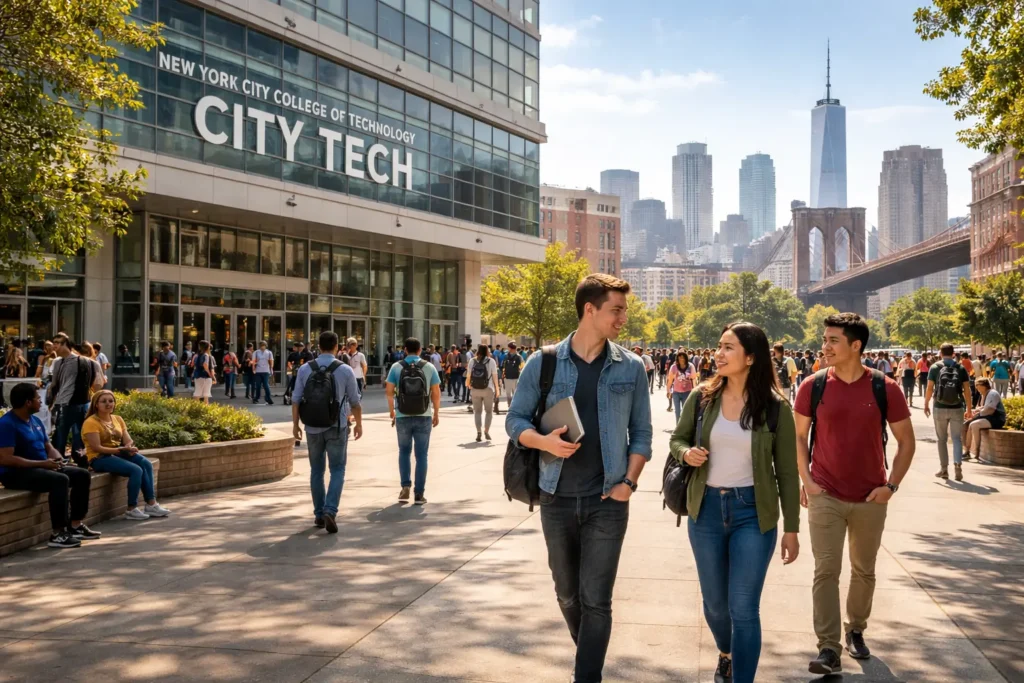
1. Overview of New York City College of Technology (City Tech)
What is City Tech Known For?
New York City College of Technology — widely known as City Tech — is a public senior college of the City University of New York (CUNY) system, located in Downtown Brooklyn, New York. Founded in 1946 as the New York State Institute for Applied Arts and Sciences, City Tech has grown into one of New York City’s premier institutions for applied technology, hands-on training, and career-focused education. The college is accredited by the Middle States Commission on Higher Education and is nationally recognized for its engineering technology, health professions, and computer science programs.
City Tech’s defining identity is its commitment to experiential, applied learning. Unlike traditional liberal arts colleges, City Tech integrates real-world skills and laboratory-based instruction directly into its curriculum, preparing graduates for high-demand careers across engineering, healthcare, design, and business.
City Tech Quick Facts
| Detail | Information |
| Founded | 1946 |
| Type | Public Senior College (CUNY) |
| Location | 300 Jay Street, Downtown Brooklyn, NY 11201 |
| Accreditation | Middle States Commission on Higher Education |
| Total Enrollment | ~14,500 – 17,000 undergraduates |
| Acceptance Rate | ~76% (test-blind admissions) |
| In-State Tuition | ~$5,730 per year |
| Out-of-State Tuition | ~$15,300 per year |
| Campus Type | Urban, 29 acres (commuter campus, no dorms) |
| Student Nickname | Yellow Jackets |
| Athletics | NCAA Division III (currently on hiatus) |
| Countries Represented | 106 |
2. Is City Tech Hard to Get Into? (Admissions Guide)
City Tech Acceptance Rate & Requirements
City Tech maintains an acceptance rate of approximately 76%, making it an accessible institution with a moderately open enrollment policy. As a test-blind school, City Tech does not require SAT or ACT scores for admission. This policy reflects the college’s commitment to serving a diverse, first-generation, and working-class student population across New York City.
However, certain competitive programs — such as Nursing (RN), Dental Hygiene, and Radiologic Technology — have higher admission standards and may require a minimum GPA of 2.5 or above, along with specific prerequisite coursework.
| Admission Factor | Details |
| Acceptance Rate | ~76% overall |
| Application Deadline | February 1 (Regular Decision) |
| Testing Policy | Test-blind — SAT/ACT not required or considered |
| Basic Requirement | High school diploma or GED equivalent |
| Annual Applicant Pool | ~17,500 applicants |
| Competitive Major Min. GPA | 2.5+ (Nursing, Dental Hygiene, Rad Tech) |
| Financial Aid Required | FAFSA + NY State Aid Form |
How to Apply to City Tech: Step-by-Step Guide
Applying to City Tech is done through the centralized CUNY application portal. Here is a complete walkthrough:
- Visit the CUNY Application Portal at cuny.edu and create an account.
- Select ‘New York City College of Technology (City Tech)’ as your target school.
- Pay the $65 application fee (fee waivers available for eligible students — apply via the CUNY portal).
- Submit your official high school transcripts or GED certificate.
- Complete the FAFSA (Federal Student Aid) form using City Tech’s FAFSA code: 002696.
- Complete the New York State TAP (Tuition Assistance Program) aid form.
- Transfer students: Use the CUNY Transfer Application and submit all college transcripts from prior institutions.
- Monitor your application status via CUNYfirst, City Tech’s student portal.
| Transfer Student Tip: City Tech has articulation agreements with CUNY community colleges such as BMCC and Kingsborough Community College. Students who complete associate degrees at these schools may qualify for streamlined transfer credit evaluation. Contact the Office of Transfer Affairs for your ePermit and credit transfer options. |
3. What Does It Cost to Attend City Tech? (Tuition & Financial Aid)
Tuition Breakdown: In-State vs. Out-of-State
City Tech offers one of the most affordable tuition rates among four-year colleges in New York City. As a CUNY institution, its in-state tuition is significantly below the national average, making it an exceptional value for New York residents pursuing technology and health careers.
| Cost Category | Annual Amount |
| In-State Tuition (NY Resident) | ~$5,730 |
| Out-of-State Tuition | ~$15,300 |
| Required Fees | ~$339 |
| Estimated Total (In-State, no housing) | ~$6,069 |
| Average Net Price (after aid) | ~$5,601 |
Note: City Tech is a commuter campus with no on-campus housing, which significantly reduces the total cost of attendance compared to residential colleges. Students are responsible for their own housing and transportation costs in the New York City area.
Average Net Price & Financial Aid
City Tech is committed to making higher education accessible. Approximately 58% of students receive Pell Grants, reflecting the high proportion of low-income and first-generation students the college serves. The average net price after financial aid for loan recipients is ~$5,601 per year — among the lowest of any four-year college in New York City.
Types of financial aid available at City Tech include:
- Federal Pell Grant (for eligible low-income students)
- Federal Supplemental Educational Opportunity Grant (SEOG)
- Direct Subsidized and Unsubsidized Loans
- Parent PLUS Loans
- Federal Nursing Scholarships (for qualifying nursing students)
- New York State TAP (Tuition Assistance Program)
- Federal Work-Study Program (institutional employment available)
- CUNY and departmental scholarships
Scholarships at City Tech
Beyond federal and state aid, City Tech offers targeted scholarships through individual departments and external partners. Notable scholarship opportunities include:
- Federal Nursing Scholarships: Available to nursing students who agree to work in underserved communities post-graduation.
- ASHE (American Society of Highway Engineers) and other professional association scholarships for engineering technology students.
- Departmental awards in Hospitality Management, Dental Hygiene, and Computer Science.
- The CUNY Decade of Science initiative supports scholarships for STEM students.
Students are strongly encouraged to contact City Tech’s Financial Aid Office and departmental advisors to identify all available funding opportunities.
4. Best Majors & Academics at City Tech
Top 5 Highest-Rated Programs
City Tech’s curriculum is defined by its applied, career-first philosophy. These are the college’s most prominent and highest-outcome programs:
| Rank | Program | Degree(s) Offered | Median Alumni Salary |
| 1 | Engineering Technology (Civil, Mechanical, Electrical) | AAS, BTech | ~$87,346 |
| 2 | Nursing (Registered Nurse) | AAS | ~$68,212 |
| 3 | Dental Hygiene | AAS | ~$68,000 |
| 4 | Radiologic Technology & Medical Imaging | AAS | ~$65,000 |
| 5 | Computer Science / Cybersecurity | BS | ~$70,732 |
Complete List of Majors by School
School of Technology & Design
- Architectural Technology
- Civil Engineering Technology
- Computer Engineering Technology
- Construction Management Technology
- Electrical Engineering Technology
- Mechanical Engineering Technology
- Environmental Control Technology
- Telecommunications Technology
- Communication Design
- Entertainment Technology
- Graphic Arts
School of Professional Studies
- Hospitality Management
- Marketing
- Accounting
- Real Estate
- Paralegal Studies
- Fashion Merchandising
School of Arts & Sciences
- Liberal Arts & Sciences
- Mathematics
- Physical Sciences
- Computer Science
- Information Systems
- Cybersecurity
- Web / Multimedia Design
School of Health Sciences
- Nursing (Registered Nursing — RN)
- Dental Hygiene
- Radiologic Technology & Medical Imaging
- Vision Care Technology (Opticianry)
- Substance Abuse Counseling
- Restorative Dentistry
Student-to-Faculty Ratio & Class Sizes
City Tech maintains a student-to-faculty ratio of approximately 13:1 to 17:1, with the majority of classes enrolling between 10 and 19 students. This relatively small class size supports a personalized learning environment, especially in laboratory-heavy programs like Nursing, Engineering, and Dental Hygiene, where hands-on instruction is central to the curriculum.
| What Makes City Tech Different: Applied & Experiential Learning Unlike traditional universities, City Tech’s curriculum is built around applied pedagogy — meaning students learn by doing. Nursing students practice in simulation labs. Engineering students work in fully equipped fabrication labs. Hospitality students operate a real teaching kitchen. This career-first model is why City Tech graduates enter the workforce with industry-ready skills from day one. |
5. Student Life at City Tech (No Dorms? No Problem)
Commuter Campus Life: What to Expect
City Tech is a commuter campus — 0% of students live on campus. This is one of the most frequently asked questions about City Tech, and it’s important to understand what it means for the student experience. Rather than dormitory life, City Tech students live throughout Brooklyn, Queens, the Bronx, and Manhattan, commuting to Downtown Brooklyn via the NYC subway, bus, and Long Island Rail Road.
For students who need help finding housing in New York City, City Tech’s Office of Student Affairs provides off-campus housing assistance and resources. Nearby neighborhoods such as DUMBO, Fort Greene, Boerum Hill, and Crown Heights are popular with City Tech students due to their proximity to campus.
Clubs, Activities & Athletics
Despite its commuter identity, City Tech offers a vibrant campus life through more than 60 student organizations. Students can join:
- STEM and Technology Clubs: Robotics Club, Computer Science Club, Engineering Society
- Creative Arts: Film Club, Photography Society, Graphic Design Club
- Professional Networks: Hospitality Management Society, Nursing Student Association
- Cultural and Diversity Organizations: Caribbean Student Association, Asian Student Alliance, LGBTQ+ Coalition
- Academic Honor Societies: Phi Theta Kappa and departmental honors societies
- Wellness and Recreational: Yoga Club, Martial Arts Club, Intramural Sports
Note: City Tech does not have fraternities or sororities on campus.
Athletics: City Tech’s teams, known as the Yellow Jackets, compete under the colors of blue and gold. The college participates at the NCAA Division III level, though its athletic program has been on hiatus in recent years. Historical sports include basketball, cross country, soccer, tennis, volleyball, and softball.
Campus Safety & Student Services
City Tech takes student safety and wellness seriously. Key services include:
- Campus Security: Compliant with the Clery Act; Campus Security Report available annually at the City Tech website.
- Student Health Center: Provides basic medical services, health screenings, and referrals.
- Mental Health Counseling: Available for all students, including specialized support for LGBTQ+ individuals, veterans, international students, and first-generation college students.
- Day Care Center: Available for student parents on or near campus.
- Women’s Center: Provides advocacy, resources, and programming for women students.
- Technology Support: Campus-wide Wi-Fi, computer labs, and partnerships with Dell and Apple for discounted hardware.
- ASAP Program: The Accelerated Study in Associate Programs (ASAP) offers intensive support for associate degree students, including tutoring, career counseling, and metro cards.
- SEEK Program: Search for Education, Elevation and Knowledge — a CUNY program providing academic and financial support for students who qualify based on income and academic need.
6. Campus & Facilities: Where You’ll Study
Main Academic Buildings
City Tech’s 29-acre urban campus in Downtown Brooklyn is composed of several specialized academic buildings:
| Building | Primary Use |
| Namm Hall | Main administration, faculty offices, classrooms |
| Ursula C. Schwerin Library | Research library, digital resources, study spaces |
| General Building | General classrooms, science labs |
| Pearl Building | Faculty offices, academic support services |
| Voorhees Hall (DUMBO) | Design programs, Entertainment Technology, Technical Theatre |
| Academic Complex (Tillary St) | Health sciences simulation labs, 1,000-seat auditorium, STEM labs |
The Academic Complex on Tillary Street is among City Tech’s most modern facilities, featuring state-of-the-art health sciences simulation labs, advanced engineering fabrication spaces, and a 1,000-seat performance auditorium. The library building provides access to an extensive collection of digital databases, journals, and research resources tailored to STEM and health professions.
Location Perks: Downtown Brooklyn
City Tech’s location in Downtown Brooklyn is a significant advantage. Situated within the Brooklyn Tech Triangle — one of New York City’s fastest-growing innovation districts — students are positioned at the intersection of technology, healthcare, and creative industries. Key location benefits include:
- 10 minutes from the Brooklyn Bridge and Manhattan
- Walking distance to MetroTech Center, a major tech and finance business hub
- Steps from Brooklyn Borough Hall subway station (2, 3, 4, 5, A, C, F, R trains)
- 15 minutes from Manhattan’s Theater District by subway
- Surrounded by world-class restaurants, cultural institutions, and shopping
- Close proximity to major healthcare employers (NYU Langone Brooklyn, NewYork-Presbyterian)
This urban location also means students have unparalleled access to internships, networking events, and employment opportunities across New York City’s diverse economy.
7. City Tech Outcomes: Graduation Rates & Salaries
What Is the Graduation Rate?
City Tech’s 4-year graduation rate is approximately 7%, a figure that requires important context. City Tech primarily serves commuter students, working adults, and part-time learners — populations that statistically take longer to complete degrees due to work and family obligations. When extended to a 6-year window, the graduation rate rises to approximately 30–40%, and many students successfully complete associate degrees and certificates on longer timelines.
The low 4-year rate is not a reflection of academic quality, but rather the reality of serving New York City’s diverse, working-class student population. Many City Tech students are first-generation college students balancing full-time jobs and family responsibilities. Programs like ASAP are specifically designed to improve completion rates.
Average Salary After Graduation
The median salary for City Tech graduates approximately 6 years after graduation is $39,982. However, this figure masks significant variation by major. Engineering and computer science graduates consistently earn well above this median:
| Major / Field | Median Mid-Career Salary |
| Engineering Technology (Civil/Mechanical/Electrical) | ~$87,346 |
| Computer Science / Cybersecurity | ~$70,732 |
| Health Professions (Nursing, Dental Hygiene) | ~$68,212 |
| Business / Hospitality | ~$48,000–$58,000 |
| Liberal Arts & Sciences | ~$39,000–$45,000 |
Salary data is sourced from the U.S. Department of Education College Scorecard. Individual outcomes vary based on degree level, employer, location, and experience.
Career Services & Alumni Network
City Tech’s Career Development & Experiential Learning center connects students with internships, job placements, career fairs, and alumni mentors. Resources include:
- On-campus recruitment events with major NYC employers in engineering, healthcare, and technology
- Interest inventory and career assessment tools
- Resume workshops, interview prep, and LinkedIn profile building
- Alumni network spanning over 75 years of graduates across New York City and beyond
Notable alumni who have leveraged City Tech’s education into successful careers include:
- Eric Adams — Mayor of New York City
- Hiroaki Aoki — Founder of Benihana restaurant chain
- Shyne (Moses Barrow) — Rapper and politician
- Patrick Clark — James Beard Award-winning chef
- Michael Lomonaco — Renowned NYC chef and restaurateur
On the faculty side, celebrated figures such as author Frank McCourt (Angela’s Ashes) and pioneering architect Norma Merrick Sklarek have been associated with City Tech, underscoring its connection to New York City’s cultural and intellectual life.
8. How Does City Tech Compare? (Rankings & Reputation)
U.S. News & World Report Rankings
City Tech consistently earns recognition in U.S. News & World Report’s annual college rankings:
- #18 in Regional Colleges — North (U.S. News)
- #13 among Top Public Schools in the Regional Colleges North category
These rankings reflect City Tech’s strong academic programming, value for cost, and service to diverse student populations.
Princeton Review & College Board Ratings
Princeton Review and College Board surveys reflect high student satisfaction with City Tech, particularly among diverse student populations. Approximately 71% of students would recommend City Tech to others. Students frequently cite the college’s affordable tuition, location in Downtown Brooklyn, career-focused programs, and diverse, welcoming campus culture as top reasons for their positive experience.
When compared to other NYC colleges, City Tech offers extraordinary value:
| College | Annual In-State Tuition (Approx.) |
| New York City College of Technology (City Tech) | ~$5,730 |
| CUNY Brooklyn College | ~$6,930 |
| CUNY Baruch College | ~$7,480 |
| New York University (NYU) | ~$60,000 |
| Columbia University | ~$65,000 |
9. Student Body: Diversity & Demographics
City Tech is one of the most diverse colleges in the United States, truly reflecting the multicultural fabric of New York City. Its demographic profile highlights a deep commitment to access, equity, and inclusion:
| Demographic Category | Data |
| Total Undergraduate Enrollment | ~14,500 – 17,000 students |
| Gender Split | 56% male / 44% female |
| Full-Time Students | ~61% |
| Part-Time Students | ~39% |
| Hispanic / Latino Students | 36–38% |
| Black / African American Students | 26–27% |
| Asian / Asian American Students | 20–21% |
| White Students | ~9% |
| In-State Students | ~99% |
| International Students (Out-of-State) | ~1% |
| Countries Represented | 106 |
| Pell Grant Recipients (low-income) | ~58% |
City Tech’s student body is predominantly first-generation college students, many of whom are balancing work and family alongside their studies. This profile makes City Tech a leader in social mobility — transforming lives and communities through accessible, career-focused education.
10. faqs
What is the acceptance rate for New York City College of Technology?
City Tech’s acceptance rate is approximately 76%, making it a moderately accessible institution. The college employs rolling admissions and does not use SAT or ACT scores in its evaluation process. Certain competitive programs such as Nursing and Radiologic Technology have higher internal requirements.
Does City Tech have dorms or on-campus housing?
No. City Tech is a commuter campus, and 0% of students live on campus. The college does not operate dormitories. However, City Tech’s Office of Student Affairs provides off-campus housing assistance for students who need help finding accommodations in the New York City area, particularly in Brooklyn neighborhoods close to campus.
Is City Tech a good school for engineering?
Yes. City Tech is widely regarded as an excellent school for engineering technology. Its ABET-accredited programs in Civil, Mechanical, and Electrical Engineering Technology produce graduates with a median mid-career salary of approximately $87,346 — one of the highest of any program at the college. The hands-on, lab-intensive approach of City Tech’s engineering curriculum prepares students for immediate employment in New York City’s construction and infrastructure industries.
What is the tuition at City Tech for in-state students?
In-state tuition at City Tech is approximately $5,730 per year, with an additional required fee of approximately $339. This makes City Tech one of the most affordable four-year colleges in New York City. After financial aid, the average net price drops to approximately $5,601 per year for students receiving loans.
What GPA do you need to get into City Tech?
City Tech does not publish a minimum GPA requirement for general admission. However, competitive health programs — including Nursing, Dental Hygiene, and Radiologic Technology — typically require a cumulative GPA of 2.5 or higher, along with completion of specific prerequisite courses. Most applicants who meet basic academic standards are admitted.
Does City Tech require SAT or ACT scores in 2025?
No. City Tech is a test-blind institution and does not require, request, or consider SAT or ACT scores in its admissions process. This policy is part of City Tech’s broader commitment to equitable access for all students.
What famous people went to City Tech?
City Tech’s alumni include New York City Mayor Eric Adams, Benihana founder Hiroaki Aoki, rapper and politician Shyne (Moses Barrow), and award-winning chefs Patrick Clark and Michael Lomonaco. Faculty have included author Frank McCourt (Angela’s Ashes) and groundbreaking architect Norma Merrick Sklarek.
What nursing programs does City Tech offer?
City Tech offers an Associate in Applied Science (AAS) in Nursing, which prepares students to sit for the NCLEX-RN licensure examination to become Registered Nurses. The program includes both classroom instruction and extensive clinical training at affiliated healthcare facilities throughout New York City. Nursing is among City Tech’s most competitive programs and has a strong track record of NCLEX pass rates.
How do I apply to City Tech as a transfer student?
Transfer students apply through the CUNY Transfer Application, available on the CUNY website. You will need to submit official transcripts from all previously attended colleges, along with your FAFSA and NY State aid form. City Tech has articulation agreements with several CUNY community colleges, including BMCC and Kingsborough, making the transfer process more streamlined for students completing associate degrees. Contact City Tech’s Office of Transfer Affairs for credit evaluation and ePermit information.
Is City Tech part of CUNY?
Yes. New York City College of Technology is a senior college of the City University of New York (CUNY) system, one of the largest public urban university systems in the United States. As part of CUNY, City Tech offers subsidized tuition for New York State residents and participates in all CUNY financial aid and transfer programs.
11. Final Verdict: Is City Tech Right for You?
Who Should Attend City Tech?
City Tech is an ideal fit for a specific profile of motivated, career-driven student:
- First-generation college students seeking a supportive, diverse campus community with robust student services
- Budget-conscious students who want a high-quality degree at a fraction of the cost of private NYC colleges
- Commuter students living in Brooklyn, Queens, the Bronx, or Manhattan who want an accessible urban campus
- Students who want hands-on, applied training in engineering, health, technology, or design
- Working adults looking to earn a degree while managing full-time employment and family responsibilities
- Students who value a diverse, multicultural environment representing over 106 countries
City Tech is particularly well-suited for students who are goal-oriented, self-motivated, and ready to engage with New York City’s professional world from their very first semester. Its location in Downtown Brooklyn puts students at the heart of one of the most dynamic cities in the world.
How to Visit City Tech
Prospective students interested in visiting the City Tech campus at 300 Jay Street, Downtown Brooklyn, NY 11201, should contact the Office of Recruitment. Campus tours are available by appointment.
- Contact: Paul Dorestant, Director of Recruitment
- Location: 300 Jay Street, Brooklyn, NY 11201
- Nearest Subway: Jay Street-MetroTech station (A, C, F, R, 2, 3, 4, 5 trains)
- Appointments: Required; visit the City Tech website for current tour schedules
City Tech’s admissions team welcomes prospective students from all backgrounds and walks of life. Whether you’re exploring your options fresh out of high school, returning to school as an adult, or transferring from another CUNY college, City Tech has the programs, support, and community to help you succeed.

Adrian Cole is a seasoned content creator specializing in artificial intelligence, emerging technologies, and digital innovation. With a strong passion for breaking down complex technical concepts into clear, practical insights, Adrian helps readers understand how AI is shaping businesses, products, and everyday life. His work focuses on real-world applications of machine learning, automation, SaaS tools, and future tech trends, making advanced technology accessible to both professionals and curious learners. Adrian is known for his balanced, experience-driven approach that blends technical accuracy with human-centered storytelling.