
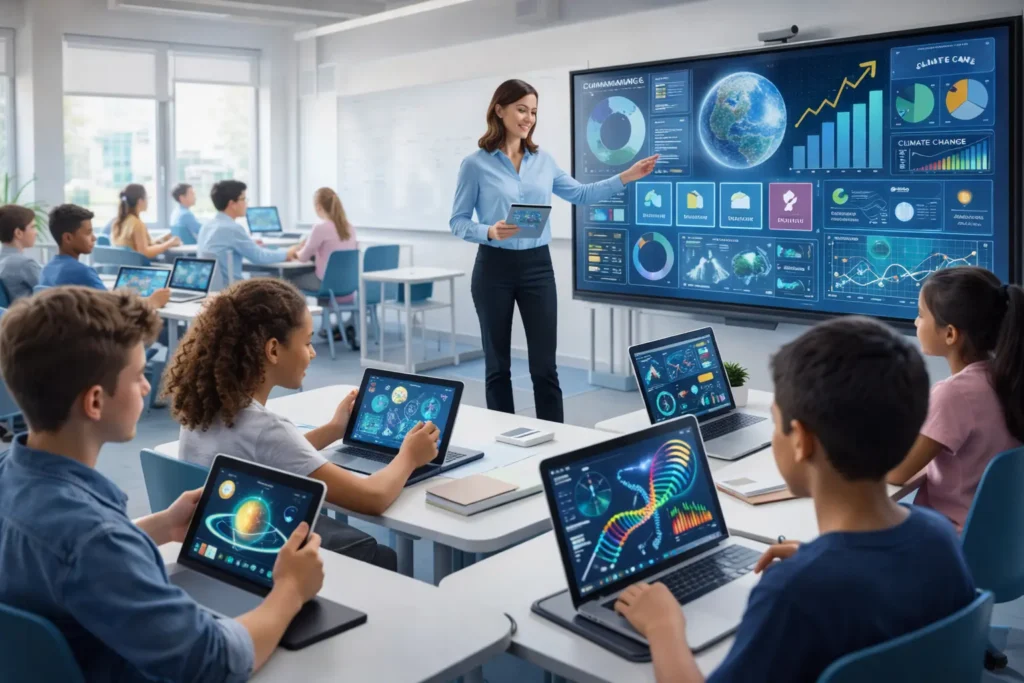
Education is undergoing its most dramatic reinvention in a century. The Classroom 15x model sits at the center of that transformation — blending flexible physical spaces, AI-driven technology, and modern pedagogy into an environment where student outcomes can be amplified dramatically. This guide is the most comprehensive resource on Classroom 15x available.
Whether you are a school principal evaluating a pilot program, a curriculum director seeking fresh frameworks, or a classroom teacher ready to reimagine your space, this guide walks you through everything: what Classroom 15x is, how it works, how to implement it on any budget, and what results you can realistically expect.
What Is Classroom 15x? Unpacking the Educational Concept
The term Classroom 15x refers to a holistic educational model designed to multiply learning outcomes — not merely improve them incrementally, but achieve transformative gains across engagement, comprehension, and future-readiness. The “15x” is not a literal class size or a product name; it represents an aspirational multiplier: the idea that by rethinking the space, tools, and teaching methods simultaneously, a school can achieve results fifteen times more impactful than those produced in a conventional setup.
At its core, the model rests on three convictions:
- Physical environment shapes cognition. Rigid rows of desks designed for passive listening actively suppress the collaborative and creative thinking that modern careers demand.
- Technology must be deeply integrated, not bolted on. Handing students a Chromebook in a traditional classroom changes very little. Technology reshapes learning only when it is woven into how space, time, and instruction are organized.
- The teacher’s role must evolve. The “sage on the stage” model is incompatible with developing critical thinkers. In a Classroom 15x, the teacher becomes a facilitator, coach, and learning designer.
It is worth noting that the term “Classroom 15x” also circulates as the name of a browser-based gaming portal. This guide is focused entirely on the educational model. See the FAQ section at the end for gaming platform questions.
The Three Pillars of the Classroom 15x Model
Every successful Classroom 15x implementation is built on three interconnected pillars. Remove any one of them and the system underperforms. Align all three and the results compound.
| Pillar | Focus | Core Elements |
| 1 — Flexible Physical Space | Environment | Modular furniture, writable surfaces, purpose-built zones, rapid reconfigurability |
| 2 — Integrated Digital Infrastructure | Technology | AI-driven platforms, analytics dashboards, cloud LMS, VR/AR stations |
| 3 — Evolving Teaching Methodology | Pedagogy | Personalized learning paths, project-based activities, real-time feedback, teacher as facilitator |
Pillar 1: Flexible Physical Spaces
A Classroom 15x environment abandons the factory-era layout of identical desks pointing toward a chalkboard. Instead, the room is divided into clearly defined functional zones that students can move between based on the task at hand.
| Zone | Purpose | Typical Furniture |
| Group Collaboration Zone | Team projects, discussion, peer review | Movable tables, writable vertical surfaces, large screens |
| Independent Focus Zone | Deep work, assessments, reading | Individual desks, privacy panels, noise-cancelling options |
| Technology & VR Station | Simulations, research, immersive learning | VR headsets, high-spec Chromebooks, charging hubs |
| Presentation Area | Student-led teaching, demonstrations, debate | Interactive display, flexible semicircle seating |
| Quiet Reflection Zone | Self-paced practice, journaling, mindfulness | Soft seating, low lighting, minimal screens |
The key design principle is rapid reconfigurability. Furniture should be lightweight, on casters, and stackable so that the same room can host a lecture-style session in the morning and four simultaneous project teams in the afternoon.
Pillar 2: Integrated Digital Infrastructure
Technology in a Classroom 15x environment is not a collection of standalone tools — it is an integrated stack in which each component feeds data and capability into the others. The typical digital infrastructure includes:
- AI-Driven Learning Platform: Adapts content difficulty in real time based on each student’s performance data. Examples include platforms built on Google for Education or proprietary adaptive systems.
- Analytics Dashboard (for teachers): Provides live visibility into which students are struggling, which are excelling, and where instructional pivots are needed.
- Cloud-Based LMS: Centralizes assignments, feedback, resources, and communication. Google Classroom, Canvas, and Schoology are common choices.
- VR/AR Stations: Enable virtual field trips, historical immersions, and science simulations impossible in a traditional classroom.
- Interactive Displays: Replace static whiteboards with touchscreen panels that students can annotate collaboratively, in real time, from their own devices.
| 💡 Pro Tip: Before purchasing technology, audit your existing infrastructure. Many schools already have the core tools (Google Workspace, Chromebooks) but lack the configuration and professional development needed to use them at Classroom 15x depth. |
Pillar 3: Evolving Teaching Methodologies
The most significant shift in a Classroom 15x is not physical or technological — it is pedagogical. The teacher transitions from being the primary source of information to being the architect of learning experiences. In practice, this means:
- Personalized learning paths: Students work through content at different paces, with the AI platform flagging when they need direct teacher support.
- Project-based learning (PBL): Students tackle real-world problems requiring collaboration, research, and presentation.
- Gamification elements: Badges, leaderboards, and challenge tiers increase motivation without sacrificing rigor.
- Real-time feedback: Students receive immediate, actionable guidance from both the AI platform and the teacher.
- Student-led sessions: The presentation zone is used regularly to have students teach each other — the deepest form of learning retention known to cognitive science.
7 Powerful Benefits of Adopting a Classroom 15x Model
The Classroom 15x model is not a branding exercise — it is a structural upgrade to the conditions under which learning happens. Research into flexible learning environments, personalized technology, and modern pedagogy consistently points to the same set of outcomes.
| Metric | Typical Impact |
| Student engagement score increase | ~30% within first academic year |
| Student-led discussion time | 2× more than traditional classrooms |
| Reduction in behavioral disruptions | ~40% in flexible seating environments |
| Teacher job satisfaction (pilot programs) | 89% report improvement |
Benefit 1: Enhanced Student Engagement
When students have agency over their physical space and learning path, passive disengagement falls dramatically. Studies on flexible classroom design consistently show engagement score improvements of 25–35% within one academic year of implementation.
| Within six weeks of switching to a flexible classroom model, I stopped fighting for attention. Students started arriving early and asking what we were doing that day. |
| — Maria L., 7th Grade Science Teacher, pilot program participant |
Benefit 2: Improved Critical Thinking and Problem-Solving
Project-based learning — the pedagogical backbone of Classroom 15x — requires students to analyze, synthesize, and evaluate information rather than simply recall it. Schools that have adopted PBL as a primary instructional approach report measurable gains on open-ended assessment tasks within two to three semesters.
Benefit 3: Better Knowledge Retention
The learning pyramid model demonstrates that students retain approximately 5% of what they hear in a lecture but up to 90% of what they teach to others. A Classroom 15x environment systematically moves students up the retention curve through peer teaching, project outputs, and real-world application.
Benefit 4: Personalized Learning at Scale
AI-driven platforms make it possible, for the first time, for a single teacher to effectively manage 28 different learning paths simultaneously. The technology handles differentiation while the teacher focuses on relationships, coaching, and mentorship that algorithms cannot replicate.
Benefit 5: Development of Future-Ready Skills
The World Economic Forum’s Future of Jobs reports consistently identify collaboration, digital literacy, adaptability, and complex problem-solving as the top skills employers will demand throughout the 2020s and 2030s. A Classroom 15x environment practices all of these skills daily.
Benefit 6: Inclusivity and Accessibility
Flexible physical spaces and adaptive technology naturally accommodate a wider range of learning needs. Students with sensory sensitivities can use the quiet zone; students with attention challenges can shift posture and location as needed; AI platforms can adjust text size, reading level, and pacing for students with learning differences.
Benefit 7: Teacher Wellbeing and Retention
When AI handles routine differentiation and data collection, teachers regain hours previously consumed by grading and administrative tracking. This reduction in workload, combined with richer, more creative work, significantly improves job satisfaction — and reduces the catastrophic teacher attrition many districts face.
How to Implement Classroom 15x: A Practical Step-by-Step Guide for Schools
Implementation is where most school initiatives fail — not because the idea is flawed but because the rollout is under-resourced, under-supported, or rushed. The following six-phase process is designed to be realistic, sustainable, and scalable.
Phase 1: Planning and Goal Setting
Begin by forming a cross-functional steering committee that includes at least one administrator, two to three classroom teachers, an IT representative, and a parent or community member. This committee should conduct a formal needs assessment: What are current engagement and attainment baselines? What physical and technological constraints exist?
Set SMART goals (Specific, Measurable, Achievable, Relevant, Time-bound). For example: “Increase average student engagement scores in the pilot classroom from 62% to 80% within two semesters, as measured by the district’s annual survey.”
| 📋 Checklist: Form committee → Conduct needs assessment → Establish baselines → Define success metrics → Secure principal/board endorsement → Communicate to staff. |
Phase 2: Budgeting for Your Classroom 15x
A functional first phase can be achieved on a remarkably modest budget — particularly if you leverage existing devices and free or open-source software.
| Budget Category | Minimal Implementation | Full Implementation | Grant-Funding Notes |
| Flexible Furniture | $1,500 – $3,000 | $8,000 – $15,000 | E-Rate, Title I, local foundations |
| Interactive Display / Panels | $0 (use existing projector) | $2,000 – $5,000 | State technology grants |
| Student Devices (Chromebooks) | $0 (reuse existing fleet) | $15,000 – $30,000 | FCC E-Rate |
| VR/AR Stations | $0 – $500 (1–2 headsets) | $2,000 – $6,000 | Google.org Impact Challenge |
| LMS / AI Platform (Software) | $0 (Google Workspace free) | $1,000 – $4,000/yr | Non-profit pricing widely available |
| Teacher Professional Development | $500 – $1,000 | $3,000 – $8,000 | Title IIA PD funds |
| TOTAL (Pilot Classroom) | ~$2,000 – $5,000 | ~$35,000 – $65,000 | Multiple grants available |
| ⚠️ Avoid this mistake: Many schools fund furniture first and professional development last — then wonder why the new tables aren’t changing outcomes. Budget professional development as a non-negotiable line item. |
Phase 3: Designing the Physical Space
Work with the pilot teacher to map the existing room and identify where each zone will live. Consider traffic flow between zones, acoustics (a collaboration zone next to a quiet zone requires at least a visual partition), and power access for device charging.
Key furniture specifications: lightweight (under 15kg per table), stackable or foldable, writable surfaces on at least two vertical panels, and casters with locking mechanisms where appropriate.
Phase 4: Investing in Digital Infrastructure
Assess your current network capacity before adding devices. A Classroom 15x environment with 28 students running video-capable applications simultaneously requires a minimum of 25–50 Mbps dedicated bandwidth. Minimum device specifications: 2GB RAM (4GB recommended), Chrome OS / Windows 10 / iOS 14+, front-facing camera and microphone, 6+ hours battery life.
Phase 5: Training Educators for Success
This is the single most important phase, and the one most frequently underinvested. Effective training includes:
- A two to three-day intensive orientation covering the model’s philosophy, technology stack, and classroom management in flexible environments
- Ongoing monthly peer learning sessions where teachers share successes and troubleshoot challenges
- Access to free online resources: Google for Education Teacher Center, ISTE online courses, and GitHub repositories of lesson plan templates
- A designated tech coach — even part-time — who can support troubleshooting without requiring the classroom teacher to become an IT specialist
| The training wasn’t about learning new software. It was about unlearning the instinct to control every moment of the lesson. That took three months to get comfortable with — and it was worth every minute. |
| — James O., High School History Teacher, Year 2 of Classroom 15x implementation |
Phase 6: Launching with a Pilot Program
Choose one pilot classroom and one enthusiastic, resilient teacher. Data collection begins on day one: baseline engagement scores, attendance rates, assessment averages, and teacher time-on-task observations. Run the pilot for a full semester — ideally a full academic year — before drawing conclusions or expanding.
| ✅ Success signal: If at the end of the pilot semester the pilot teacher is recommending the model to colleagues unprompted, the initiative is working. |
Classroom 15x vs. Traditional Classrooms and Other Modern Models
Understanding how Classroom 15x compares to alternatives helps decision-makers choose the right approach for their specific context, constraints, and goals.
| Criteria | Traditional Classroom | Google Classroom | Classroom 30x | Classroom 15x |
| Physical Flexibility | None — fixed layout | No physical component | Flexible | Highly flexible, zone-based |
| Technology Integration | Minimal / optional | Strong (digital-only) | Moderate | Deep, AI-driven integration |
| Personalized Learning | One-size-fits-all | Teacher-dependent | Moderate | AI-automated pathways |
| Implementation Cost | Low (already in place) | Low (free software) | Moderate–High | Low–High (scales with ambition) |
| Teacher Training Required | Minimal | Moderate | Moderate | High — but worth it |
| Student Engagement Impact | Low (passive model) | Moderate | Good | Highest of the four |
| Data & Analytics | Minimal | Good | Moderate | Comprehensive, real-time |
| Scalability | Already at scale | Highly scalable | Moderate | Scalable with planning |
The key differentiator of Classroom 15x is the combination of physical, digital, and pedagogical transformation. Google Classroom is a powerful digital tool but does nothing for physical space. Classroom 15x is the only model that addresses all three dimensions simultaneously — and that integration is precisely where its outsized outcomes come from.
Addressing Challenges and Ensuring Responsible Implementation
A credible guide to Classroom 15x must address its challenges honestly. Every implementation will encounter friction. The schools that succeed are not those that avoided obstacles but those that anticipated and planned for them.
Challenge 1: Screen Fatigue and Over-Reliance on Technology
The concern: More screens do not automatically mean better learning. Extended screen time without purpose can lead to cognitive fatigue, eye strain, and disengagement.
The solution: Build explicit “screen-free” periods into the daily schedule. Designate the quiet reflection zone as a low-screen environment. Ensure physical collaboration and hands-on tasks are genuinely central to instruction.
Challenge 2: The Digital Divide
The concern: A model depending on devices and connectivity risks leaving behind students from lower-income households who lack reliable home internet.
The solution: Ensure that all AI-assisted personalization and core learning activities happen during school hours on school devices. Explore device lending programs and municipal broadband partnerships for extended access.
Challenge 3: Teacher Resistance and Change Fatigue
The concern: Teachers have been asked to adopt “the next big thing” many times. Cynicism about new initiatives is entirely rational and should be respected, not dismissed.
The solution: Do not mandate Classroom 15x adoption — invite it. Begin with volunteers. Make early adopters visible champions whose results speak louder than any administrator’s directive.
Challenge 4: Cost Barriers for Under-Resourced Schools
The concern: The schools that could most benefit from this model are often the ones with the fewest resources.
The solution: Start with the minimal implementation: flexible furniture and free software. Document results. Use those results to apply for grant funding that enables a fuller implementation. Progress over perfection.
Challenge 5: Scalability and Consistency
The concern: Piloting successfully in one classroom does not guarantee the model will perform equally well across an entire school or district.
The solution: Document every decision made in the pilot with exhaustive specificity. Build a replicable playbook, not a one-off experiment. Expand slowly and invest in peer mentoring networks.
Safety, Privacy, and Security in a Digital-First Classroom
For school administrators and parents, data privacy is non-negotiable. Any platform adopted in a U.S. school must comply with three key federal frameworks:
- FERPA (Family Educational Rights and Privacy Act): Governs who can access student education records. Schools must ensure any third-party platform has a signed data processing agreement restricting use of student data to educational purposes only.
- COPPA (Children’s Online Privacy Protection Act): For students under 13, requires verifiable parental consent before any personal data collection. Platforms used with elementary students must be COPPA-certified.
- GDPR (General Data Protection Regulation): Applies to schools in the EU and to any platform processing data of EU citizens. Requires data minimization, explicit consent, and the right to erasure.
| ⚠️ Red Flag: Any edtech vendor that cannot provide a clear, specific answer to “How do you use our students’ data?” should not be in your classroom. |
faqs
Educational Model FAQs
What is the Classroom 15x model?
Classroom 15x is a comprehensive educational model that integrates flexible physical spaces, AI-driven technology, and modern pedagogy to dramatically amplify student learning outcomes. The “15x” represents the goal of multiplied impact — not a specific class size or product name.
How is Classroom 15x different from a traditional classroom?
A traditional classroom is organized around a passive model: one teacher lectures to a fixed group of students in rows. Classroom 15x replaces that with a zone-based, student-active environment where learners move, collaborate, receive personalized AI-assisted support, and take genuine ownership of their learning.
What technology is used in a Classroom 15x?
Core technologies include an AI-driven adaptive learning platform, a cloud-based LMS (Google Classroom or Canvas), student devices (Chromebooks or tablets), an interactive display panel, and optionally VR/AR stations. The specific tools vary by budget and context.
How much does it cost to set up a Classroom 15x?
A minimal pilot classroom can be established for as little as $2,000–$5,000 if existing devices and free software are already in place. A fully equipped implementation typically runs $35,000–$65,000 per classroom, with significant grant-funding opportunities available through E-Rate, Title I, and Title IIA programs.
What are the main benefits for students?
Key benefits include enhanced engagement, improved critical thinking, better knowledge retention, personalized learning pathways, development of future-ready skills (collaboration, digital literacy, problem-solving), and greater inclusivity for students with diverse learning needs.
How can schools train teachers for Classroom 15x?
Effective teacher training includes a two to three-day intensive orientation, ongoing monthly peer learning sessions, access to free online resources (Google for Education Teacher Center, ISTE), and assignment of a part-time tech coach. Professional development must be budgeted as a non-negotiable line item.
What are the biggest challenges of implementing Classroom 15x?
The most common challenges are screen fatigue, the digital divide for lower-income students, teacher resistance to change, cost barriers for under-resourced schools, and scalability beyond the pilot. Each has practical, documented mitigation strategies — see the Challenges section above.
Is Classroom 15x the same as Classroom 30x?
No. While both models share a commitment to modern pedagogy and technology integration, Classroom 30x is a separate initiative with its own design philosophy, furniture standards, and technology stack. Classroom 15x distinguishes itself through AI-driven personalization and its highly zoned physical layout.
How does Classroom 15x ensure student data privacy?
All platforms adopted under the Classroom 15x model must comply with FERPA, COPPA, and (where applicable) GDPR. Schools should require a signed Data Privacy Agreement from every edtech vendor, verify compliance registry status, and communicate transparently with parents about data collection practices.
What is the role of the teacher in a Classroom 15x?
The teacher shifts from “sage on the stage” to “guide on the side” — functioning as a learning architect, coach, and mentor rather than the sole source of information. The AI platform handles routine differentiation, freeing the teacher to focus on relationships, complex facilitation, and creative learning design.
Gaming Platform FAQs
A separate entity known as “Classroom 15x” also operates as a browser-based gaming portal. Here are the most common questions about that platform.
Is Classroom 15x a real educational tool or just a gaming site?
Both. “Classroom 15x” is used for two distinct purposes: the educational model described throughout this guide, and a separate gaming portal providing browser-based games. This guide focuses on the educational model.
Are Classroom 15x games free?
Yes. The gaming portal offers free, browser-based games with no subscription required and no account needed to access most titles.
Do I need to download anything to play Classroom 15x games?
No. The platform’s games run entirely in the browser using HTML5 and WebGL technology, requiring no software installation. A standard browser (Chrome or Edge) and basic internet connection are sufficient.
Can I play Classroom 15x games on a school Chromebook?
The platform is designed to be compatible with school-issued Chromebooks and to function on low-bandwidth school networks. Whether access is permitted depends entirely on your school’s network policy and administrator settings.
Why is Classroom 15x called “unblocked”?
“Unblocked” refers to the platform’s ability to be accessed on school networks that typically restrict gaming sites. Whether using such a platform is appropriate is a decision for school administrators and families.
What is the “panic button” on the Classroom 15x gaming site?
The panic button is a feature that instantly redirects the browser to a neutral, school-appropriate page when a student needs to quickly conceal gaming activity. Its existence is a transparency point worth noting for parents and administrators.
Are the games on Classroom 15x safe for my child?
The platform is designed to host school-appropriate, non-violent browser games. Parents and administrators should review available titles directly rather than relying on platform self-descriptions. The platform does not collect personal data or require account creation.
The Future of Classroom 15x: What’s Next?
The Classroom 15x model as described here is already operational in forward-thinking schools around the world. But the trajectory points toward capabilities that will make even today’s most advanced implementations look modest within a decade.
| Emerging Trend | What It Means for Schools |
| Neuroadaptive Environments | Biometric sensors detect cognitive load and stress in real time, automatically adjusting lighting, temperature, and task complexity to optimize each student’s learning state. |
| Global AI Learning Networks | AI platforms connect classrooms across continents, enabling real-time collaboration between students in different countries, mediated by language translation and cultural context layers. |
| Autonomous Educational Agents | AI tutors move from passive content delivery to genuine Socratic dialogue — questioning students, challenging assumptions, and adapting coaching style to each learner’s personality. |
| Equitable Global Access | Lightweight offline-capable versions of Classroom 15x tools are being developed for low-bandwidth environments in Sub-Saharan Africa, South Asia, and rural communities everywhere. |
| Metaverse Classrooms | Fully immersive virtual learning environments allow students to attend class as spatial avatars, walk through historical events, conduct virtual chemistry experiments, or debate in simulated chambers. |
| Teacher as Learning Designer | As AI handles more differentiation and assessment workload, teachers focus on curriculum design, mentorship, and community building — the uniquely human dimensions of education. |
The common thread running through all of these future developments is the same principle that animates the Classroom 15x model today: that the future of learning is not about making students sit still for longer — it is about creating the conditions in which human curiosity, creativity, and connection can flourish at full scale.
Conclusion: Is Classroom 15x Right for Your School?
Classroom 15x is not a silver bullet, and this guide has not tried to present it as one. It requires genuine investment — of money, time, and institutional will. It challenges deeply ingrained assumptions about what a classroom should look like and what a teacher’s role should be.
But the fundamental logic of the model is sound: when you redesign the space, integrate the technology purposefully, and equip teachers to facilitate rather than lecture, student outcomes improve measurably and significantly. The evidence from pilot programs, cognitive science research, and schools that have made this transition is consistent on this point.
The question is not whether Classroom 15x works. The question is whether your school is ready to commit to the kind of sustained, thoughtful implementation that makes it work. If the answer is yes — or even “we want to find out” — start with a single classroom, a single enthusiastic teacher, and a clear set of measurable goals. The rest follows from there.

Adrian Cole is a seasoned content creator specializing in artificial intelligence, emerging technologies, and digital innovation. With a strong passion for breaking down complex technical concepts into clear, practical insights, Adrian helps readers understand how AI is shaping businesses, products, and everyday life. His work focuses on real-world applications of machine learning, automation, SaaS tools, and future tech trends, making advanced technology accessible to both professionals and curious learners. Adrian is known for his balanced, experience-driven approach that blends technical accuracy with human-centered storytelling.