
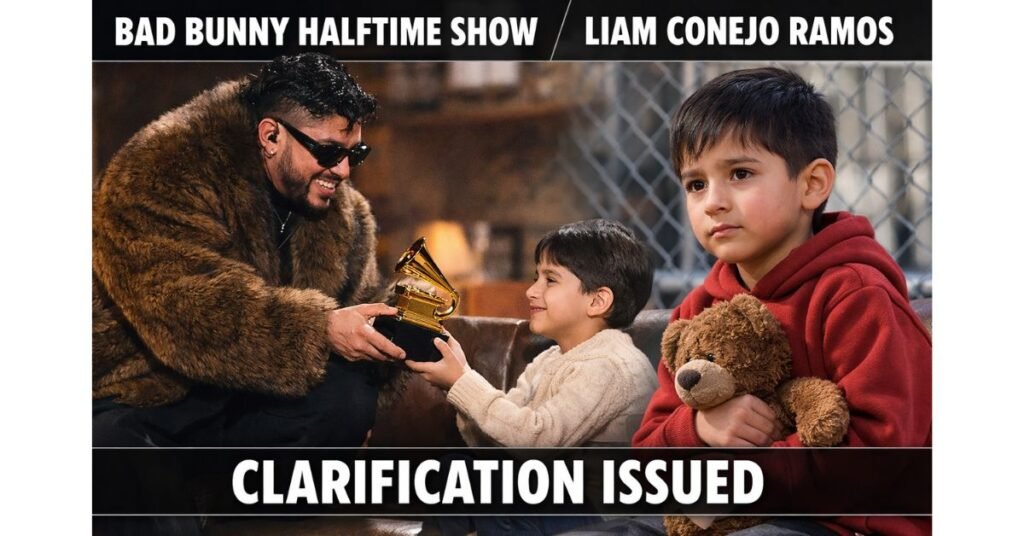
Washington, United States- Questions spread online after Bad Bunny handed a Grammy trophy to a child during the Super Bowl LX halftime show on February 8 in Santa Clara, California, prompting speculation the boy was Liam Conejo Ramos, a child previously detained by U.S. immigration authorities. Officials and the performer’s representatives later clarified the child onstage was an actor, not Ramos, according to media reports.
The halftime performance featured a scene in which the Puerto Rican artist presented a Grammy to a young boy inside a staged living-room setting, a symbolic gesture intended to convey hope and ambition, a source told ABC News.
Social media users quickly suggested the child resembled Ramos, whose detention in Minnesota earlier this year drew protests and national attention.
A publicist for Bad Bunny told NPR Music the child in the performance was not Ramos but a young actor, later identified as Lincoln Fox, a detail also confirmed by other outlets.
Federal officials previously said Ramos was allowed to remain with his father after the father’s arrest in Minneapolis to avoid family separation, amid broader demonstrations linked to immigration enforcement policies.
Bad Bunny’s halftime show highlighted Puerto Rican culture and included appearances by prominent Latino performers, while the onstage Grammy handoff became one of the event’s most widely shared moments online.
The clarification about the child’s identity tempered online speculation but underscored the broader public focus on immigration cases involving minors in the United States.
ALSO READ: Bad Bunny Makes Grammy History With Album of the Year Win at 2026 Awards

Hannah Price is a dedicated news content creator with a sharp eye for accuracy, clarity, and relevance. She specializes in covering current events, global developments, and trending stories, delivering information in a clear, engaging, and trustworthy manner. With a background rooted in research-driven reporting, Hannah excels at turning fast-moving news into well-structured, reader-friendly content. Her work prioritizes credibility, context, and responsible journalism, helping audiences stay informed without unnecessary noise or bias.