
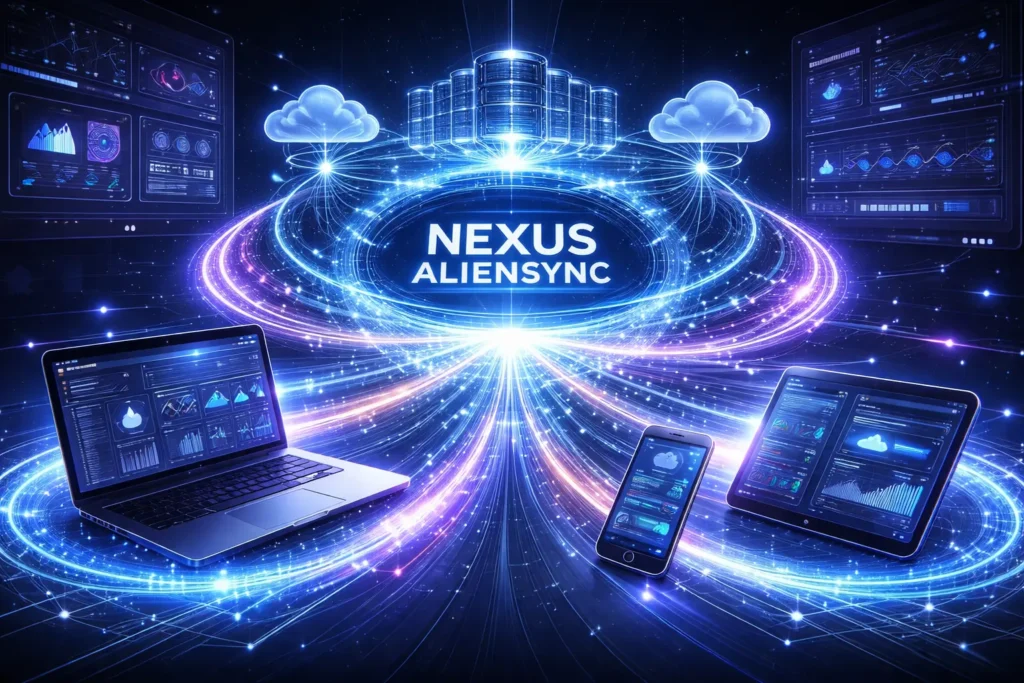
Nexus Aliensync is a cutting-edge synchronization framework engineered to deliver real-time data flow, cross-platform compatibility, and automated conflict resolution across enterprise systems. In today’s hyper-connected digital environment, organizations depend on accurate, instantaneous data exchange between applications, departments, and devices. Without a reliable synchronization layer, teams suffer from data discrepancies, manual errors, integration failures, and costly operational delays.
This comprehensive guide covers everything you need to know about Nexus Aliensync — from core features and system setup to advanced enterprise applications, security compliance, pricing, and optimization strategies. Whether you are an IT administrator, developer, or business decision-maker, this guide will help you understand how Nexus Aliensync eliminates data silos and drives operational excellence.
1. What Is Nexus Aliensync?
Definition and Core Functionality
Nexus Aliensync is a robust, enterprise-grade synchronization framework designed to connect multiple systems, applications, and databases through a single, unified data pipeline. At its core, it facilitates seamless data flow between heterogeneous platforms — ensuring that every connected endpoint reflects the most current, accurate state of information in real time.
Unlike traditional batch-processing integrations that sync data at scheduled intervals, Nexus Aliensync operates on an event-driven, continuous update architecture. This means changes made in one system — whether a CRM entry, a financial record, or a software repository commit — propagate instantly to all connected systems with minimal latency.
Why Organizations Need Nexus Aliensync
Modern enterprises operate across a sprawling ecosystem of cloud services, desktop applications, mobile platforms, and legacy systems. Without a centralized synchronization solution, this complexity breeds critical problems:
- Data discrepancies: Different systems hold conflicting versions of the same record
- Integration failures: Point-to-point integrations break as systems evolve
- Manual errors: Teams copy-paste data between platforms, introducing mistakes
- Operational delays: Decision-makers act on stale information
- Compliance risks: Inconsistent data creates audit failures
Nexus Aliensync addresses all of these pain points through its intelligent, automated synchronization engine, transforming fragmented data landscapes into a coherent, real-time information ecosystem.
2. Key Features of Nexus Aliensync
Real-Time Synchronization Engine
The cornerstone of Nexus Aliensync is its high-performance, real-time synchronization engine. Built for minimal latency and maximum throughput, it supports event-driven triggers that fire synchronization processes the moment data changes are detected. Whether syncing a single record or batch-propagating thousands of updates, the engine maintains data consistency without perceptible delay.
Key capabilities include sub-second update propagation, configurable synchronization intervals for bandwidth-sensitive environments, trigger-based and scheduled sync modes, and support for high-frequency transaction environments such as financial trading platforms and real-time inventory systems.
Cross-Platform Compatibility
Nexus Aliensync is architected for true cross-platform compatibility. It operates seamlessly across Windows, macOS, Linux, iOS, and Android environments, as well as major cloud platforms including AWS, Azure, and Google Cloud. Pre-built connectors support hundreds of enterprise applications — from Salesforce and SAP to Microsoft 365 and custom REST APIs.
Whether your organization operates on-premise, in the cloud, or in a hybrid configuration, Nexus Aliensync bridges the gaps between device types, operating systems, and software stacks without requiring custom middleware development.
Automated Conflict Resolution
In distributed data environments, conflicts — instances where two systems attempt to update the same record simultaneously — are inevitable. Nexus Aliensync includes a sophisticated automated conflict resolution engine that detects, classifies, and resolves conflicts using configurable rules-based logic.
Administrators can define resolution policies such as last-write-wins, source-system priority, or field-level merge rules. For complex conflicts that require human judgment, the system generates real-time alerts and queues items for manual review, maintaining an audit trail of all resolution decisions for compliance purposes.
Security and Compliance Framework
Security is built into every layer of Nexus Aliensync. All data in transit is protected by end-to-end encryption using AES-256 and TLS 1.3 protocols. At-rest data encryption ensures that stored synchronization logs and cached payloads remain protected against unauthorized access.
The platform is designed to meet the stringent requirements of GDPR, HIPAA, SOC 2 Type II, and ISO 27001. Role-based access control (RBAC) and multi-factor authentication (MFA) govern user access, while comprehensive audit logs record every synchronization event, configuration change, and access attempt.
3. System Requirements and Setup Guide
Prerequisites
Before deploying Nexus Aliensync, ensure your environment meets the following minimum requirements:
- Operating System: Windows Server 2016+, Ubuntu 20.04+, macOS 12+, or compatible Linux distribution
- Processor: 4-core CPU at 2.4 GHz or faster (8-core recommended for enterprise deployments)
- Memory: 8 GB RAM minimum (16 GB+ recommended for high-volume sync environments)
- Storage: 50 GB available disk space for core installation plus log retention
- Network: Reliable broadband connection with minimum 10 Mbps; dedicated bandwidth recommended for real-time sync
- Ports: TCP 443 (HTTPS), TCP 5672 (messaging), TCP 5432 (database connector)
Step-by-Step Installation
Follow these steps to deploy Nexus Aliensync in your environment:
- Step 1: Download the core framework installer from the official Nexus Aliensync portal and verify the SHA-256 checksum before executing.
- Step 2: Run the installer as an administrator (or with sudo on Linux/macOS). Select your deployment type: Server, Client, or Full Stack.
- Step 3: Install the server module on your central host. This establishes the synchronization hub that all client nodes communicate through.
- Step 4: Deploy client modules on each endpoint system — workstations, cloud instances, or application servers.
- Step 5: Configure network permissions and firewall rules to allow the required ports listed in the prerequisites.
- Step 6: Connect to the web-based administration console (default: https://localhost:8443) and complete the initial setup wizard.
Initial Configuration Best Practices
After installation, follow these configuration recommendations to optimize performance and security from day one:
- Set synchronization intervals based on data criticality — real-time for transactional systems, scheduled for analytics workloads
- Configure role-based access control before onboarding users — apply least-privilege principles
- Enable comprehensive logging and connect your SIEM or monitoring platform to the Nexus Aliensync log stream
- Establish backup strategies for your synchronization configuration files and encryption keys
- Test conflict resolution rules in a staging environment before pushing to production
4. Practical Applications of Nexus Aliensync
Enterprise Management
Large enterprises managing operations across multiple locations, business units, and systems gain transformative value from Nexus Aliensync. Finance teams achieve real-time consistency between ERP systems, billing platforms, and reporting dashboards — eliminating reconciliation errors and accelerating close cycles. HR departments synchronize employee data across payroll, benefits administration, and workforce management platforms without manual intervention.
For multinational organizations, Nexus Aliensync handles the complexity of multi-currency, multi-timezone, and multi-language data environments, ensuring that regional offices and headquarters operate from a single source of truth at all times.
Digital Collaboration for Remote Teams
The rise of distributed workforces demands synchronization solutions that keep remote teams aligned in real time. Nexus Aliensync integrates with collaboration platforms, project management tools, and document management systems to ensure that every team member — regardless of location or time zone — works with current, accurate data.
Integrated notifications alert team members when relevant documents or records are updated, shared task boards reflect changes instantly, and version conflicts in shared documents are automatically detected and resolved before they cause disruption.
Software Development and CI/CD Pipelines
Development teams leveraging Nexus Aliensync gain a powerful layer of synchronization across their software delivery lifecycle. Code repositories, issue trackers, test environments, and deployment pipelines stay aligned through automated synchronization, reducing integration errors and ensuring consistent datasets across development, staging, and production environments.
Integration with continuous integration/continuous delivery (CI/CD) tools enables Nexus Aliensync to trigger synchronization events based on pipeline milestones — automatically propagating approved configuration changes, database schema updates, and feature flags across environments.
Industry-Specific Use Cases
Nexus Aliensync delivers tailored value across regulated and high-velocity industries:
- Healthcare: Synchronize patient records, lab results, and clinical workflows across EHR systems, telehealth platforms, and pharmacy management systems — maintaining HIPAA compliance throughout
- Retail: Keep inventory levels, pricing, and product data consistent across e-commerce storefronts, point-of-sale systems, and warehouse management platforms in real time
- Financial Services: Ensure transaction data consistency across core banking systems, payment processors, fraud detection platforms, and regulatory reporting tools
- Manufacturing: Synchronize production schedules, supply chain data, and quality control records across factory floors, supplier portals, and ERP systems
5. Performance Optimization and Troubleshooting
Monitoring Tools and Metrics
Nexus Aliensync includes a comprehensive monitoring dashboard that provides real-time visibility into synchronization health. Key metrics surfaced by the monitoring suite include:
- Sync status: Active, pending, paused, or failed for each connected endpoint
- Latency metrics: End-to-end sync duration broken down by data type and connector
- Error rates: Volume and classification of synchronization errors over configurable time windows
- Throughput: Records synchronized per second, per minute, and per hour
- Queue depth: Pending synchronization tasks awaiting processing
Integration with popular observability platforms including Datadog, Grafana, Splunk, and New Relic is supported via native exporters and webhook notifications.
Performance Tuning Tips
To maintain optimal sync performance as data volumes and connected systems grow, implement these tuning strategies:
- Adjust synchronization frequency based on data criticality — avoid over-syncing low-priority datasets that consume bandwidth unnecessarily
- Implement delta synchronization (sync only changed records) rather than full-dataset sync for large tables
- Allocate dedicated bandwidth quotas to high-priority synchronization channels to prevent resource contention
- Regularly update connector versions to benefit from performance improvements and bug fixes
- Archive historical synchronization logs to prevent storage saturation from degrading system performance
Common Issues and Fixes
The following table outlines the most frequently encountered synchronization issues and their recommended resolutions:
| Issue | Likely Cause | Resolution |
| Connection failures | Firewall rules blocking sync ports | Verify port 443 and 5672 are open; check proxy settings |
| Data conflicts | Concurrent writes from multiple sources | Review and update conflict resolution rules; enable source-priority mode |
| Performance degradation | Excessive full-dataset syncs or log accumulation | Enable delta sync; archive logs; increase memory allocation |
| Authentication errors | Expired API keys or certificates | Rotate credentials; check certificate expiry dates |
| Missing records | Sync scope misconfiguration | Audit data mapping rules; verify field-level sync scope settings |
6. Security, Privacy, and Compliance Deep Dive
Data Encryption Standards
Nexus Aliensync enforces encryption at every stage of the data lifecycle. Data in transit between endpoints is encrypted using TLS 1.3, ensuring that synchronization payloads cannot be intercepted or tampered with en route. At-rest encryption using AES-256 protects stored data including configuration backups, synchronization logs, and cached payloads.
Certificate pinning prevents man-in-the-middle attacks, and key management is handled through integration with enterprise key management systems including AWS KMS, Azure Key Vault, and HashiCorp Vault.
Compliance Certifications
Nexus Aliensync is purpose-built for regulated industries. The platform supports compliance with:
- GDPR: Data residency controls, right-to-erasure support, and consent management integration ensure compliance for organizations handling EU personal data
- HIPAA: Audit controls, access restrictions, and data integrity safeguards meet the technical safeguard requirements of the HIPAA Security Rule
- SOC 2 Type II: Annual third-party audits verify the platform meets Trust Services Criteria for security, availability, and confidentiality
- ISO 27001: Information security management practices are aligned with international standards
Access Control and Audit Logs
Granular access control is enforced through a role-based access control (RBAC) model that allows administrators to define precisely which users and service accounts can initiate, monitor, or modify synchronization jobs. Multi-factor authentication is enforced for all administrative access.
Every synchronization event, configuration change, user login, and permission modification is captured in immutable audit logs with timestamps, user identifiers, and IP addresses. These logs can be exported to SIEM platforms for real-time security monitoring and are retained for a configurable period to meet regulatory requirements.
7. Nexus Aliensync vs. Other Synchronization Tools
How does Nexus Aliensync compare to other integration and synchronization platforms? The table below provides a high-level comparison across key dimensions:
| Feature | Nexus Aliensync | MuleSoft | Zapier | Workato |
| Real-Time Sync | Yes (sub-second) | Yes (complex setup) | Near real-time | Yes |
| Conflict Resolution | Automated + Manual | Manual configuration | Limited | Rule-based |
| GDPR/HIPAA Ready | Yes (native) | Yes (enterprise) | Partial | Yes (enterprise) |
| Cross-Platform | Full (cloud+on-prem) | Full | Cloud only | Full |
| Latency | Minimal (<1s) | Low (configurable) | 1-15 minutes | Low |
| Target Audience | Enterprise + SMB | Large Enterprise | SMB / No-code | Mid-Market |
Nexus Aliensync’s key differentiators are its combination of minimal latency, native automated conflict resolution, and built-in compliance certifications — advantages that make it uniquely suitable for regulated industries and high-frequency data environments where competing solutions require extensive custom development.
8. Pricing, Plans, and Free Trial
Nexus Aliensync offers flexible pricing tiers designed to serve organizations at every stage of growth:
| Feature | Basic (Individual) | Pro (Teams) | Enterprise (Custom) |
| Connected Systems | Up to 5 | Up to 25 | Unlimited |
| Real-Time Sync | Yes | Yes | Yes + SLA guarantee |
| Conflict Resolution | Basic rules | Advanced rules | Custom + AI-assisted |
| Compliance | Standard | GDPR + HIPAA | Full compliance suite |
| Support | Community | Priority email | Dedicated CSM + SLA |
| API Access | Limited | Full REST API | Full API + webhooks |
Annual subscriptions are available at a 20% discount compared to monthly billing. A 14-day free trial is available for all new accounts — no credit card required. Enterprise organizations can request a personalized demo and proof-of-concept engagement with a dedicated solutions engineer.
9. Case Studies and Success Stories
Case Study 1: Global Financial Services Firm Reduces Data Errors by 40%
A multinational financial services organization operating across 18 countries deployed Nexus Aliensync to synchronize its core banking platform, risk management system, and regulatory reporting tools. Prior to deployment, the firm experienced daily reconciliation errors requiring manual intervention by a team of six analysts. After implementing Nexus Aliensync with automated conflict resolution and real-time sync, the firm reduced data discrepancies by 40% in the first quarter, eliminated the daily manual reconciliation cycle, and achieved continuous compliance readiness for GDPR and local financial regulations.
Case Study 2: Software Development Team Cuts Integration Time by 60%
A 200-person software development organization integrated Nexus Aliensync into its CI/CD pipeline to synchronize code repositories, test environments, and deployment configuration across AWS, Azure, and on-premise infrastructure. The team previously spent 15 hours per sprint manually aligning environments before release. After deployment, environment synchronization became fully automated, reducing integration overhead by 60%, accelerating release cycles, and enabling the team to deploy with greater confidence and consistency.
10. FAQS
What is Nexus Aliensync used for?
Nexus Aliensync is used to synchronize data in real time across multiple enterprise systems, platforms, and applications. Common use cases include enterprise data management, remote team collaboration, CI/CD pipeline integration, and industry-specific workflows in healthcare, finance, and retail.
Is Nexus Aliensync secure?
Yes. Nexus Aliensync employs end-to-end encryption (AES-256, TLS 1.3), role-based access control, multi-factor authentication, and immutable audit logging. The platform is certified for GDPR, HIPAA, SOC 2 Type II, and ISO 27001 compliance.
How does Nexus Aliensync handle data conflicts?
Nexus Aliensync detects concurrent conflicting updates using its real-time monitoring engine and resolves them automatically using configurable rules — including last-write-wins, source-system priority, or field-level merge. Complex conflicts are queued for manual review with full audit trail logging.
Can Nexus Aliensync integrate with my existing CRM or ERP?
Yes. Nexus Aliensync includes pre-built connectors for hundreds of enterprise applications including Salesforce, SAP, Oracle, Microsoft Dynamics, HubSpot, and more. Custom REST API and webhook integrations are available for proprietary or legacy systems.
How much does Nexus Aliensync cost?
Nexus Aliensync offers three tiers: Basic (individual users), Pro (teams), and Enterprise (custom pricing). A 14-day free trial is available for new accounts. Contact the sales team for enterprise pricing and volume discounts.
Does Nexus Aliensync offer a free trial?
Yes. A 14-day free trial with full Pro-tier features is available for new accounts. No credit card is required to start your trial.
What are the system requirements?
Nexus Aliensync requires a compatible OS (Windows Server 2016+, Ubuntu 20.04+, macOS 12+), 4-core CPU, 8 GB RAM, 50 GB storage, and a reliable internet connection. Enterprise deployments recommend 8-core CPU and 16 GB RAM.
How is Nexus Aliensync different from Zapier or MuleSoft?
Nexus Aliensync differentiates itself through sub-second real-time synchronization, native automated conflict resolution, built-in GDPR/HIPAA compliance, and support for both cloud and on-premise deployments — capabilities that Zapier lacks entirely and MuleSoft requires significant custom engineering to achieve.
Is Nexus Aliensync compliant with GDPR and HIPAA?
Yes. Nexus Aliensync is purpose-built for regulated environments with native support for GDPR data residency and erasure requirements and HIPAA technical safeguards. Compliance documentation and Data Processing Agreements are available upon request.
How do I get support for Nexus Aliensync?
Support options vary by plan: Basic users have access to the community forum and documentation portal; Pro users receive priority email support; Enterprise customers are assigned a dedicated Customer Success Manager with SLA-backed response times and 24/7 critical incident support.
11. Future Developments and Roadmap
The Nexus Aliensync development roadmap reflects a commitment to staying ahead of the evolving demands of enterprise data synchronization. Upcoming developments include:
- AI-Driven Predictive Sync: Machine learning models will anticipate synchronization needs based on usage patterns, pre-staging data updates before they are explicitly triggered — further reducing latency in high-frequency environments
- Enhanced Analytics Dashboard: Advanced visualization of synchronization performance, data quality trends, and conflict resolution patterns will provide actionable operational intelligence
- Expanded Connector Library: New pre-built connectors for emerging platforms in the healthcare, manufacturing, and financial services sectors are scheduled for release
- Large-Scale Dataset Optimization: Architectural improvements targeting petabyte-scale synchronization workloads will expand Nexus Aliensync’s suitability for data-intensive industries
- No-Code Workflow Automation: A visual drag-and-drop interface for building synchronization workflows will make the platform accessible to non-technical business users
These enhancements reinforce Nexus Aliensync’s position at the forefront of enterprise data synchronization technology, ensuring the platform continues to deliver measurable value as organizational data complexity grows.
Conclusion
Nexus Aliensync delivers a comprehensive, enterprise-grade synchronization solution that eliminates the data discrepancies, integration failures, and manual overhead that hold modern organizations back. Through its real-time synchronization engine, automated conflict resolution, cross-platform compatibility, and robust security and compliance framework, Nexus Aliensync transforms fragmented data environments into cohesive, accurate, and continuously updated information ecosystems.
Whether you are managing global enterprise operations, leading a distributed software development team, or navigating the compliance demands of a regulated industry, Nexus Aliensync provides the synchronization infrastructure you need to operate with confidence, agility, and precision.

Adrian Cole is a seasoned content creator specializing in artificial intelligence, emerging technologies, and digital innovation. With a strong passion for breaking down complex technical concepts into clear, practical insights, Adrian helps readers understand how AI is shaping businesses, products, and everyday life. His work focuses on real-world applications of machine learning, automation, SaaS tools, and future tech trends, making advanced technology accessible to both professionals and curious learners. Adrian is known for his balanced, experience-driven approach that blends technical accuracy with human-centered storytelling.