
Introduction
If you spend any time reading emails, internal reports, Slack messages, or long strategy documents, you’ve probably seen the phrase TL;DR at the top or bottom of a message. It’s short, almost cryptic, and yet incredibly powerful in modern communication.
So naturally, many professionals ask: what does TLDR mean in business?
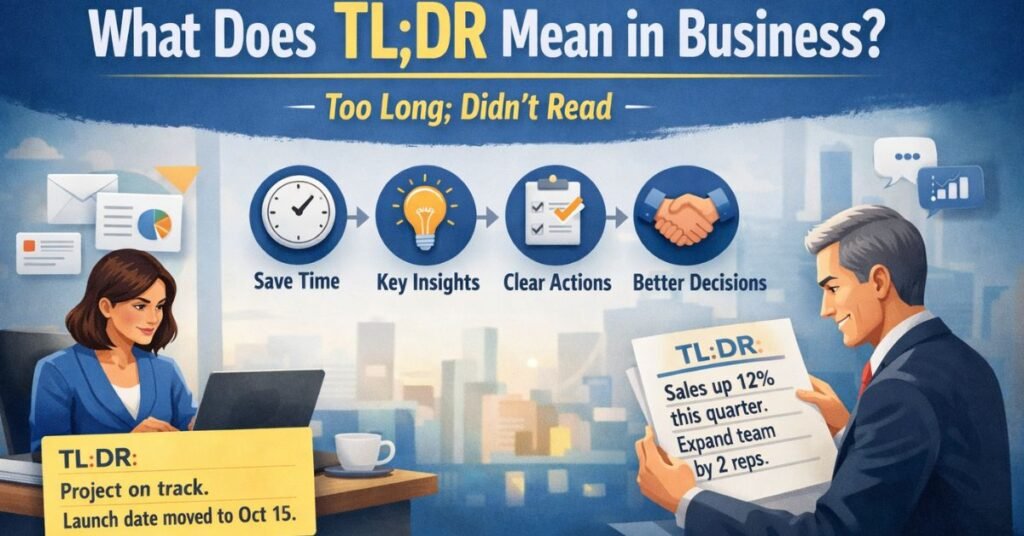
The short answer is simple: TL;DR stands for “Too Long; Didn’t Read.” In business communication, it’s used to provide a quick summary of a longer message so busy readers can understand the key point without reading everything.
But the deeper story is much more interesting.
In today’s workplace, attention is one of the most valuable resources. Managers skim reports. Executives read emails between meetings. Teams communicate across time zones. In that environment, clear and concise communication wins.
That’s exactly why TL;DR has moved from internet slang into professional business writing.
Used correctly, TL;DR can:
- Save time for leadership teams
- Improve clarity in long emails
- Increase engagement with reports
- Prevent misunderstandings
- Help decision-makers grasp key insights instantly
Used incorrectly, however, it can sound lazy, sarcastic, or even rude.
In this complete guide, we’ll break down everything you need to know about what TLDR means in business, including:
- The exact meaning and origin of TL;DR
- Why it became popular in corporate communication
- When it’s appropriate (and when it’s not)
- How to write effective TL;DR summaries
- Examples used in real business situations
- Tools that help summarize information
- Common mistakes professionals make
By the end of this guide, you’ll not only understand the meaning of TL;DR in business — you’ll know how to use it like a seasoned professional communicator.
What Does TLDR Mean in Business?
At its core, TL;DR stands for “Too Long; Didn’t Read.”
Originally, it was internet slang used on forums and social media when someone skipped a long piece of content. Over time, however, the phrase evolved into something far more useful.
In modern business communication, TL;DR means a short summary of key information from a longer message or document.
Think of it as a mini executive summary.
A Simple Example
Let’s say you send a long email explaining a project update. At the top of the email, you might include this:
TL;DR:
The marketing campaign launches Monday. Budget approved. Need final design files by Friday.
That single summary allows readers to instantly understand the most important points without scanning the entire message.
Why Businesses Started Using TL;DR
Business communication has changed dramatically in the last decade.
Workplaces now rely heavily on:
- Team messaging apps
- Project management platforms
- Internal documentation
- Remote communication
Because of this shift, professionals deal with massive information overload every day.
A typical office worker receives 100+ emails daily, along with Slack messages, reports, dashboards, and meeting notes.
TL;DR emerged as a practical solution to this overload.
It allows readers to quickly identify:
- Key decisions
- Important updates
- Required actions
- Major takeaways
TL;DR vs Executive Summary
Many people confuse TL;DR with traditional business summaries.
Here’s the difference.
TL;DR is:
- Shorter
- Informal but professional
- Often 1–3 sentences
- Used in emails, Slack, and documents
Executive summaries are:
- More formal
- Several paragraphs long
- Usually found in reports and proposals
You can think of TL;DR as the modern digital version of an executive summary designed for fast communication.
Where TL;DR Appears in Business
Today, TL;DR is commonly used in:
- Internal emails
- Slack or Microsoft Teams messages
- Project updates
- Long documents
- Company announcements
- Meeting notes
- Strategy reports
In many companies, it has become an expected communication format, especially in tech, startups, and remote-first organizations.
The Real Meaning Behind TL;DR in Business
While the literal translation is “Too Long; Didn’t Read,” the professional meaning is actually closer to this:
“Here’s the important part if you’re short on time.”
When used thoughtfully, TL;DR shows respect for the reader’s time, which is one of the most valued traits in modern workplace communication.
Why TL;DR Has Become So Important in Modern Business Communication
If you look at how business communication worked twenty years ago, the contrast is striking.
Important information was typically delivered through:
- Formal reports
- Meetings
- Printed memos
- Presentations
These formats encouraged longer explanations and detailed narratives.
But today’s workplace operates very differently.
Information moves quickly. Teams collaborate across continents. Managers review dozens of updates every day. As a result, brevity has become a competitive advantage in communication.
That’s where TL;DR comes in.
The Attention Economy at Work
Modern professionals operate in what experts often call the attention economy. In simple terms, attention is limited while information is unlimited.
Executives often skim messages rather than reading them word for word. Team members scan updates quickly before jumping to the next task.
When a message starts with a TL;DR summary, readers can immediately decide:
- Whether the message requires action
- Whether they should read the full details
- Whether it can wait until later
This helps reduce decision fatigue and keeps workflows moving efficiently.
TL;DR Encourages Clear Thinking
Another reason TL;DR has become so popular in business is that it forces the writer to clarify their own thinking.
If you cannot summarize your message in one or two sentences, there’s a good chance the message itself is unclear.
Writing a TL;DR requires answering key questions like:
- What is the core message?
- What decision needs to be made?
- What action is required?
- What outcome matters most?
This process naturally improves the quality of communication.
Leaders Prefer Concise Communication
Senior leaders rarely have time to read lengthy explanations.
In many organizations, executives expect updates that quickly answer three questions:
- What happened?
- Why does it matter?
- What should we do next?
A TL;DR summary addresses exactly those questions.
That’s why you’ll often see TL;DR summaries in:
- leadership reports
- board updates
- project summaries
- internal announcements
Remote Work Increased the Need for TL;DR
The rise of remote and hybrid work has made written communication more important than ever.
Without hallway conversations or quick desk check-ins, teams rely heavily on written updates.
In distributed teams, TL;DR helps ensure that:
- Everyone understands key information
- Messages are accessible across time zones
- Important decisions are easy to find
- Team members stay aligned
In many remote-first companies, clear summaries are now considered a core professional skill.
TL;DR as a Sign of Respect
At first glance, the phrase “Too Long; Didn’t Read” might sound dismissive.
But in business contexts, it often communicates the opposite.
Including a TL;DR tells the reader:
“I understand you’re busy, so here’s the most important part.”
That small gesture can make communication far more effective.
And in fast-paced work environments, respecting someone’s time is one of the most valuable forms of professionalism.
Benefits and Real-World Use Cases of TL;DR in Business
Understanding what TLDR means in business is only the first step. The real value comes from seeing how it improves communication in everyday professional situations.
When used properly, TL;DR transforms long messages into clear, actionable insights. Instead of forcing readers to dig through paragraphs of explanation, it delivers the core message instantly.
Let’s explore the most important benefits and real-world scenarios where TL;DR makes a major difference.
Faster Decision-Making
One of the biggest advantages of TL;DR summaries is speed.
In fast-moving organizations, leaders must make dozens of decisions every day. Reading full reports or long email threads simply isn’t realistic.
A TL;DR section highlights:
- the key issue
- the recommended solution
- the decision needed
Example:
TL;DR:
Customer churn increased 12% this quarter. Recommend launching a retention campaign and updating onboarding flow.
With that short summary, a manager immediately understands the situation and can decide whether to review the full report.
Clearer Project Updates
Project managers often send detailed updates covering multiple tasks, timelines, and risks. Without a summary, stakeholders may struggle to identify the most important information.
A TL;DR summary simplifies communication by highlighting the critical points.
Example project update TL;DR:
TL;DR:
Project is on schedule. Budget remains within limits. Waiting on vendor approval before the next milestone.
Even if someone skips the detailed report, they still understand the project’s status.
Improved Internal Communication
Large organizations often suffer from communication overload.
Employees receive updates from multiple departments including marketing, operations, HR, finance, and leadership. TL;DR summaries help employees quickly determine which messages require attention.
For example, an HR announcement might start with:
TL;DR:
New hybrid work policy begins July 1. Employees must work in-office two days per week.
The rest of the message can include details, but the core policy is immediately clear.
Better Email Efficiency
Many professionals complain about long emails that bury the main point at the bottom.
TL;DR solves that problem.
Instead of forcing the reader to scroll through explanations, the summary appears at the top.
A well-structured business email might look like this:
TL;DR:
We need approval for the $25,000 marketing budget by Friday to keep the campaign launch on schedule.
Details follow in the body of the email.
This approach dramatically increases the likelihood that busy recipients will respond quickly.
Stronger Team Alignment
Teams often struggle with miscommunication, especially when projects involve multiple departments.
TL;DR summaries help everyone stay aligned by clearly stating the outcome or action required.
For example:
TL;DR:
The product launch moved to October 10 due to supply chain delays.
Even if someone doesn’t read the full explanation, they still understand the new timeline.
Ideal for Executive Updates
Executives typically review many reports each week. They often scan summaries first before deciding whether to dive deeper.
This makes TL;DR extremely valuable for leadership communication.
A leadership report might include a TL;DR like this:
TL;DR:
Revenue increased 8% this quarter. Growth driven primarily by enterprise customers. Hiring three additional sales reps recommended.
In just two sentences, leadership receives the key insight.
Useful in Knowledge Sharing
TL;DR is also helpful when sharing educational or informational resources inside organizations.
For example, when sending a research report:
TL;DR:
AI adoption among competitors increased significantly. Companies using automation reduced operational costs by 15–20%.
Now readers know why the report matters before committing time to read it.
TL;DR in Customer Communication
Some companies even use TL;DR summaries in customer-facing documentation, such as product updates or policy changes.
Customers appreciate quick summaries because they reduce confusion and make information easier to digest.
For example:
TL;DR:
We updated our pricing plans. Existing customers will keep current rates until renewal.
The details can follow, but the main message is already clear.
How to Write an Effective TL;DR Summary in Business
Knowing what TLDR means in business is helpful, but knowing how to write one properly is what separates effective communicators from average ones.
A great TL;DR summary isn’t just a shorter version of a message. It captures the most important insight in a way that allows the reader to understand the situation immediately.
Let’s break down the process step by step.
Step 1: Identify the Core Message
Before writing a TL;DR summary, ask yourself one simple question:
If someone only reads one sentence, what should they learn?
Most business messages contain multiple details, but only one or two points truly matter.
These might include:
- a decision required
- an important update
- a key insight
- an urgent action item
Your TL;DR should highlight that core message.
Example:
Instead of summarizing everything, focus on the outcome.
Poor TL;DR:
This report discusses marketing performance, customer behavior, and upcoming strategy plans.
Better TL;DR:
Marketing conversions increased 20% after the new landing page launch.
The second version delivers a clear takeaway.
Step 2: Keep It Extremely Short
The biggest mistake people make with TL;DR summaries is writing something that is still too long.
A good TL;DR usually contains:
- one to three sentences
- one or two key ideas
- simple language
Remember the purpose: quick understanding.
If your summary takes more than ten seconds to read, it may not be concise enough.
Example format:
TL;DR:
The product launch is delayed by two weeks due to supplier issues. Updated timeline attached.
That’s clear, direct, and efficient.
Step 3: Focus on Outcomes, Not Explanations
The full document or message can contain detailed reasoning. The TL;DR should highlight results or decisions.
Readers want to know:
- what happened
- why it matters
- what comes next
For example:
TL;DR:
Customer support tickets increased 30% after the software update. Engineering team is investigating.
This communicates both the problem and the response.
Step 4: Place It in the Right Location
In most business communication, the TL;DR appears at the top of the message.
This allows readers to immediately understand the key information before reading further.
However, in some formats such as long articles or reports, the TL;DR may appear at the end as a recap.
Common placements include:
- Top of emails
- Beginning of reports
- Start of Slack messages
- Summary sections of documents
The key principle is visibility.
If readers must search for the TL;DR, it loses its value.
Step 5: Make It Action-Oriented When Necessary
If the message requires action, the TL;DR should clearly state what needs to happen.
Example:
TL;DR:
Please review the contract changes and approve by Thursday so we can finalize the partnership.
This avoids confusion and ensures the reader knows exactly what is expected.
Step 6: Use Plain Language
Professional communication should always prioritize clarity over complexity.
Avoid jargon, overly technical phrases, or complicated sentences.
For example:
Weak TL;DR:
The operational optimization initiative demonstrates a measurable improvement in logistical efficiencies.
Better TL;DR:
Our new process reduced shipping times by 18%.
The second version is clearer and easier to understand.
Step 7: Update the TL;DR as the Message Evolves
If you revise a report or email, make sure the TL;DR still reflects the key message.
Sometimes writers update the body of a document but forget to adjust the summary.
This can create confusion and miscommunication.
A good practice is to review the TL;DR last, ensuring it accurately represents the final message.
Tools That Help Create TL;DR Summaries
As information volumes grow, many professionals rely on tools to help summarize content quickly.
These tools are especially useful when working with long documents, research papers, or complex reports.
However, it’s important to remember that automation should assist — not replace — human judgment.
Let’s look at some helpful tools and approaches.
AI Writing Assistants
Modern AI tools can analyze large blocks of text and generate concise summaries.
These tools are helpful for:
- summarizing reports
- condensing meeting notes
- extracting key insights from research
- drafting TL;DR sections
Pros:
- saves time
- quickly processes large documents
- provides multiple summary options
Cons:
- may miss nuance
- requires human editing
- sometimes oversimplifies complex ideas
The best approach is to use AI as a starting point, then refine the summary yourself.
Document Collaboration Platforms
Many project management and documentation tools support summary sections within documents.
Examples include:
- collaborative workspaces
- team knowledge bases
- internal documentation platforms
These systems often encourage writers to include summaries at the top of documents, which functions similarly to a TL;DR.
Advantages include:
- improved team visibility
- easier information scanning
- consistent communication structure
Meeting Summary Tools
Meeting transcripts can be lengthy and difficult to review.
Summary tools can generate quick TL;DR recaps that highlight:
- decisions made
- action items
- key discussion points
These summaries help teams stay aligned without rewatching entire meetings.
Manual Summarization Frameworks
Even without software tools, professionals can use simple frameworks to generate TL;DR summaries.
One effective method is the 3-point summary technique.
Answer three questions:
- What happened?
- Why does it matter?
- What happens next?
For example:
TL;DR:
Customer retention dropped this quarter. Primary cause appears to be onboarding friction. Product team is redesigning the onboarding flow.
This format works well for many types of business communication.
Common TL;DR Mistakes Professionals Make
While TL;DR summaries are powerful communication tools, they can easily backfire when used incorrectly.
Many professionals misunderstand how TL;DR works or apply it in ways that confuse readers rather than helping them.
Let’s examine the most common mistakes and how to fix them.
Writing a TL;DR That Is Still Too Long
Ironically, the most frequent problem with TL;DR summaries is that they aren’t short enough.
Some writers include entire paragraphs or multiple bullet points, defeating the purpose of a quick summary.
For example:
Weak TL;DR:
This report analyzes marketing performance over the past quarter, including paid campaigns, organic traffic, email engagement, and customer acquisition metrics.
This summary doesn’t reveal the key takeaway.
A stronger version would be:
Better TL;DR:
Paid ads drove 70% of new customers this quarter, making them our most effective acquisition channel.
The goal is clarity, not completeness.
Including Too Many Details
A TL;DR should highlight the most important information, not every supporting detail.
Trying to include too much creates cognitive overload.
Focus on:
- the main result
- the key decision
- the most important insight
Everything else belongs in the full message.
Using TL;DR in the Wrong Context
Although TL;DR is common in modern workplaces, it may not be appropriate in highly formal communication.
Situations where TL;DR might feel out of place include:
- legal documents
- formal government reports
- official contracts
- academic publications
In these contexts, a traditional executive summary may be more appropriate.
Understanding your audience is essential.
Sounding Sarcastic or Dismissive
Because TL;DR originally meant “Too Long; Didn’t Read,” it can sometimes sound sarcastic if used poorly.
For example:
TL;DR:
Your report was too long so here’s the real point.
That tone can easily offend colleagues.
Instead, frame TL;DR as a helpful summary.
Example:
TL;DR:
The report recommends expanding the marketing budget to support customer growth.
This approach keeps the tone professional and respectful.
Hiding Important Actions in the Body
Sometimes writers include a TL;DR summary but still bury critical action items in the full message.
If a response is required, it should appear in the TL;DR itself.
Example:
TL;DR:
Please approve the updated marketing budget by Friday so we can launch the campaign next week.
This ensures the reader understands exactly what is needed.
Forgetting to Update the Summary
When documents evolve, the TL;DR must evolve as well.
Failing to update the summary can cause confusion if it no longer reflects the actual content.
Always review the TL;DR as the final step before sending or publishing a message.
Conclusion
Understanding what TLDR means in business is more than learning a simple internet acronym. It’s about mastering one of the most valuable communication techniques in modern workplaces.
In a world overflowing with information, clarity is a competitive advantage. Professionals who can summarize complex ideas quickly are far more likely to capture attention, influence decisions, and move projects forward.
TL;DR works because it respects the reader’s time. It highlights the most important insight before asking someone to invest energy into the details.
When used effectively, TL;DR can:
- improve workplace communication
- accelerate decision-making
- reduce confusion
- increase message engagement
- strengthen leadership reporting
But like any tool, it must be used thoughtfully. A good TL;DR is concise, clear, and focused on outcomes.
As workplaces continue to evolve toward faster digital communication, the ability to summarize information clearly will only become more valuable.
So the next time you write a long email, project update, or report, ask yourself one simple question:
If someone only reads the TL;DR, will they still understand the most important message?
If the answer is yes, you’re communicating like a pro.
FAQs
What does TLDR mean in business communication?
TL;DR means “Too Long; Didn’t Read.” In business communication, it refers to a short summary of a longer message or document that highlights the key takeaway or required action.
Is TL;DR professional to use at work?
Yes, in many modern workplaces TL;DR is widely accepted, especially in emails, Slack messages, reports, and internal updates. However, in very formal documents an executive summary may be more appropriate.
Where should TL;DR appear in a business message?
Most commonly, TL;DR appears at the top of an email, report, or document. This allows readers to quickly understand the core message before reading the details.
How long should a TL;DR summary be?
A good TL;DR summary is typically one to three sentences long. The goal is to deliver the most important insight quickly and clearly.
Is TL;DR the same as an executive summary?
No. A TL;DR is usually shorter and more informal, while an executive summary is a formal section of a report that may contain several paragraphs explaining the key findings.