
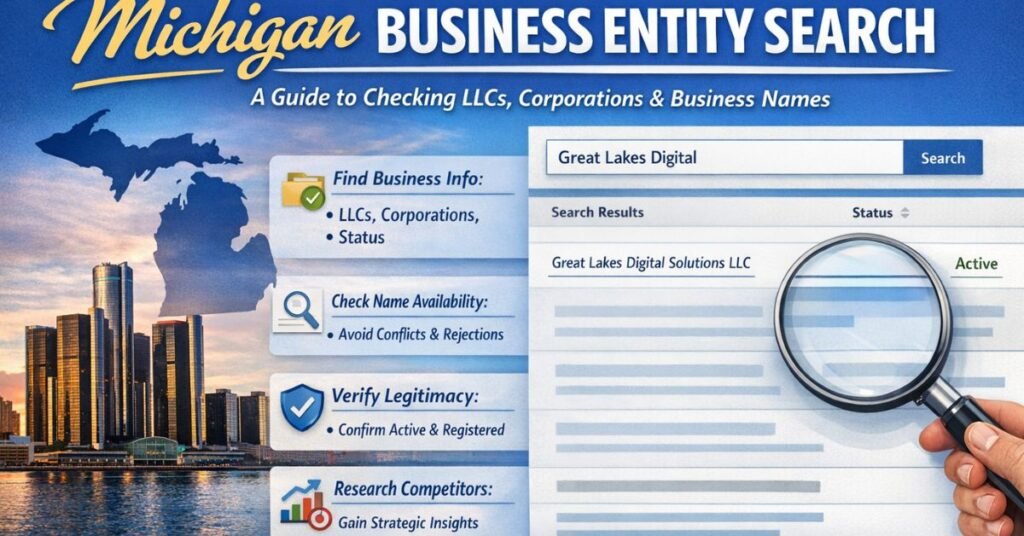
If you have ever tried to start a business in Michigan, verify a company’s legitimacy, or check whether a business name is already taken, you have almost certainly come across the michigan business entity search. It sounds simple enough—type a name, hit search, get results—but in real life, it’s rarely that straightforward.
I have seen entrepreneurs lose weeks because they skipped this step. I have watched freelancers sign contracts with businesses that didn’t legally exist. I have helped clients fix rejected LLC filings that could have been avoided with a five-minute search. That is why this tool matters far more than most people realize.
In this in-depth guide, I am going to walk you through everything you need to know about the Michigan business entity search—from what it is and why it matters to how to use it like a pro, avoid common mistakes, and apply the results in real-world situations. Whether you are launching your first LLC, checking a competitor, or doing due diligence before a partnership, this article will give you clarity, confidence, and practical direction.
Understanding the Michigan Business Entity Search (What It Is and Why It Exists)
At its core, the Michigan business entity search is a public database that allows anyone to look up registered businesses in the state of Michigan. The database is maintained by the Michigan Department of Licensing and Regulatory Affairs, often referred to as LARA.
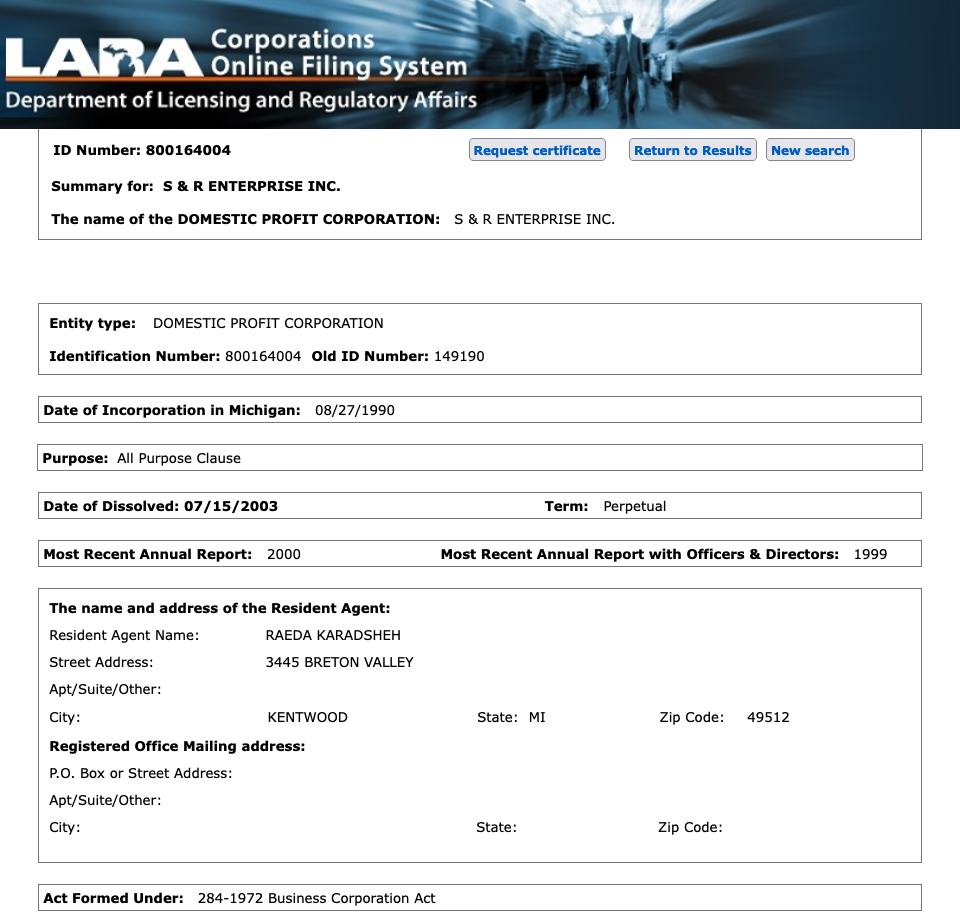
Think of it as Michigan’s official business registry. Every LLC, corporation, nonprofit, and limited partnership that legally operates in the state leaves a paper trail here. That trail includes:
- Legal business name
- Entity type (LLC, corporation, nonprofit, etc.)
- Identification number
- Status (active, dissolved, withdrawn, inactive)
- Formation or registration date
- Registered office and mailing address
- Name of the registered agent
If that sounds dry, here is a better way to think about it. Imagine Michigan as a massive marketplace. The business entity search is the master ledger that shows who has a booth, who shut theirs down, and who is operating under what name. Without this ledger, there would be chaos—duplicate names, fake businesses, and zero accountability.
This tool exists for transparency and protection. It protects the public from fraud, protects business owners from name conflicts, and helps the state enforce compliance. Once you understand that, you stop seeing it as a bureaucratic formality and start seeing it as a practical business safeguard.
Why the Michigan Business Entity Search Matters More Than You Think
Many people treat the Michigan business entity search as a box to check before filing paperwork. That mindset leads to problems.
Here is why this search matters in real life:
First, it helps you avoid name conflicts. Michigan law does not allow two active businesses of the same type to operate under identical or deceptively similar names. If you file an LLC without checking availability properly, your filing can be rejected—or worse, approved and later challenged.
Second, it protects you from scams. Just because someone claims to own a company does not mean they do. A quick entity search can tell you whether a business is legitimate, active, and registered in Michigan.
Third, it supports due diligence. Investors, lenders, partners, and even clients use this tool to verify your business. If your information is inaccurate or your status is inactive, it raises red flags instantly.
Finally, it helps you stay compliant. You can confirm whether your own business is listed correctly, whether annual statements are up to date, and whether your registered agent information is current.
In short, the Michigan business entity search is not just for starting businesses. It is a living reference tool that supports smart decisions at every stage of business ownership.
Who Should Use the Michigan Business Entity Search (With Real-World Scenarios)
This tool is useful for far more people than just first-time founders. Let’s look at who benefits most—and how they actually use it.
Entrepreneurs and startups use it to check name availability before forming an LLC or corporation. This avoids rejections, delays, and rebranding headaches.
Freelancers and consultants use it to verify clients. Before signing a contract or sending an invoice, checking whether a business is active can save you from nonpayment or legal disputes.
Investors and partners use it to confirm ownership details, entity status, and longevity. An “inactive” or “dissolved” status is often a deal breaker.
Job seekers use it to confirm that a company offering employment is real and legally registered.
Competitors and marketers use it for research. Understanding when a competitor was formed, how many entities they control, or whether they recently restructured can reveal strategic insights.
Attorneys, accountants, and real estate professionals rely on it daily for compliance checks and transactional work.
If you are interacting with a Michigan business in any meaningful way, this search tool is relevant to you.
Step-by-Step: How to Use the Michigan Business Entity Search Correctly

Using the Michigan business entity search is simple on the surface, but there are nuances that separate casual users from confident professionals.
Step one is accessing the official search page through LARA’s Corporations Division. Always use the official state site. Third-party sites can be outdated or incomplete.
Step two is choosing the right search method. You can search by:
- Business name (full or partial)
- Identification number
- Officer or registered agent name
For name searches, less is more. Start with a partial name rather than the full legal name. For example, instead of “Great Lakes Digital Solutions LLC,” search “Great Lakes Digital.” This captures variations and avoids false negatives.
Step three is reviewing the results list carefully. Pay attention to entity type and status. Two businesses can have similar names but different entity types. An inactive entity may free up a name, while an active one blocks it.
Step four is clicking into the entity record. This is where the real value lives. Verify:
- Status (active is good; dissolved or inactive requires caution)
- Formation date (older entities often signal stability)
- Registered agent (important for legal notices)
- Address consistency
Step five is documenting what you find. Screenshot or save the entity record, especially if you are using it for filings, contracts, or due diligence.
This process takes five to ten minutes but can save weeks of rework later.
Best Practices for Accurate and Reliable Search Results
Here is where experience really matters. These best practices come from real-world use, not theory.
Avoid exact-match tunnel vision. Michigan allows variations like “LLC,” “L.L.C.,” and “Limited Liability Company.” A name that looks different may still be considered deceptively similar.
Check phonetic similarities. Names that sound alike can still cause issues. If “Mitten Tech” exists, “MittenTek” may be risky.
Look at entity status history. Some records show past activity. A recently dissolved business may still cause confusion or trademark issues.
Cross-reference with trademarks. The Michigan business entity search does not replace trademark searches. Always check both if branding matters.
Search multiple times. Try name variations, abbreviations, and keywords. Professionals rarely trust a single search result.
Treat the database as authoritative but not infallible. Delays happen. Very recent filings may not appear immediately.
Free vs Paid Tools: What the Michigan Business Entity Search Does and Does Not Do


The Michigan business entity search is completely free—and that is one of its strengths. But free does not mean all-inclusive.
What the official search does well:
- Provides authoritative, up-to-date registration data
- Confirms legal existence and status
- Shows registered agent and address information
What it does not do:
- Reserve business names
- Check trademarks
- File documents on your behalf
- Provide legal or compliance advice
This is where paid services come in. LLC formation platforms and registered agent services often bundle name checks, filing, reminders, and compliance tools.
Free tools are ideal if you are comfortable navigating filings yourself and understand the rules. Paid tools are helpful if you value convenience, automation, or guidance—especially for first-time founders.
There is no right or wrong choice. The key is understanding that the Michigan business entity search is your foundation. Everything else builds on top of it.
Common Mistakes People Make (and How to Fix Them)
Even smart people make mistakes with this tool. The good news is that most errors are easy to avoid once you know what to look for.
One common mistake is assuming “no results” means the name is available. Often, the search was too specific. Fix this by using partial keywords and multiple variations.
Another mistake is ignoring inactive entities. While inactive businesses may not block name usage, they can still cause confusion or legal friction. Investigate why they are inactive.
Some users confuse business registration with licensing. A business may exist legally but still lack required licenses. The entity search does not show licenses.
Others forget to recheck before filing. Availability can change quickly. Always search again right before submission.
Finally, many people misinterpret status labels. “Good standing” and “active” are not always the same thing. Read status definitions carefully.
Avoiding these mistakes turns a basic search into a strategic advantage.
How Professionals Use Michigan Business Entity Search for Due Diligence
For professionals, this tool goes beyond name checks.
Accountants use it to verify client entities before filing taxes. Attorneys use it to confirm service of process details. Investors use it to validate portfolio companies. Real estate professionals use it to confirm ownership entities before transactions.
In each case, the search answers three core questions:
- Does this business legally exist?
- Is it active and compliant?
- Who is responsible for it?
If any answer is unclear, that is a signal to dig deeper.
Final Thoughts: Why Mastering This Search Puts You Ahead
The Michigan business entity search is one of those tools that looks simple but rewards depth. Anyone can type a name into a search box. Not everyone knows how to interpret the results, avoid traps, and apply the information strategically.
When you use this tool well, you reduce risk, save time, and make smarter decisions. Whether you are starting your first LLC or managing a portfolio of businesses, that edge compounds over time.
If there is one takeaway from this guide, it is this: never treat the Michigan business entity search as an afterthought. Treat it as a core business skill.
FAQs
What is the Michigan business entity search used for?
It is used to look up registered businesses in Michigan, verify their legal status, and check name availability.
Is the Michigan business entity search free?
Yes, the official LARA database is completely free to use.
Can I reserve a business name through the search tool?
No. The search only shows availability. Name reservation requires a separate filing.
Does an inactive business block my name?
Usually no, but similar names can still cause confusion or legal issues.
How often is the database updated?
Updates are frequent, but recent filings may take time to appear.