There is a magnetic pull to French fashion that the rest of the world has been trying to decode for decades. It is that elusive quality known as je ne sais quoi an effortless blend of elegance, nonchalance, and timeless sophistication. When you invest in french brands clothing, you aren’t just buying a garment; you are buying into a philosophy that prioritizes quality over quantity and enduring style over fleeting trends.
Whether you are looking to build a capsule wardrobe worthy of a stroll along the Seine or simply want to elevate your daily office attire, understanding the landscape of French fashion is essential. From the historic couture houses that defined the 20th century to the digital-first contemporary labels dominating Instagram today, this guide will navigate you through the best names in the business. We will explore key designers, decode the sizing systems, and help you identify the essential pieces needed to capture that coveted Parisian aesthetic.
The Three Tiers of French Fashion
To navigate the market effectively, it helps to categorize french brands clothing into three distinct tiers. Each offers a different price point and aesthetic, but all share that common thread of impeccable taste.
1. The Heritage Powerhouses (Haute Couture & Luxury)
These are the pillars of the industry. They set the global trends during Paris Fashion Week and represent the pinnacle of craftsmanship.
- Chanel: The inventor of the Little Black Dress and the tweed suit. Chanel represents ultimate timelessness.
- Saint Laurent: Known for “Le Smoking” tuxedo and a rock-and-roll, edgy glamour.
- Hermès: The gold standard for leather goods and silk scarves, representing quiet, ultra-expensive luxury.
- Dior: Synonymous with the “New Look,” focusing on feminine silhouettes and architectural tailoring.
2. The Contemporary “Cool Girl” Brands (Accessible Luxury)
This is where most modern fashion lovers shop. These brands offer high-quality designs at a price point below the luxury giants, often ranging from $150 to $500 per piece.
- Sandro: Known for clean lines and masculine-feminine tailoring. Expect sharp blazers and structured dresses.
- Maje: The bohemian sister to Sandro. Think flowing prints, lace details, and softer silhouettes.
- The Kooples: Offers a British-punk influence mixed with Parisian chic. Famous for their couple-focused marketing and leather jackets.
- Zadig & Voltaire: The go-to for luxury basics like cashmere sweaters with edgy motifs (skulls, wings) and rock-chic boots.
3. The Digital Natives & Cult Favorites
These brands grew up in the social media age, bypassing traditional department stores to sell directly to consumers.
- Sézane: Perhaps the most famous success story. Sézane dropped limited-edition collections that sell out in minutes, focusing on vintage-inspired romanticism.
- Rouje: Founded by influencer Jeanne Damas, this brand captures the vintage, 70s-inspired “French girl” look perfectly with wrap dresses and cardigans.
- Ba&sh: Created by two best friends, focusing on joy and freedom with colorful prints and easy-to-wear dresses.
Decoding the Aesthetic: What Makes it “French”?
Why does french brands clothing look so distinct? It isn’t just the label; it is the design philosophy.
The “Undone” Look
French style is never perfect. If the outfit is tailored, the hair is messy. If the makeup is bold, the outfit is simple. It is about balance. Brands like Isabel Marant champion this aesthetic, mixing sequin skirts with oversized, slouchy grey sweatshirts.
Neutral Palettes with Pops of Red
Open a Parisian wardrobe, and you will see a sea of navy, black, white, beige, and grey. These colors mix and match effortlessly. However, French brands often inject a singular pop of color—usually a bright red lip or a red accessory—to break the monotony.
Quality Fabrics
Polyester is rarely the star of the show. French consumers are notoriously picky about fabrics. They prefer natural fibers that breathe and age well:
- Linen: For breathable summer shirts.
- Silk: For blouses that drape perfectly.
- Wool and Cashmere: For winter layering that isn’t bulky.
Essential French Wardrobe Staples
If you want to dress like a local, you need to identify the key items that anchor the look. Here are the must-haves from top french brands clothing lines.
The Marinière (Breton Stripe Top)
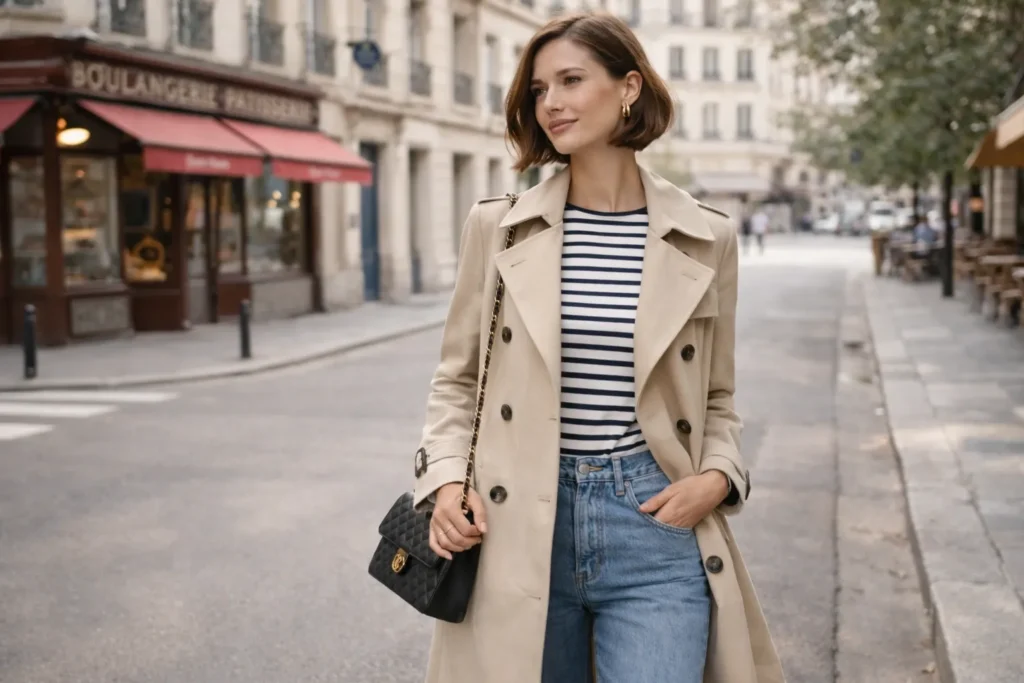
Originally the uniform for the French Navy in Brittany, the striped shirt was popularized by Coco Chanel. Brands like Saint James and Petit Bateau are the authentic go-tos for this heavy cotton staple. It pairs perfectly with jeans, trousers, or tucked into a skirt.
The Trench Coat
While Burberry (British) is the most famous, French brands have adopted the trench as their own. It is the ultimate transition piece for Paris’s famously rainy grey weather. Look for a fluid, unstructured trench from brands like Comptoir des Cotonniers that can be belted tightly at the waist.
The Straight-Leg Jean
Skinny jeans had their moment, but the classic French look relies on a straight-leg, high-waisted cut. It is often rigid denim (100% cotton) in a medium blue vintage wash. It flatters the bum without clinging to the thighs. A.P.C. is the undisputed king of this category, known for their raw, minimalist denim.
The Ballet Flat
Comfort is non-negotiable for women who walk everywhere. The ballet flat is chic, feminine, and practical. Repetto is the heritage brand here—they actually make real ballet shoes and adapted them for street wear at the request of Brigitte Bardot.
Navigating French Sizing
One of the biggest hurdles when shopping for french brands clothing online is the sizing. It is notoriously tricky for international shoppers.
The Conversion Basics
French sizing (FR) is different from Italian (IT) or European (EU) sizing, though they look similar.
- US 2 / XS ≈ FR 34
- US 4 / S ≈ FR 36
- US 6 / M ≈ FR 38
- US 8 / L ≈ FR 40
- US 10 / XL ≈ FR 42
The Fit Philosophy
French clothing tends to be cut slimmer in the shoulders, arms, and hips compared to American sizing.
- Vanity Sizing Doesn’t Exist: In the US, sizes have shifted downward over the years (a size 6 today is bigger than a size 6 in 1990). In France, sizing has remained fairly static.
- The “Petit” Frame: Many contemporary brands (like Maje or Sandro) design for a frame that is slightly shorter and narrower. If you are tall or have an athletic build with broad shoulders, you will almost certainly need to size up one or two sizes.
Sustainability: The New French Revolution
France is arguably the world leader in sustainable fashion regulation. The government has appointed a “Minister of Fashion” in the past and passed laws banning the destruction of unsold luxury goods.
Because of this cultural backdrop, many modern french brands clothing companies are eco-conscious by default.
- Veja: The sneaker brand that took the world by storm. They use wild rubber from the Amazon and organic cotton, offering complete transparency on their supply chain.
- Sézane: Their “Grand Action” program raises millions for children’s charities, and they rely heavily on eco-friendly materials and recycled packaging.
- Vestiaire Collective: While not a clothing brand itself, this French resale platform has popularized the idea of circular fashion, encouraging people to buy second-hand luxury rather than new fast fashion.
How to Shop Like a Parisian (Even Online)
You don’t need a plane ticket to Charles de Gaulle airport to curate this wardrobe.
- Wait for the “Soldes”: In France, sales are state-regulated and happen twice a year (January and July). Prices on French brand websites often drop significantly during these periods, even for international shoppers.
- Check the Composition Label: Before buying that knit from a French brand, check if it’s acrylic or wool. The “French” price tag should command natural fibers.
- Invest in Accessories First: If a full Saint Laurent outfit is out of budget, start with a belt or a scarf. French style relies heavily on accessories to elevate simple basics. A great leather belt from a mid-range brand like Soeur can make a high-street outfit look expensive.
Conclusion: Buying Less, Buying Better
Embracing french brands clothing is about shifting your mindset. It is a rejection of the “wear it once” culture. The French woman might have a smaller closet than her American counterpart, but every piece in it is a heavy hitter.
By investing in brands like Sandro for tailoring, Saint James for basics, and maybe saving up for that one special piece from Celine or Dior, you build a wardrobe that serves you. It is clothes that feel good against the skin, fits impeccably, and never look dated. That is the true secret of French style—it isn’t about chasing the trend; it’s about finding what works and sticking to it with confidence.
FAQs
Q: Why are French clothing sizes so small?
A: French sizing is based on a historically smaller, more petite frame standard that hasn’t changed much over decades. Additionally, the cut is often slimmer in the arms and bust. It is standard advice for international shoppers to size up, especially in tailored items like blazers.
Q: Is Sézane considered a luxury brand?
A: Sézane fits into the “accessible luxury” or premium high-street category. It is more expensive than Zara or H&M, offering higher quality fabrics and ethical production, but it is significantly cheaper than designer luxury brands like Chanel.
Q: What is the most famous French clothing item?
A: The “Marinière” or Breton stripe shirt is likely the most globally recognized symbol of French fashion. Originally a navy uniform, it became a fashion staple thanks to Coco Chanel and later Jean-Paul Gaultier.
Q: Are French brands cheaper in Paris?
A: Yes, generally. If you are visiting France, you can save money on french brands clothing because you avoid import duties and shipping costs. Plus, non-EU residents can claim a VAT refund (détaxe) of around 12% on purchases over €100, making it much cheaper than buying in the US or UK.
Q: What is the difference between Haute Couture and Prêt-à-Porter?
A: Haute Couture refers to custom-fitted clothing constructed by hand from start to finish, protected by law in France. Prêt-à-Porter means “ready-to-wear”—these are the high-quality, factory-made collections that you find in boutiques and department stores.

Sofia Bennett is a fashion content creator known for her refined perspective on style, trends, and modern elegance. She specializes in curating content that blends timeless fashion principles with contemporary aesthetics, helping readers develop confidence through personal style. Sofia’s work spans outfit styling, wardrobe essentials, and fashion inspiration, always with an emphasis on authenticity and practicality. Her approachable voice and eye for detail make fashion accessible, empowering readers to express themselves with confidence and sophistication.