
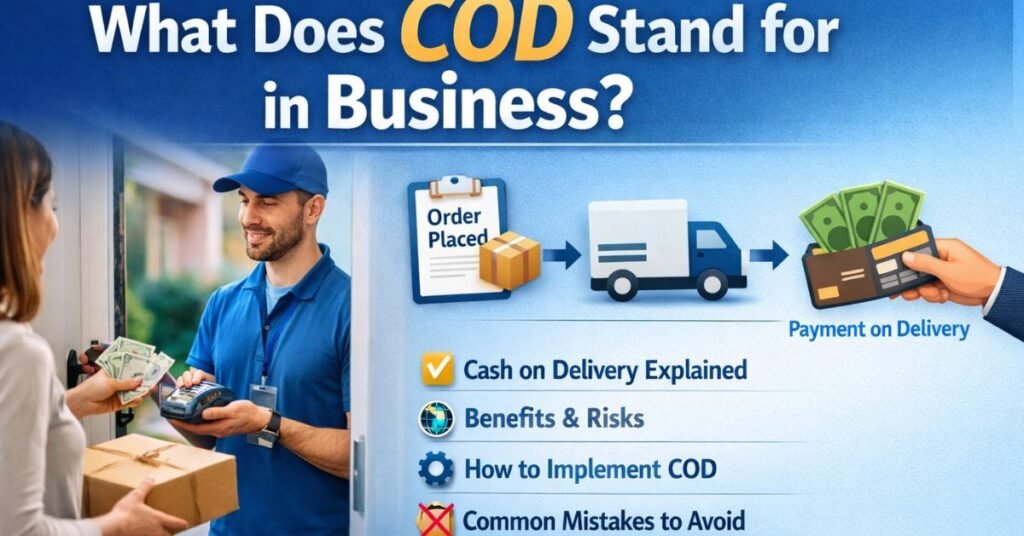
If you’ve ever seen the phrase “Cash on Delivery available” at checkout and paused to wonder, what does COD stand for in business? — you’re not alone.
It’s one of those terms that sounds simple, almost old-school. Yet behind those three letters sits a powerful payment method that continues to shape how millions of businesses operate — especially in eCommerce, wholesale trade, and emerging markets.
Whether you’re a small business owner, an online seller, a logistics professional, or simply someone researching payment models, understanding COD is more than just knowing the acronym. It’s about cash flow, customer trust, risk management, and smart operations.
In this guide, you’ll learn:
- Exactly what COD means in business
- How Cash on Delivery works step by step
- Why companies still use it in the digital age
- The benefits and risks of COD
- Tools and systems that support COD operations
- Common mistakes businesses make (and how to avoid them)
- Expert tips to make COD profitable, not painful
Let’s start with the basics.
What Does COD Stand for in Business?
In business, COD stands for Cash on Delivery.
It’s a payment method where the buyer pays for goods at the time of delivery, rather than in advance.
Instead of paying online or upfront, the customer pays the delivery person when the package arrives. Payment can be made in:
- Cash
- Card (via portable POS machines)
- Mobile wallet (depending on the region)
Simple Definition (Featured Snippet Ready)
Cash on Delivery (COD) is a payment method in which the buyer pays for goods when they are delivered, rather than before shipment.
It’s that straightforward — but its impact on operations, risk, and customer psychology runs deep.
A Beginner-Friendly Breakdown of Cash on Delivery
Let’s make this practical.
Imagine you run an online clothing store. A customer orders a jacket worth $80. Instead of paying through a credit card at checkout, they choose “Cash on Delivery.”
You ship the jacket.
When the courier arrives at the customer’s doorstep, the customer pays $80. Only then is the package handed over.
That’s COD in action.
Why Would Anyone Choose COD?
Because trust is currency.
Many customers:
- Don’t trust online payments
- Don’t have access to credit/debit cards
- Prefer inspecting the package before paying
- Want flexibility
In regions like South Asia, the Middle East, and parts of Africa, COD isn’t just an option — it’s often the dominant payment model.
COD vs. Prepaid Orders
Here’s the fundamental difference:
Prepaid model:
- Customer pays first
- Seller ships after payment confirmation
- Lower risk for seller
COD model:
- Seller ships first
- Customer pays on delivery
- Higher operational risk for seller
That shift — shipping before collecting money — changes everything from cash flow to logistics planning.
How Cash on Delivery Works (Step-by-Step)
Understanding the mechanics is essential if you’re considering offering COD.
Here’s how it typically works:
Step 1: Customer Places an Order
The customer selects “Cash on Delivery” at checkout instead of paying online.
Step 2: Seller Confirms and Ships
The seller processes the order and hands it over to a courier or logistics company that supports COD.
Step 3: Delivery Attempt
The courier delivers the package to the customer’s address.
Step 4: Payment Collection
The delivery agent collects payment at the doorstep.
Depending on the agreement, this may include:
- Product cost
- Shipping fee
- COD service fee
Step 5: Remittance to Seller
The courier company deposits the collected funds into the seller’s account — usually within 2–7 business days.
This delay in fund transfer is a crucial operational detail many new businesses overlook.
Why COD Still Matters in the Digital Age
You might think COD is outdated in a world dominated by Stripe, PayPal, and Apple Pay.
It’s not.
In fact, for many businesses, it’s a revenue driver.
Here’s why.
1. It Builds Instant Trust
Customers feel safer paying when the product is physically in front of them. This is especially powerful for:
- New online brands
- Small eCommerce stores
- High-ticket items
2. It Expands Market Reach
Not everyone has:
- A credit card
- A bank account
- Confidence in online transactions
COD allows businesses to serve customers who would otherwise never complete checkout.
3. It Increases Conversion Rates
In some markets, removing COD can cut sales by 30–50%.
That’s not a minor tweak — that’s survival-level impact.
Benefits of Cash on Delivery for Businesses
Now let’s go deeper.
COD isn’t just about accommodating customers. It has strategic advantages — when managed properly.
1. Higher Order Volume
Offering COD often increases checkout completion rates. Customers who hesitate to pay upfront feel more comfortable selecting COD.
More payment flexibility = fewer abandoned carts.
2. Competitive Advantage
If your competitors offer COD and you don’t, customers may choose them instead.
In trust-sensitive markets, COD isn’t optional — it’s expected.
3. Reduced Payment Gateway Dependency
Prepaid transactions require:
- Payment gateway fees
- Fraud detection tools
- Chargeback management
With COD, there are no chargebacks from stolen cards — though you face different risks (like returns).
4. Market Testing Opportunity
For new businesses, COD can:
- Encourage trial purchases
- Help test demand
- Reduce friction for first-time buyers
The Downsides of COD (And Why They Matter)
COD isn’t free money.
It carries real operational risks.
1. Higher Return Rates
One of the biggest challenges of COD is “refused delivery.”
Customers sometimes:
- Change their mind
- Aren’t home
- Place fake orders
You pay shipping both ways.
That eats margins quickly.
2. Cash Flow Delays
With prepaid orders, you receive money instantly.
With COD:
- You ship first
- Courier collects later
- Funds transfer days afterward
That lag can strain working capital — especially for small businesses.
3. Operational Complexity
You must:
- Track remittances
- Reconcile courier payments
- Manage reverse logistics
It’s more admin-heavy than prepaid models.
Who Should Use Cash on Delivery?
COD isn’t for everyone.
It’s ideal for:
- New eCommerce stores building trust
- Brands selling in emerging markets
- Businesses targeting customers without digital payment access
- High-conversion consumer goods like fashion, cosmetics, and electronics
It may not be suitable for:
- Low-margin products
- Subscription services
- Digital goods
- International shipping-heavy businesses
Strategic use matters more than blanket adoption.
Step-by-Step Guide: How to Implement COD in Your Business
If you’re serious about offering COD, don’t just flip the switch. Plan it carefully.
Step 1: Analyze Your Market
Ask:
- Do customers expect COD?
- What percentage of competitors offer it?
- What are typical return rates?
Market research first. Emotion later.
Step 2: Choose the Right Courier Partner
Not all logistics companies handle COD efficiently.
Look for:
- Reliable remittance timelines
- Transparent COD fees
- Strong tracking systems
- Low return handling costs
Negotiate rates early.
Step 3: Add Order Verification Systems
To reduce fake orders:
- Confirm COD orders via SMS or phone call
- Send order confirmation emails
- Use address validation tools
Even a simple confirmation call can reduce bogus orders dramatically.
Step 4: Implement Clear COD Policies
Be transparent about:
- Delivery timelines
- Return policy
- COD fees (if applicable)
- Refusal penalties (if any)
Clarity prevents disputes.
Step 5: Monitor Metrics Weekly
Track:
- COD acceptance rate
- Return-to-origin (RTO) percentage
- Remittance delays
- Net profit after shipping losses
COD requires active management, not passive hope.
Tools and Platforms That Support COD
Let’s talk practical tech.
eCommerce Platforms
Many platforms support COD out of the box:
- Shopify
- WooCommerce
- Magento
They allow you to enable COD as a payment option during checkout.
Logistics Integrators
Depending on your region, you may use:
- Local courier companies
- Third-party logistics providers (3PL)
- Fulfillment centers
Some offer dashboard tracking for COD collections and settlements.
Order Verification Tools
To reduce fake COD orders:
- SMS verification tools
- OTP confirmation systems
- Address validation software
Some advanced tools even block repeat fake customers automatically.
Free vs. Paid Systems: What’s Worth It?
Free setup:
- Basic COD option enabled
- Manual reconciliation
- Minimal fraud protection
Paid solutions:
- Automated COD confirmation
- Integrated logistics tracking
- Analytics dashboards
- Fraud detection
If you’re processing under 100 orders per month, manual may work.
Beyond that? Automation pays for itself.
Common Mistakes Businesses Make with COD
I’ve seen businesses bleed money because they misunderstood COD.
Here are the most common errors.
1. Offering COD Without Data
Blindly enabling COD without market research leads to high RTO losses.
Fix: Test COD in one region first.
2. No Order Verification
Fake orders destroy margins.
Fix: Add mandatory confirmation before dispatch.
3. Ignoring Courier Performance
Some couriers delay remittances or mishandle cash.
Fix: Audit courier reports monthly.
4. Treating COD Like Prepaid
They’re not the same.
COD requires tighter tracking and cash flow planning.
Expert Tips to Make COD Profitable
Over time, successful businesses develop systems.
Here’s what works.
Add Small COD Fees
A small fee:
- Filters unserious buyers
- Offsets logistics risk
Even $1–$3 makes a difference.
Encourage Prepaid With Incentives
Offer:
- Small discount for prepaid
- Faster delivery
- Loyalty points
Gradually shift serious customers toward prepaid.
Blacklist Repeat Offenders
Track customers who frequently refuse delivery.
Block future COD orders from them.
Conclusion: Is Cash on Delivery Worth It?
So, what does COD stand for in business?
On the surface, it’s Cash on Delivery.
In reality, it’s a strategic decision.
It’s about trust. Access. Market reach. Operational discipline.
Used carelessly, COD drains profit through returns and logistics losses.
Used intelligently, it unlocks customers who would never click “Pay Now.”
If you’re running an eCommerce store or product-based business, COD shouldn’t be an afterthought. It should be a calculated, data-driven choice.
Start small. Track aggressively. Optimize continuously.
And remember — in business, flexibility often wins.
If you’ve implemented COD in your business, what was your biggest challenge? Let’s talk in the comments.
FAQs
What does COD stand for in business?
COD stands for Cash on Delivery, a payment method where customers pay when goods are delivered.
Is COD safe for businesses?
It can be, but it carries higher return and operational risks compared to prepaid orders.
Why do customers prefer COD?
Trust, lack of digital payment access, and the ability to inspect goods before paying.
Does COD increase sales?
In many markets, yes. It often improves conversion rates significantly.
What is the biggest risk of COD?
High return-to-origin (RTO) rates and cash flow delays.