If you’ve ever sat in a leadership meeting thinking, “Why does everything feel harder than it should?” — you’re not alone.
At some point, nearly every growing company hits the same wall: unclear roles, inconsistent execution, endless meetings, and goals that look great on paper but never quite land.
That’s where the question comes in: what does EOS stand for in business?
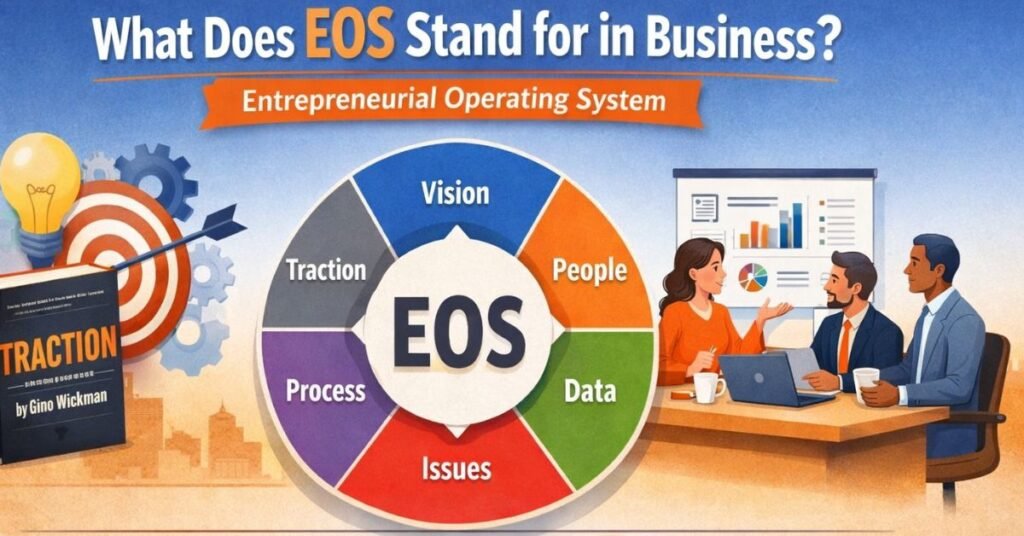
EOS stands for Entrepreneurial Operating System — a practical, structured framework designed to help businesses get aligned, stay accountable, and execute consistently.
But EOS isn’t just another business buzzword. It’s a full operating system for companies that want to grow without chaos. And in this guide, we’re going deep — not just into what it means, but how it works, who it’s for, how to implement it, and whether it’s right for your organization.
If you’re a founder, operator, manager, or entrepreneur trying to bring clarity to your company, this article will walk you through everything you need to know.
What Does EOS Stand for in Business? (Simple Explanation First)
Let’s make this clear and snippet-ready.
EOS stands for Entrepreneurial Operating System.
It’s a structured business framework designed to help companies:
- Clarify their vision
- Strengthen leadership teams
- Improve accountability
- Solve issues effectively
- Execute goals consistently
Think of EOS as the “operating system” behind your business — similar to how Windows or macOS runs a computer. Your team, products, marketing, and sales are the apps. EOS is the structure that keeps everything running smoothly.
The system was created by Gino Wickman, author of the book Traction, which introduced EOS to the business world. Since then, thousands of companies — particularly small to mid-sized entrepreneurial organizations — have adopted it.
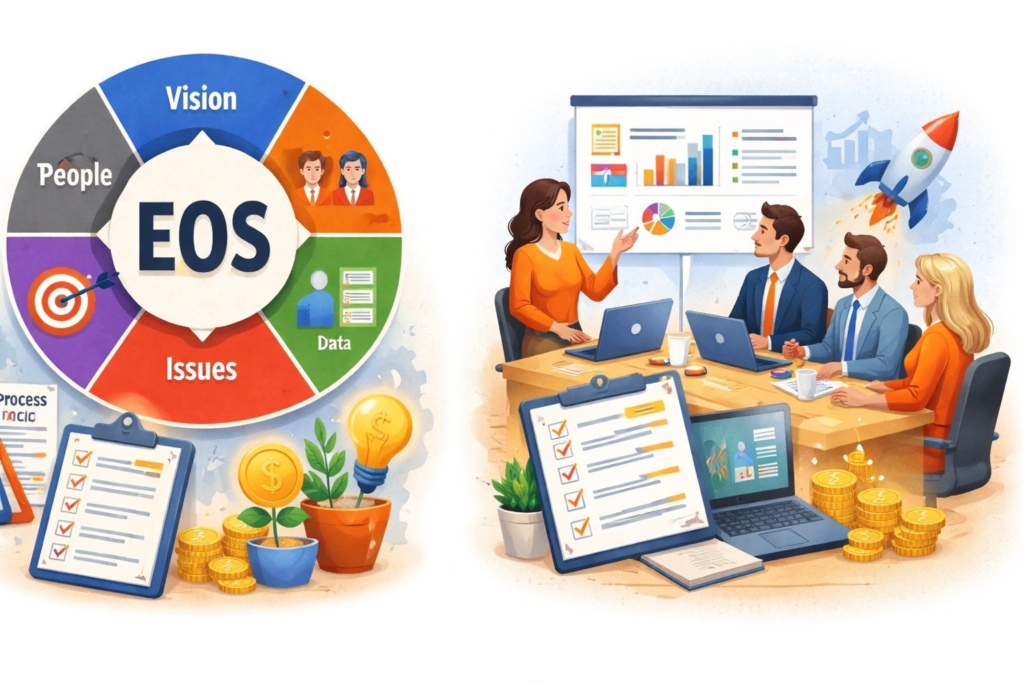
At its core, EOS is built around six key components:
- Vision
- People
- Data
- Issues
- Process
- Traction
We’ll break each one down in depth shortly.
But first, let’s talk about why this system even exists.
Why EOS Exists: The Problem It Solves
Most businesses don’t fail because of a bad idea.
They fail because:
- Leadership teams aren’t aligned.
- Priorities change weekly.
- No one knows who owns what.
- Meetings produce talk — not action.
- Accountability feels uncomfortable.
If you’ve ever run a business, you’ve felt this friction.
EOS was built to eliminate that friction.
Gino Wickman noticed a recurring pattern among entrepreneurial companies: they were creative and passionate but lacked structure. They needed discipline without losing their entrepreneurial spirit.
So EOS was designed to bring:
- Structure without bureaucracy
- Accountability without micromanagement
- Clarity without complexity
Instead of adding layers of management, EOS simplifies your company down to core principles and repeatable systems.
The Six Key Components of EOS (Deep Breakdown)
To truly understand what EOS stands for in business, you need to understand its six components. These are the pillars that hold the entire framework together.
1. Vision: Getting Everyone 100% on the Same Page
Most companies think they’re aligned. They’re not.
Ask five leaders where the company will be in three years — you’ll likely get five different answers.
EOS solves this through a tool called the Vision/Traction Organizer (V/TO). It clarifies:
- Core values
- Core focus
- 10-year target
- 3-year picture
- 1-year plan
- Quarterly goals (called Rocks)
- Marketing strategy
The goal? Absolute clarity.
When everyone understands:
- Where you’re going
- Why you exist
- What matters most
Execution becomes dramatically easier.
And clarity reduces politics. Because when the vision is clear, decisions become simpler.
2. People: Right People, Right Seats
EOS has a simple rule:
Right people + Right seats = Healthy company
“Right people” means they share your core values.
“Right seats” means they’re in roles that match their strengths.
EOS uses something called the People Analyzer, where team members are evaluated against core values. It also uses the GWC concept:
- Get it
- Want it
- Capacity to do it
If someone doesn’t “GWC” their role, they’re in the wrong seat — even if they’re talented.
This is one of the most uncomfortable parts of EOS. But it’s also one of the most powerful.
When everyone is in the right seat, accountability becomes natural instead of forced.
3. Data: Running on Numbers, Not Feelings
Entrepreneurs love instincts. But instincts alone don’t scale.
EOS introduces a Scorecard — a weekly set of 5–15 measurable numbers that predict performance.
Instead of asking, “How do things feel?”
You ask, “What do the numbers say?”
Examples might include:
- Sales calls made
- Leads generated
- Production errors
- Customer churn rate
- Cash balance
Each number has an owner.
If a number is off track, it becomes an issue to solve — not a blame session.
Data creates objectivity. Objectivity reduces drama.
4. Issues: Solving Problems Permanently
Most businesses have the same problems week after week.
EOS uses the IDS method:
- Identify
- Discuss
- Solve
Instead of surface-level conversations, teams dig down to root causes.
Every weekly leadership meeting includes an Issues List. Problems get documented and prioritized — not buried.
Over time, your organization becomes better at problem-solving. And that skill compounds.
5. Process: Documenting How Things Are Done
Chaos often comes from inconsistency.
EOS encourages companies to document their Core Processes — usually 6–10 key processes that run the business.
For example:
- Sales process
- Marketing process
- Hiring process
- Customer onboarding process
- Billing process
The rule is simple:
Document the 20% that drives 80% of results.
Then train everyone to follow them.
Consistency creates scale.
6. Traction: Turning Vision Into Results
Vision is useless without execution.
This is where EOS shines.
It introduces:
- 90-day priorities (Rocks)
- Weekly Level 10 Meetings
- Clear accountability charts
- Measurable quarterly goals
Everything runs in 90-day cycles.
Why 90 days?
Because it’s short enough to stay urgent — but long enough to accomplish meaningful work.
When companies implement this rhythm, productivity increases dramatically.
Benefits of EOS in Business
Now that we’ve answered what EOS stands for in business, let’s talk about why companies adopt it.
1. Clarity Across the Organization
Everyone knows:
- The vision
- Their role
- The priorities
- How success is measured
This reduces confusion and misalignment.
2. Improved Accountability
Roles are clearly defined using the Accountability Chart.
Instead of vague job descriptions, every seat has measurable outcomes.
This reduces overlap and finger-pointing.
3. Better Meetings
EOS meetings follow a strict agenda.
No rambling.
No side conversations.
No wasted time.
Decisions get made. Issues get solved.
4. Stronger Leadership Teams
Leadership alignment becomes mandatory.
You can’t hide behind ambiguity.
5. Predictable Growth
Because you’re running on data and quarterly execution cycles, growth becomes more intentional.
Who Is EOS Best Suited For?
EOS is not for every business.
It works best for:
- Entrepreneurial companies with 10–250 employees
- Founder-led businesses
- Leadership teams struggling with alignment
- Growing companies experiencing operational chaos
- Businesses seeking scalable structure
It may not be ideal for:
- Solo freelancers
- Highly corporate bureaucracies
- Companies resistant to accountability
If your company is in growth mode and struggling with structure, EOS might fit perfectly.
Step-by-Step Guide: How to Implement EOS in Your Business
Let’s make this actionable.
Step 1: Read Traction
Start with Traction by Gino Wickman.
It explains the full framework in practical detail.
Step 2: Decide DIY vs. EOS Implementer
You can:
- Self-implement
- Hire a Professional EOS Implementer
Hiring an implementer brings expertise and objectivity.
DIY saves money but requires strong internal discipline.
Step 3: Conduct a Focus Day
This is typically the first structured session.
Leadership reviews:
- Current challenges
- Goals
- Structure
- Alignment gaps
Step 4: Clarify Vision
Complete the Vision/Traction Organizer.
Document:
- Core values
- Core focus
- Long-term targets
- Quarterly Rocks
Step 5: Build Accountability Chart
Replace traditional org charts with an Accountability Chart.
Focus on roles first — then people.
Step 6: Launch Level 10 Meetings
Run weekly leadership meetings with strict agendas:
- Segue
- Scorecard
- Rock review
- Customer/employee headlines
- To-do list
- IDS
Consistency is everything.
Step 7: Implement Quarterly Planning
Every 90 days:
- Review progress
- Set new Rocks
- Adjust priorities
That’s the EOS rhythm.
Tools, Comparisons & Alternatives
EOS has proprietary tools, but there are alternatives.
EOS vs. OKRs
OKRs (Objectives and Key Results) focus heavily on measurable goal tracking.
EOS goes broader — incorporating vision, people, data, and process.
EOS vs. Scaling Up
Scaling Up offers another structured growth framework.
Scaling Up is often more complex. EOS is simpler and more accessible for mid-sized companies.
Free vs. Paid EOS Options
Free:
- Read Traction
- Download basic templates
- Run internal workshops
Paid:
- Hire certified EOS Implementer
- Attend EOS workshops
- Use official tools and materials
Paid options provide structure and expertise — which often accelerates results.
Common Mistakes When Implementing EOS (And How to Avoid Them)
Mistake 1: Half-Implementing
Some companies cherry-pick tools.
EOS works best as a complete system.
Fix: Commit fully for at least one year.
Mistake 2: Avoiding Hard Conversations
People component requires courage.
Fix: Address seat misalignment early.
Mistake 3: Inconsistent Meetings
Skipping Level 10 meetings breaks rhythm.
Fix: Protect weekly meeting time religiously.
Mistake 4: Ignoring Data Discipline
Without scorecards, everything becomes subjective.
Fix: Identify 5–15 predictive numbers.
Is EOS Worth It?
From real-world implementation stories, companies often report:
- Clearer leadership alignment
- Faster decision-making
- Increased revenue
- Reduced employee turnover
- Improved culture
But EOS requires discipline.
It’s not magic. It’s structured consistency.
If you’re willing to commit to clarity and accountability, EOS can transform how your business operates.
Conclusion: Should You Use EOS in Your Business?
So — what does EOS stand for in business?
It stands for Entrepreneurial Operating System, a structured framework designed to help companies gain clarity, accountability, and traction.
But more importantly, EOS represents a mindset shift:
From chaos to clarity.
From reaction to execution.
From personality-driven leadership to system-driven growth.
If your company feels stuck, misaligned, or scattered, EOS offers a proven roadmap.
And if you’re serious about building a scalable business — not just a busy one — it might be exactly what you need.
Have you implemented EOS? Thinking about it? Drop your thoughts below — I’d love to hear your experience.
FAQs
What does EOS stand for in business?
EOS stands for Entrepreneurial Operating System, a business framework created by Gino Wickman to help companies improve alignment and execution.
Is EOS only for large companies?
No. EOS is typically used by small to mid-sized entrepreneurial businesses, especially those with 10–250 employees.
Who created EOS?
EOS was created by Gino Wickman, author of the book Traction.
How long does EOS take to implement?
Most companies commit to at least one year to fully integrate EOS principles.
Can you implement EOS without a consultant?
Yes, but hiring a certified EOS Implementer often accelerates results.