
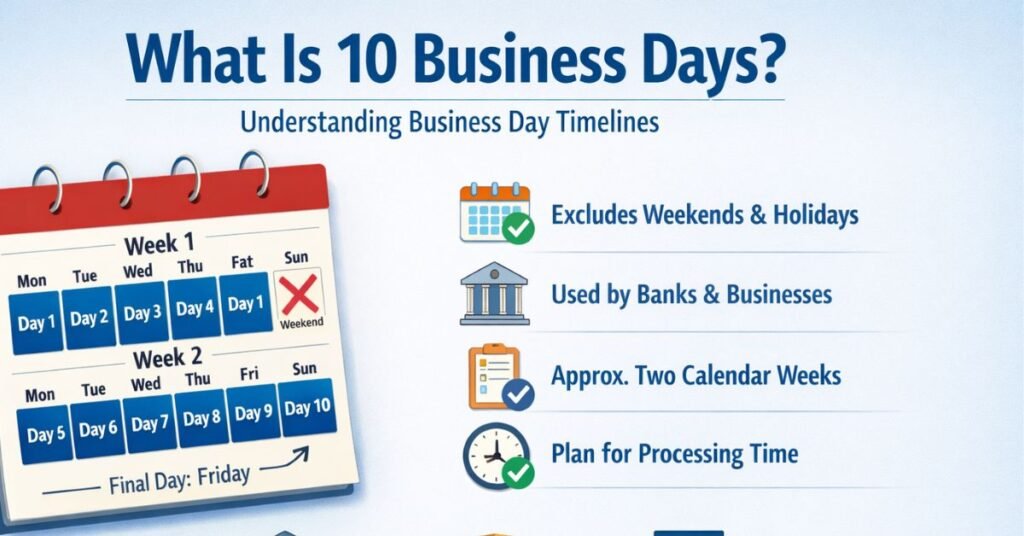
If you’ve ever filled out paperwork, ordered something online, or waited for a bank transfer, you’ve probably seen a phrase like: “Please allow 10 business days for processing.”
But what exactly does that mean?
Many people assume it simply means ten days from today. In reality, 10 business days works very differently from regular calendar days, and misunderstanding it can lead to confusion, missed expectations, or unnecessary frustration.
Imagine applying for a refund, submitting documents for a visa, or waiting for a bank verification. You check the calendar ten days later expecting results — yet nothing happens. Why? Because weekends and holidays often don’t count as business days.
Understanding how business days work is essential in modern life. Banks, government offices, shipping companies, corporate offices, and online businesses all rely on business-day timelines to set expectations and process tasks.
In this in-depth guide, you’ll learn:
- Exactly what 10 business days means
- How to calculate it accurately
- When business days are used in real life
- Common mistakes people make
- Helpful tools to calculate business days instantly
- Practical examples from banking, shipping, and legal processes
By the end, you’ll never be confused by a “10 business day” deadline again.
What Is 10 Business Days?
At its core, 10 business days means ten working days that exclude weekends and official holidays.
In most countries, business days are defined as:
- Monday
- Tuesday
- Wednesday
- Thursday
- Friday
Weekends — Saturday and Sunday — are not counted.
This means that 10 business days equals two full work weeks under normal circumstances.
Simple Definition
A business day is a standard working day used by businesses, banks, and government offices to conduct operations.
Therefore:
10 business days = 10 working days (excluding weekends and holidays).
Quick Example
Let’s say today is Monday.
If something takes 10 business days, the timeline would look like this:
Week 1
Monday – Day 1
Tuesday – Day 2
Wednesday – Day 3
Thursday – Day 4
Friday – Day 5
Weekend (not counted)
Week 2
Monday – Day 6
Tuesday – Day 7
Wednesday – Day 8
Thursday – Day 9
Friday – Day 10
So the final day falls two weeks later on Friday.
What Happens If You Start Mid-Week?
Example: Starting on Wednesday.
Wednesday – Day 1
Thursday – Day 2
Friday – Day 3
Weekend skipped
Monday – Day 4
Tuesday – Day 5
Wednesday – Day 6
Thursday – Day 7
Friday – Day 8
Weekend skipped
Monday – Day 9
Tuesday – Day 10
So 10 business days from Wednesday ends on the Tuesday of the following week after next.
Why Businesses Use Business Days
Businesses prefer this system because:
- Offices typically operate Monday–Friday
- Staff availability is predictable
- Processing timelines stay consistent
- Customer expectations are easier to manage
Without this standard, timelines would constantly shift based on weekends and closures.
Why Business Days Exist: The Logic Behind the System
The concept of business days developed alongside the modern corporate and banking system. Before global commerce expanded, businesses operated on predictable schedules, usually during daylight hours on weekdays.
As commerce expanded internationally, companies needed a consistent time measurement for transactions, processing, and legal deadlines.
The Core Reason: Operational Availability
Most organizations function during weekday office hours. That includes:
- Banks
- Government agencies
- Corporate offices
- Logistics companies
- Legal firms
- Insurance providers
When a company promises a response within 10 business days, it essentially means:
“We will process this within ten days when our staff is actively working.”
The Banking System Influence
Banks were one of the earliest institutions to formalize business days.
Transactions such as:
- Wire transfers
- Loan processing
- Check clearing
- Account verification
all require internal processing and regulatory checks. Weekends typically halt these operations.
Because of this, financial institutions standardized Monday through Friday as official business days.
Global Standardization
While some countries have different weekend schedules, the majority of the world now follows the Monday–Friday structure.
However, variations exist:
Middle Eastern countries often use Sunday–Thursday workweeks.
Some international financial markets operate with unique schedules.
But regardless of regional differences, the principle remains the same:
Business days represent operational working days.
Why the System Still Matters
Even in a digital world where services are available 24/7, business days remain important because:
- Human approvals are required
- Compliance checks must occur
- Legal deadlines depend on official working days
- Internal teams process requests during office hours
Understanding this structure helps prevent unrealistic expectations when dealing with banks, companies, or government services.
How to Calculate 10 Business Days Correctly
Calculating 10 business days may sound simple, but it often trips people up — especially when holidays enter the picture.
Let’s break down a reliable method.
Step 1: Identify the Starting Day
The first step is determining whether the current day counts.
In many cases:
- The day you submit a request does not count
- Counting starts the next business day
Example:
You submit a request on Monday afternoon.
Day 1 typically begins Tuesday.
Always confirm the policy of the organization you’re dealing with.
Step 2: Count Only Weekdays
Once the start day is determined, count forward excluding weekends.
Example:
Start Date: Tuesday
Tuesday – Day 1
Wednesday – Day 2
Thursday – Day 3
Friday – Day 4
Weekend skipped
Monday – Day 5
Tuesday – Day 6
Wednesday – Day 7
Thursday – Day 8
Friday – Day 9
Weekend skipped
Monday – Day 10
Step 3: Account for Public Holidays
If a holiday occurs during the timeline, that day does not count.
Example:
Suppose Thursday is a national holiday.
Wednesday – Day 1
Thursday – Holiday (skip)
Friday – Day 2
This pushes the deadline further out.
Step 4: Verify Time Zones and Regional Calendars
If dealing with international businesses, consider:
- Time zones
- Local holidays
- Different weekend schedules
A company in another country may follow a different business calendar.
Quick Shortcut
A rough rule of thumb:
10 business days ≈ 14 calendar days
But holidays can extend that timeline.
Real-Life Examples of 10 Business Days
You’ll encounter the phrase 10 business days in countless real-world situations.
Let’s explore where it commonly appears.
Banking and Financial Transactions
Banks frequently use business-day timelines for tasks that require verification or processing.
Examples include:
- Account approvals
- Loan decisions
- Refund processing
- Credit card disputes
- Fraud investigations
For example, a credit card dispute might say:
“Resolution may take up to 10 business days.”
This allows banks enough time to:
- Review transaction logs
- Contact merchants
- Validate evidence
- Update records
Online Shopping and Refunds
E-commerce companies often use business-day estimates for refunds.
A message might read:
“Refunds may take 5–10 business days to appear in your account.”
Why?
Because multiple systems are involved:
- Merchant approval
- Payment gateway processing
- Bank clearing time
Each step may take several working days.
Government Processing
Government agencies frequently use business-day deadlines.
Examples include:
- Passport processing updates
- Tax refund reviews
- Permit approvals
- Document verification
These institutions typically operate only on weekdays, making business-day timelines essential.
Shipping and Logistics
Shipping companies also rely on business days.
A shipping promise of 10 business days typically means:
- Weekends do not count
- Warehouse operations pause during holidays
- Delivery schedules follow weekday routes
Job Applications and Hiring
Employers sometimes say:
“We’ll respond within 10 business days.”
Hiring processes often require coordination among multiple teams, interviews, and approvals.
Business-day timelines give HR teams flexibility while maintaining transparency.
Benefits of Understanding Business Day Timelines
Knowing how 10 business days works provides practical advantages in everyday life.
1. Better Planning
Understanding business-day timelines helps you plan for:
- Travel documents
- Financial transactions
- Application deadlines
You’ll know when to expect results and avoid unnecessary stress.
2. Reduced Frustration
Many people assume deadlines are calendar-based.
Understanding business days prevents misunderstandings with companies or institutions.
3. Improved Professional Communication
In business environments, referencing timelines accurately makes you appear more organized and knowledgeable.
For example:
“Please allow 10 business days for processing.”
Using proper terminology helps maintain clarity in professional communication.
4. Smarter Deadline Management
If you know a task takes 10 business days, you can calculate backward to determine when to start.
Example:
If documents are needed by the end of the month, you’ll know when to submit requests.
5. More Realistic Expectations
Instead of checking daily for updates, you’ll understand the normal processing window and avoid unnecessary follow-ups.
Tools That Help You Calculate Business Days
Fortunately, you don’t have to manually calculate timelines anymore.
Several tools make business-day calculations fast and accurate.
Online Business Day Calculators
These tools allow you to:
- Enter a start date
- Choose the number of business days
- Automatically exclude weekends and holidays
Popular examples include:
TimeandDate business calculator
CalculatorSoup business day calculator
WorkingDays calendar tool
These are especially useful when:
- Planning projects
- Managing delivery timelines
- Scheduling deadlines
Calendar Apps
Many digital calendars can help visualize business-day timelines.
Examples include:
- Google Calendar
- Outlook
- Apple Calendar
Simply skip weekends and count weekdays.
Project Management Tools
Professional teams often rely on project management platforms that automatically calculate workdays.
Examples include:
- Trello
- Asana
- Monday.com
- ClickUp
These tools help track tasks based on working-day schedules.
Spreadsheet Formulas
If you use spreadsheets, functions can calculate business days automatically.
Examples include formulas that exclude weekends and holidays.
This approach is especially useful for businesses managing large timelines.
Common Mistakes People Make When Counting Business Days
Despite its simplicity, people frequently misunderstand how business days work.
Let’s explore the most common mistakes.
Counting Weekends
The biggest mistake is assuming weekends count.
If a deadline says 10 business days, Saturdays and Sundays do not apply.
This misunderstanding often leads people to expect results earlier than possible.
Ignoring Holidays
Public holidays pause business operations.
For example:
- National holidays
- Bank holidays
- Government closures
These days extend timelines.
Counting the Starting Day Incorrectly
Some organizations begin counting the next day, not the same day.
If you submit something Monday evening, counting may start Tuesday.
Always confirm the rule.
Forgetting Time Zones
If working with international companies, business days may follow a different time zone.
This can shift deadlines slightly.
Assuming All Businesses Follow the Same Calendar
Different industries may operate on different schedules.
For example:
- Banks close weekends
- Some tech companies operate 7 days a week
Always check the specific policy.
Step-by-Step Method to Calculate 10 Business Days Quickly
Here’s a simple process you can follow every time.
Step 1
Identify the starting date.
Step 2
Determine whether counting begins the same day or the next day.
Step 3
Count only weekdays.
Step 4
Skip Saturdays and Sundays.
Step 5
Remove any holidays.
Step 6
Stop once you reach the tenth business day.
Example
Start Date: Monday
Tuesday – Day 1
Wednesday – Day 2
Thursday – Day 3
Friday – Day 4
Weekend skipped
Monday – Day 5
Tuesday – Day 6
Wednesday – Day 7
Thursday – Day 8
Friday – Day 9
Weekend skipped
Monday – Day 10
Final deadline: Monday.
Conclusion
Understanding what is 10 business days is surprisingly important in everyday life. From banking transactions to shipping deliveries, hiring timelines to government approvals, business-day calculations influence countless processes.
The key takeaway is simple:
10 business days means ten working days, typically Monday through Friday, excluding weekends and holidays.
In most cases, this equals roughly two calendar weeks, though holidays may extend the timeline slightly.
Once you understand how to count business days properly, you can:
- Manage deadlines more effectively
- Avoid confusion with companies or institutions
- Plan applications, payments, and projects with confidence
Next time you see a message saying “please allow 10 business days,” you’ll know exactly what to expect.
FAQs
What does 10 business days mean?
10 business days means ten working days, excluding weekends and public holidays.
Is 10 business days the same as two weeks?
Usually yes. Two weeks normally contain ten business days if no holidays occur.
Do weekends count as business days?
No. Saturdays and Sundays are typically not considered business days.
Do holidays count in business days?
No. Official holidays usually pause the business-day count.
How long is 10 business days from Monday?
If no holidays occur, 10 business days from Monday ends on the Friday of the following week.