
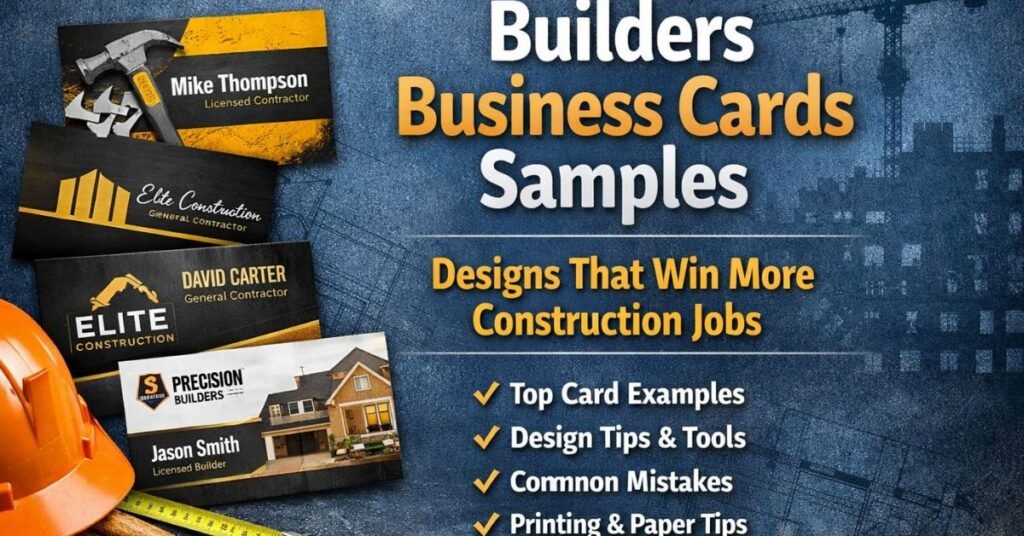
If you’re a contractor, carpenter, plumber, or general builder, chances are you’ve handed out dozens — maybe hundreds — of business cards over the years. But here’s the uncomfortable question: how many of those builders business cards samples actually brought you new jobs?
A business card in construction isn’t just a formality. It’s often your first handshake after the handshake. It sits in a client’s wallet, toolbox, or kitchen drawer. And when they finally need a renovation, extension, or emergency repair — your card either gets the call… or it doesn’t.
In this comprehensive guide, we’ll dive deep into builders business cards samples that actually convert. You’ll learn:
- What makes a builder’s card stand out in a competitive local market
- Real-world design principles that work in construction
- Step-by-step instructions to create your own high-converting card
- Tools (free and paid) to design and print like a pro
- Mistakes builders commonly make — and how to avoid them
- FAQs to help you fine-tune your approach
Whether you’re just starting your building business or refreshing your branding after 15 years on-site, this guide will give you practical, field-tested insights you can apply immediately.
Understanding Builders Business Cards Samples: What They Really Represent
Let’s break it down simply.
When people search for builders business cards samples, they’re not just looking for pretty templates. They’re looking for inspiration, structure, proof — and often reassurance.
A builder’s business card is more than contact information. It communicates:
- Professionalism
- Reliability
- Quality of work
- Brand identity
- Trustworthiness
Think of it like this: if your work is the house, your business card is the front door. Before anyone sees your craftsmanship, they see that small piece of cardstock.
In construction, perception matters. A poorly designed card can signal disorganization. A sharp, well-thought-out card says, “I take my business seriously.”
Builders business cards samples typically fall into a few categories:
- Classic and traditional (simple logo, clean layout)
- Industrial-themed (tools, steel textures, bold fonts)
- Minimalist and modern (clean lines, whitespace, premium feel)
- Photo-based (project images or before-and-after shots)
Each style communicates something different. The key is aligning the design with your target market. A high-end renovation contractor serving luxury clients needs a different look than a local handyman targeting quick residential fixes.
In short: your business card is a branding tool — not just a phone number.
Why Builders Business Cards Still Matter in a Digital World
We live in the era of websites, Instagram reels, and Google Business profiles. So why do builders business cards samples still matter?
Because construction is local and relationship-driven.
A builder often gets hired through:
- Referrals
- Word of mouth
- Networking events
- Site visits
- Supplier recommendations
In these moments, you don’t send a LinkedIn request. You hand over a card.
Here’s what a physical card does that digital can’t always replicate:
- Creates a tangible memory
- Reinforces professionalism
- Makes it easy for referrals (“Here’s his card”)
- Feels intentional and personal
Imagine this scenario:
You just completed a kitchen remodel. The homeowner’s neighbor walks over and asks, “Who did the work?” The homeowner reaches into a drawer and pulls out your card.
Now compare that to, “Let me search through my messages and find his number.”
Which one is more powerful?
Builders business cards samples help you model designs that feel worth keeping. Because the goal isn’t just to hand out cards — it’s to create cards people hold onto.
Types of Builders Business Cards Samples That Convert
Below are common styles that perform well in the construction industry — along with when to use them.
Classic Professional Builder Card
This is the no-nonsense design.
- Logo at top
- Name and title (e.g., General Contractor)
- Phone number (large and clear)
- Email and website
- License number (if applicable)
This type works well for:
- Established contractors
- Commercial builders
- Renovation companies
Why it works: It signals stability and seriousness.
Industrial-Themed Builder Card


These builders business cards samples often include:
- Hard hat icons
- Hammer or wrench graphics
- Steel or concrete textures
- Bold, heavy fonts
This style works well for:
- Tradespeople
- Roofers
- Handymen
- Small local crews
It feels hands-on and approachable.
Premium Minimalist Builder Card


Think:
- Black background with gold or white text
- Lots of whitespace
- Clean sans-serif typography
This works best for:
- High-end residential builders
- Custom home contractors
- Design-build firms
It signals refinement and premium service.
Photo-Based Builder Card
Some builders use a small image of:
- A finished project
- Before-and-after transformation
- A signature build
Use this carefully. A cluttered image can reduce readability. But when done right, it visually proves your capability in seconds.
The Key Benefits of Well-Designed Builders Business Cards
A strong card delivers more than aesthetics. It creates measurable business advantages.
1. Improves First Impressions
In construction, trust is everything. Clients often invest tens of thousands of dollars in a builder. A polished card reinforces that you’re serious, organized, and legitimate.
2. Supports Referrals
Good builders thrive on referrals. A card makes it easy for past clients to pass along your details.
3. Strengthens Brand Recall
When your colors, logo, and style match your van, uniform, and website, your brand sticks.
Consistency = recognition.
4. Differentiates You From Competitors
If five builders quote on a job, but yours has a sharp, memorable card — that small detail can influence perception.
5. Creates Offline Visibility
Your card can sit on:
- Notice boards
- Supplier counters
- Café community boards
- Local hardware stores
Each placement expands your reach.
Builders business cards samples help you visualize these benefits in practical design form.
Step-by-Step Guide to Designing Builders Business Cards That Win Jobs
Let’s walk through a clear, structured process.
Step 1: Define Your Target Market
Before opening any design tool, answer:
- Do I target residential or commercial?
- Budget homeowners or luxury clients?
- Quick repairs or large builds?
Your audience determines your visual tone.
Step 2: Clarify Your Brand Identity
Choose:
- 1–2 main brand colors
- 1 strong, readable font
- A simple, recognizable logo
Avoid overcomplicating. Simplicity wins.
Step 3: Include Essential Information Only
Must-have elements:
- Business name
- Your name
- Title (Builder, Contractor, Carpenter, etc.)
- Phone number
- Website
- License number (if required in your region)
Optional but powerful:
- QR code to portfolio
- Short tagline
- Social media handle
Step 4: Prioritize Readability
Builders business cards samples that convert share one trait: clarity.
Tips:
- Use at least 8pt–10pt font
- Avoid script fonts
- Ensure high contrast (dark text on light background or vice versa)
Remember: many clients are middle-aged homeowners. Make it easy on their eyes.
Step 5: Choose Quality Printing
Cheap, flimsy cards hurt credibility.
Consider:
- 350–450gsm thickness
- Matte finish for modern look
- Spot UV for logo highlight
- Rounded corners for differentiation
The tactile experience matters more than you think.
Tools for Creating Builders Business Cards: Free vs Paid
You don’t need a design degree. But you do need the right tool.
Canva
Canva
Best for beginners.
Pros:
- Drag-and-drop interface
- Large template library
- Affordable printing options
Cons:
- Templates can look generic if not customized
Adobe Express
Adobe
More flexibility than Canva, still beginner-friendly.
Pros:
- Strong typography control
- Professional templates
Cons:
- Slight learning curve
Fiverr Designers
Fiverr
Hire a designer for $20–$100.
Pros:
- Custom design
- Unique branding
Cons:
- Quality varies by seller
Local Graphic Designer
Higher investment, stronger long-term brand consistency.
Best for established construction companies scaling up.
Comparing Free Templates vs Custom Designs
Free Templates:
- Quick
- Affordable
- Great for startups
Custom Designs:
- Unique
- Fully aligned with brand
- More memorable
If you’re just launching, start simple. Once revenue stabilizes, invest in custom branding.
Builders business cards samples give you a reference point — but your final version should reflect your identity, not just copy a template.
Common Mistakes Builders Make (And How to Fix Them)
1. Overloading Information
Some cards list every service imaginable.
Fix: Keep it focused. Direct clients to your website for full service list.
2. Tiny Fonts
Small text equals frustration.
Fix: Increase font size. Remove unnecessary elements.
3. Poor Color Contrast
Yellow text on white background? Hard pass.
Fix: Ensure strong contrast.
4. No Call to Action
Many builders forget to guide action.
Add a simple line like:
“Call today for a free quote.”
5. Cheap Paper
Thin paper feels disposable.
Upgrade your stock. It’s worth it.
Conclusion: Your Card Is a Silent Salesperson
Your builders business cards samples aren’t just design ideas — they’re blueprints for growth.
A strong card:
- Builds trust
- Supports referrals
- Reinforces your brand
- Differentiates you locally
In construction, reputation is everything. And sometimes, that reputation starts with a 3.5 x 2 inch piece of paper.
If your current card feels outdated, generic, or forgettable, now’s the time to redesign it. Study strong samples. Clarify your brand. Invest in quality.
And remember: the best business card isn’t the flashiest one. It’s the one that gets the phone to ring.
FAQs
What should be included on a builder’s business card?
Include business name, your name, title, phone number, email, website, and license number if required.
Should builders include photos on business cards?
Only if high-quality and uncluttered. A clean design is usually more effective.
What size should a builder’s business card be?
Standard 3.5 x 2 inches works best for wallets and storage.
Are QR codes worth adding?
Yes, especially if they link to a portfolio or Google reviews.
What paper thickness is recommended?
At least 350gsm for a premium feel.