
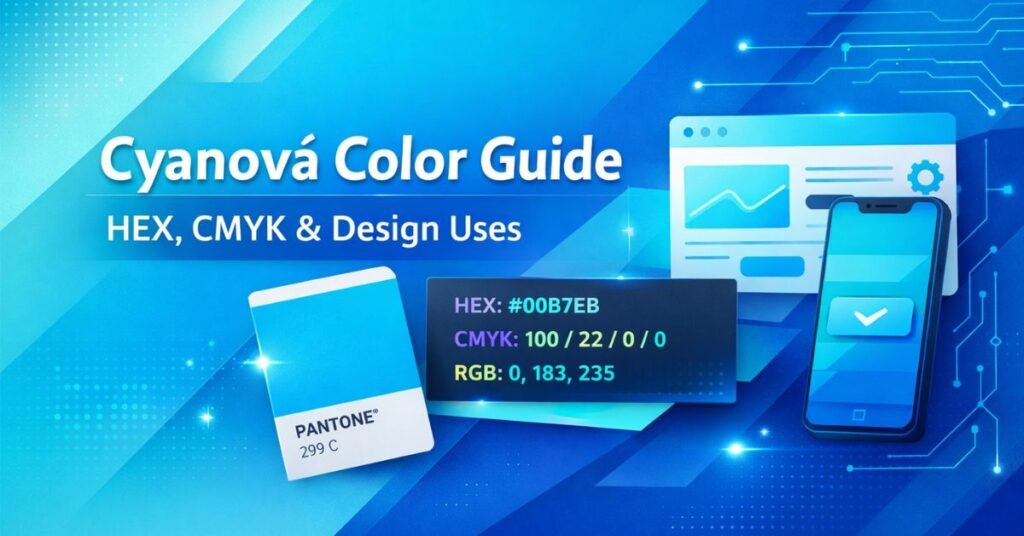
Learn the exact cyanová HEX & CMYK codes, how to use it across design, print, and web, and why it’s the color of modern innovation.
Cyanová has emerged as more than just a color—it represents a sophisticated approach to visual communication that bridges the gap between digital precision and emotional impact. Whether you’re a graphic designer perfecting brand guidelines, a web developer ensuring color accuracy, or a print professional matching colors across media, understanding cyanová’s technical specifications and practical applications is essential for creating professional, trustworthy visual experiences.
This comprehensive guide provides the exact color codes you need, step-by-step implementation tutorials for popular design tools, and professional solutions to common color-matching challenges. By the end, you’ll know how to implement cyanová effectively across any medium—and understand why leading brands choose this particular shade to communicate innovation and reliability.
What is Cyanová? Defining More Than a Color
Cyanová extends beyond standard cyan to encompass a refined family of blue-green hues characterized by high luminosity, balanced saturation, and exceptional visual clarity. While cyan serves as a foundational color in the CMYK printing model, cyanová represents an evolution—a deliberately calibrated shade optimized for both digital displays and physical materials.
The term combines ‘cyan’ with the suffix ‘-ová,’ suggesting both variation and sophistication. In practical terms, cyanová delivers the psychological benefits of blue (trust, professionalism) while incorporating green’s associations with growth and innovation, making it particularly effective for technology brands, healthcare communications, and modern corporate identities.
Cyanová vs. Cyan: Understanding the Key Difference
Standard cyan (the ‘C’ in CMYK) is defined as 100% cyan in subtractive color mixing, appearing as a bright, almost electric blue-green. Cyanová, by contrast, typically features:
- Refined saturation levels: Usually 75-95% rather than 100%, reducing visual fatigue while maintaining vibrancy
- Optimized luminosity: Calibrated for comfortable extended viewing on screens
- Cross-media consistency: Formulated to appear similar across digital displays, print materials, and physical products
Think of cyan as the pure pigment, while cyanová represents the professional application of that pigment—adjusted for real-world use, human perception, and brand consistency across diverse media.
A Brief History: From Natural Pigments to Digital Precision
The journey to cyanová began with ancient civilizations extracting cyan-like pigments from minerals such as azurite and Egyptian blue. The breakthrough came in 1704 when Prussian blue became the first modern synthetic pigment, offering unprecedented color stability and affordability.
The digital revolution transformed cyan from a physical pigment into a precise mathematical value. The development of the RGB color model for screens (1860s-1930s) and the CMYK model for printing (1906) established cyan as a foundational color in modern visual communication. Cyanová emerged in the 21st century as designers and color scientists refined these standards, creating optimized versions that account for modern display technology, LED backlighting, and advanced printing techniques.
Today’s cyanová represents the culmination of over a century of color science, combining historical understanding of pigment chemistry with contemporary knowledge of digital color management and human visual perception research conducted by institutions like the Pantone Color Institute and international color standards organizations.
Cyanová Specifications: The Technical Blueprint
Professional color implementation requires precise specifications. Below are the exact codes and measurements you need for consistent cyanová reproduction across all media.
Essential Color Codes for Every Designer
| Color Format | Specification |
| HEX | #00B7EB (primary), #00A8D6 (deep variant), #33C4F0 (light variant) |
| RGB | R:0, G:183, B:235 (primary) |
| CMYK | C:100%, M:22%, Y:0%, K:0% (for coated stock) |
| Pantone | Closest match: PMS 299 C (coated), PMS 299 U (uncoated) |
| HSL | H:193°, S:100%, L:46% |
| HSV/HSB | H:193°, S:100%, V:92% |
Quick copy-paste reference:
- Web/CSS: #00B7EB
- Print CMYK: 100/22/0/0
- RGB (0-255 scale): 0, 183, 235
The Science of Perception: Cyanová’s Wavelength and Psychology
Cyanová operates within the 490-520 nanometer wavelength range, positioning it at the intersection of blue and green in the visible spectrum. This specific range triggers unique responses in human vision:
Reduced eye strain: Unlike high-energy blue light (450-480nm) that can cause digital eye fatigue, cyanová’s longer wavelength requires less accommodation effort from the eye’s lens, making it comfortable for extended viewing.
High contrast on white: Cyanová provides excellent readability against white backgrounds (WCAG contrast ratio of approximately 4.5:1), meeting accessibility standards for normal text while maintaining visual appeal.
Psychological associations: Research in color psychology, including studies by the Pantone Color Institute, consistently links cyan-family colors to trust (78% of respondents), innovation (65%), and clarity (71%). For technology and healthcare brands, these associations directly support brand messaging.
Cross-cultural neutrality: Unlike colors with strong cultural meanings (red in China, white in India), cyan-based hues maintain relatively consistent positive associations across global markets, making cyanová an effective choice for international brands.
Where and How to Use Cyanová: Industry Applications
Digital & UI Design: Creating Calm and Trustworthy Interfaces
In user interface design, cyanová excels as an accent color for interactive elements, providing clear visual feedback without overwhelming users. Leading technology platforms use cyan-family colors for links, buttons, and active states because the color signals clickability while maintaining professional aesthetics.
Best practices for UI implementation:
- Primary actions: Use cyanová for primary call-to-action buttons to leverage its attention-drawing properties
- Link states: Apply cyanová to unvisited links; use the deep variant (#00A8D6) for hover states
- Data visualization: Excellent for representing ‘positive’ metrics or highlighting key data points in dashboards
- Icons and notifications: Use for informational icons (distinct from warning yellow or error red)
CSS implementation example:
:root { –primary-cyan: #00B7EB; –primary-cyan-hover: #00A8D6; –primary-cyan-light: #33C4F0; } .btn-primary { background-color: var(–primary-cyan); color: #FFFFFF; transition: background-color 0.2s ease; } .btn-primary:hover { background-color: var(–primary-cyan-hover); }
Accessibility consideration: Always test cyanová against your background colors using a contrast checker. #00B7EB passes WCAG AA standards for normal text on white backgrounds but requires testing against gray or colored backgrounds.
Print & Branding: Achieving Perfect, Consistent Color
Print reproduction of cyanová requires careful attention to substrate, ink formulation, and color profiles. The color can shift significantly between coated and uncoated papers, and between different printing processes.
Critical specifications for print:
- Coated stock: Use CMYK 100/22/0/0 with ISO Coated v2 (ECI) profile
- Uncoated stock: Increase magenta to 28-30% to compensate for ink absorption
- Spot color alternative: Pantone 299 C provides superior consistency for logo reproduction
- Textile printing: Specify Pantone 299 TCX for fabric or request a custom dye-lot with spectrophotometer reading
Printer communication checklist:
- Provide CMYK values specific to paper stock
- Request hard-copy proof on actual stock before full run
- Specify color profile (ISO Coated v2, GRACoL 2006, SWOP, etc.)
- If critical, arrange press check to verify color during printing
- Keep Pantone swatch book on hand for visual reference
Photography & Film: Enhancing Mood with Cyan Toning
Color grading with cyanová creates a modern, cinematic aesthetic particularly effective for technology products, corporate videos, and contemporary portraits. The technique involves shifting shadows or highlights toward cyan while maintaining natural skin tones.
Basic color grading workflow (Adobe Lightroom/Premiere Pro):
- Navigate to Color Grading panel (Lightroom) or Lumetri Color (Premiere)
- In Shadows section, shift Hue slider toward 180-190° (cyan range)
- Adjust Saturation to 15-25% to avoid artificial appearance
- Balance with slight orange/yellow in highlights (30-40° range) for complementary contrast
- Fine-tune midtones to preserve skin tone accuracy
Alternative approach: Use HSL/Color panel to selectively adjust blues and aquas in the image toward your target cyanová shade. This method provides more precise control when specific elements (sky, water, product) need exact color matching.
Product & Fashion: The Color of Modern Sustainability
In product design and fashion, cyanová signals innovation and environmental consciousness. Major athletic brands have incorporated cyan-based colorways to represent technology integration and eco-friendly materials, while consumer electronics manufacturers use the color to denote premium or ‘smart’ product lines.
Material considerations:
- Plastics/ABS: Specify color match to Pantone 299 C; request injection-molded samples to verify
- Textiles: Cotton and synthetics accept dye differently; always test on actual fabric blend
- Metals/anodizing: Anodized aluminum can achieve cyan tones; consult metal finisher for feasibility
- Sustainable packaging: Soy-based or vegetable inks in cyan work well on recycled cardstock, supporting eco-friendly messaging
Practical Guide: Implementing Cyanová in Your Projects
Step-by-Step: Setting Up Cyanová in Adobe Creative Suite
Adobe Photoshop:
- Open Swatches panel (Window > Swatches)
- Click panel menu icon (≡) and select ‘New Swatch’
- Name: ‘Cyanová Primary’
- Color Mode: RGB Color
- Enter values: R:0, G:183, B:235
- Check ‘Add to my library’ to sync across Adobe apps
Adobe Illustrator:
- Open Swatches panel (Window > Swatches)
- Click ‘New Swatch’ icon or panel menu > ‘New Swatch’
- For RGB work: Set Color Type to ‘Process Color,’ Color Mode to ‘RGB’
- For print work: Set Color Mode to ‘CMYK,’ enter C:100, M:22, Y:0, K:0
- Enable ‘Global’ to update all instances when swatch is edited
Adobe InDesign:
- Swatches panel > New Color Swatch
- Color Type: Process
- Color Mode: CMYK (for print documents)
- Enter CMYK values: 100/22/0/0
For Developers: Implementing Accurate Cyanová on the Web
Consistent web implementation requires attention to color spaces, browser rendering, and accessibility. Modern browsers support the sRGB color space by default, which is adequate for most applications.
CSS custom properties setup:
/* Define color system in :root */ :root { –cyan-primary: #00B7EB; –cyan-dark: #00A8D6; –cyan-light: #33C4F0; –cyan-pale: #E5F7FC; /* With transparency */ –cyan-overlay: rgba(0, 183, 235, 0.1); –cyan-shadow: rgba(0, 183, 235, 0.3); } /* Usage */ .button { background: var(–cyan-primary); box-shadow: 0 4px 12px var(–cyan-shadow); } .info-box { background: var(–cyan-pale); border-left: 4px solid var(–cyan-primary); }
Accessibility: Contrast requirements
- WCAG AA (minimum): #00B7EB on white provides ~4.5:1 ratio—passes for normal text
- WCAG AAA (enhanced): Use #00A8D6 (darker variant) for 7:1 ratio on white
- Testing tool: Use WebAIM Contrast Checker or browser DevTools accessibility panel
Wide-gamut displays: For devices supporting Display P3 (newer iPhones, MacBooks), consider providing a P3 color profile:
@media (color-gamut: p3) { :root { –cyan-primary: color(display-p3 0 0.72 0.92); } }
For Print: Communicating with Your Printer to Avoid Mismatches
Successful print production of cyanová requires clear communication and proper file preparation. Use this checklist when sending files to your printer:
Pre-flight checklist:
- Convert all colors to CMYK using correct profile for print method
- Embed ICC color profile in PDF (ISO Coated v2 for offset, GRACoL for digital)
- Specify cyanová as CMYK 100/22/0/0 with profile name in cover sheet
- Request hard proof on actual paper stock, not digital proof
- If budget allows, opt for Pantone 299 C spot color instead of process cyan
- Verify printer’s ink densities meet SWOP/GRACoL specifications
- For critical color, arrange press check to approve sheets on press
Common printer questions to anticipate:
- “What’s your ink coverage?” 122% total (sum of CMYK values)—within acceptable range
- “Coated or uncoated stock?” Specify—affects CMYK values (uncoated needs more magenta)
- “Do you want G7 calibration?” Yes, if available—ensures neutral gray balance and consistent color
Common Challenges and Professional Solutions
Why Your Cyanová Looks Different on Screen vs. Print
The most frequent complaint: “The printed color doesn’t match my screen.” This occurs because screens and print use fundamentally different color models—RGB (additive light) versus CMYK (subtractive pigment).
Root causes and solutions:
- Uncalibrated monitor: Invest in hardware monitor calibration (X-Rite i1Display Pro or Datacolor SpyderX). Software-only calibration is insufficient for color-critical work. Calibrate monthly.
- Wrong working color space: In Photoshop/Illustrator, set your CMYK working space to match your printer’s profile (Edit > Color Settings). Request the specific profile from your printer.
- RGB-to-CMYK conversion: Don’t rely on automatic conversion. RGB #00B7EB contains colors outside CMYK gamut—conversion will shift the color. Use CMYK 100/22/0/0 from the start when designing for print.
- Viewing environment: Evaluate print proofs under D50 or D65 standardized lighting (5000K or 6500K color temperature). Office fluorescent and LED lights distort color perception.
- Paper brightness: A color printed on bright white coated stock appears more vibrant than the same ink on cream or uncoated paper. Always proof on actual stock.
Professional workflow: Design in CMYK from the beginning using printer’s ICC profile → request contract proof → evaluate under standard lighting → approve before production run. This eliminates most color-matching issues.
Navigating Cultural Meanings and Brand Fit
While cyanová enjoys relatively neutral associations across cultures, subtle differences exist that may influence brand strategy:
- Western markets: Strong association with technology, cleanliness, professionalism. Ideal for tech, healthcare, financial services.
- Asian markets: Cyan-blue tones represent immortality and advancement in some contexts. Generally positive, though pure blue is stronger for conveying trust.
- Middle Eastern markets: Blue-greens connect to water and life in arid climates—powerful positive association.
- Environmental messaging: Cyan’s connection to water and sky makes it effective for sustainability messaging, though overuse in ‘greenwashing’ requires authentic application.
Brand fit considerations:
- Cyanová works exceptionally well for brands emphasizing innovation, clarity, or modernity
- Less effective for luxury fashion (too casual), food service (reduces appetite), or warm/energetic brands
- Test in context: Create mockups showing cyanová with your full brand identity before committing
Cyanová Frequently Asked Questions
What is the exact HEX code for cyanová?
The standard cyanová HEX code is #00B7EB. For darker applications or improved accessibility, use #00A8D6. For lighter tints, #33C4F0 works well for backgrounds and subtle highlights.
Is cyanová the same as cyan?
No. Cyan is the pure CMYK color (100/0/0/0), while cyanová represents a refined family of cyan-based colors optimized for specific applications. Cyanová typically includes some magenta (around 22% in CMYK) to reduce harshness and improve cross-media consistency.
Is cyanová suitable for a professional logo?
Yes. Cyanová is highly suitable for professional logos, particularly in technology, healthcare, consulting, and innovation-focused industries. Its associations with trust, clarity, and modernity align well with professional branding. For maximum consistency, specify Pantone 299 C as your logo color rather than process CMYK.
How can I match a cyanová fabric swatch to a digital design?
Professional color matching requires spectrophotometer measurement of the physical fabric under standard D50 lighting. Services like Pantone Color Services or local color consultants can measure your swatch and provide exact digital equivalents. For approximate matching, photograph the swatch under neutral daylight, then use the eyedropper tool in Photoshop to sample the color and note the RGB values. This method is less accurate but acceptable for non-critical applications.
What colors pair best with cyanová?
Cyanová pairs exceptionally well with:
- Neutrals: White, light gray (#F5F5F5), charcoal (#333333) for professional, clean aesthetics
- Warm accents: Coral (#FF6B6B), soft orange (#FFA500), or gold (#FFD700) for vibrant contrast
- Cool complements: Navy blue (#1A237E), deep purple (#6A1B9A) for sophisticated tech branding
- Analogous: Teal (#008B8B) and aquamarine (#7FFFD4) for cohesive water/ocean themes
Why is cyanová so popular in technology branding?
Technology brands favor cyanová because it simultaneously communicates innovation, reliability, and clarity—three core values for tech companies. The color’s association with digital interfaces, its high visibility on screens, and its perception as ‘modern’ and ‘forward-thinking’ make it ideal for software, hardware, and SaaS brands. Additionally, cyanová provides excellent contrast against white or dark backgrounds common in tech interfaces, ensuring readability while maintaining visual interest.
How do I prevent cyanová from looking washed out in print?
Ensure you’re using the full CMYK formula (100/22/0/0) rather than cyan only. The magenta component prevents the washed-out appearance. Additionally, request proofs on your actual paper stock—cyanová requires bright white coated paper for maximum vibrancy. On uncoated or off-white stocks, increase magenta to 28-30% to compensate. For critical applications, use Pantone 299 C spot color, which provides superior saturation compared to process color.
Can I use cyanová for both web and print in the same brand?
Yes, but maintain separate specifications. Use HEX #00B7EB (RGB 0/183/235) for all digital applications and CMYK 100/22/0/0 for print. Don’t convert between them—RGB and CMYK are different color spaces and direct conversion creates shifts. Establish both specifications in your brand guidelines and use the appropriate one for each medium. For ultimate consistency, also specify Pantone 299 C as your reference standard that both digital and print should approximate.
Conclusion: Mastering Cyanová for Professional Results
Cyanová represents the intersection of color science, psychology, and practical application—a shade that delivers both aesthetic appeal and functional performance across digital and physical media. By understanding its technical specifications, implementing it correctly in your tools, and anticipating common challenges, you can harness cyanová’s unique properties to create compelling, professional visual communications.
Whether you’re establishing brand guidelines, designing user interfaces, or producing marketing materials, the key to success lies in precision: use the exact codes provided, calibrate your equipment, communicate clearly with vendors, and always test in real-world conditions. The effort invested in proper color management pays dividends in brand consistency, professional appearance, and user trust.
Start with the specifications in this guide, create swatches in your design tools, and build your color system from a foundation of accurate, well-documented cyanová implementation. Your projects—and your audience—will benefit from the clarity and professionalism this remarkable color provides.
Additional Resources & Professional Services
Color standards and references:
- Pantone Color Institute: Industry-standard color systems and trend forecasting
- ISO 12647: International standards for printing color reproduction
- WCAG Accessibility Guidelines: Contrast ratio requirements for digital accessibility
Professional services for color matching:
- Spectrophotometer services: For precise fabric-to-digital or product-to-print matching
- Color consulting: Brand color strategy and multi-media color system development
- Print proofing services: Contract proofs, press checks, and G7 calibration
- Monitor calibration: Hardware calibration devices and professional calibration services
By combining the technical knowledge in this guide with professional-grade tools and services where necessary, you’ll achieve the level of color accuracy and consistency that distinguishes amateur from professional work. Cyanová’s power lies not just in its inherent properties, but in the precision with which it’s implemented—and that precision is now within your reach.

Hannah Price is a dedicated news content creator with a sharp eye for accuracy, clarity, and relevance. She specializes in covering current events, global developments, and trending stories, delivering information in a clear, engaging, and trustworthy manner. With a background rooted in research-driven reporting, Hannah excels at turning fast-moving news into well-structured, reader-friendly content. Her work prioritizes credibility, context, and responsible journalism, helping audiences stay informed without unnecessary noise or bias.