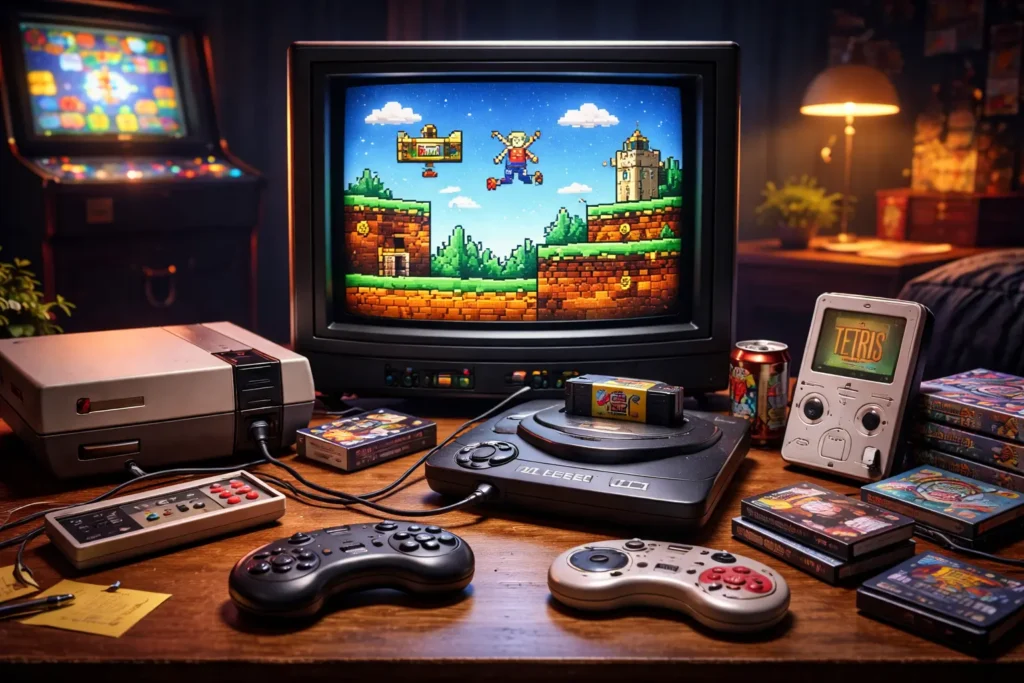
Whether you are a lifelong fan of classic gaming or just discovering the magic of old school games for the first time, retro gaming offers something truly unique: a direct window into the history of interactive entertainment. This guide covers everything from defining what retro gaming actually means, to playing vintage titles today, navigating the legal landscape, building a collection, and even developing your own retro-inspired games.
What Exactly Is Retro Gaming?
Retro gaming is the practice of playing, collecting, and preserving video games and hardware from earlier technological eras. While nostalgia is a powerful motivator, retro gaming is equally about historical preservation and the appreciation of design philosophies that differ fundamentally from modern games.
Defining the Eras: 4:3, 2D, and 16-Bit
The retro gaming umbrella broadly covers the 8-bit era (NES, Commodore 64), the 16-bit era (SNES, Sega Genesis), and the 2D-to-3D transition period of the mid-1990s. Visually, these games are characterized by pixel art, limited color palettes, CRT scanlines, and a 4:3 aspect ratio — all technical constraints that developers turned into an art form.
The 20-Year Rule
A widely accepted benchmark — popularized by the Japanese television series GameCenter CX — holds that a console must be at least 20 years old and commercially discontinued to qualify as “retro.” By this standard, hardware through the original PlayStation (PS1) and Nintendo 64 era firmly qualifies. Fifth-generation consoles and their games are now textbook examples of outmoded hardware that define the retro experience.
Nostalgia vs. Preservation: The Two Audiences
Retro gaming attracts two distinct audiences. The first is driven by nostalgia — a desire to re-experience games from their childhood. The second is motivated by historical archiving and authenticity, treating old games the way film scholars treat classic cinema. Both audiences contribute to remix culture, inspiring modern developers to revisit and reinterpret foundational game design concepts.
How to Play Retro Games Today
There are three main routes to playing retro games in the modern era, each with its own trade-offs in terms of authenticity, cost, and convenience.
Original Hardware: The Vintage Route
Playing on original hardware is the gold standard for authenticity. Cartridge-based games deliver the exact experience intended by developers, including subtle quirks in timing, audio, and physics that emulators sometimes miss. However, the market for vintage hardware has become significantly more expensive.
The COVID-19 pandemic triggered a sharp spike in demand for retro consoles and cartridges, as nostalgia and lockdown boredom drove collectors to revisit childhood favorites. Prices for sealed or graded titles soared dramatically compared to pre-2020 values.
Collectors should also be aware of counterfeit cartridge flooding the market — particularly for popular SNES and Game Boy titles. Always verify board markings, battery types, and label printing quality before purchasing. Trusted grading services like Wata Games can help authenticate high-value finds.
Software Emulation: Legal and Practical Considerations
Software emulation is the most accessible way to play retro games today. Emulators are programs that replicate the behavior of legacy hardware on modern computers or mobile devices. They offer features original hardware cannot, including save states, rewind functions, upscaled graphics, and reduced input latency.
Emulators are entirely legal to create and use. What can be legally problematic is downloading ROM files for games you do not personally own, which constitutes copyright infringement. The key emulation legal precedent is discussed in detail in the Legal Landscape section below.
Popular emulators cover virtually every major platform: RetroArch (multi-system), ZSNES/Snes9x (SNES), PCSX2 (PS2), Dolphin (GameCube/Wii), and MAME (arcade). Each requires the appropriate BIOS files and ROMs to function.
Official Ports, Mini Consoles & Plug-and-Play
The safest and most convenient option for many players is official ports and plug-and-play systems. Nintendo’s NES Classic and SNES Classic mini consoles delivered curated libraries of licensed titles in a plug-and-play format. Sega’s Genesis Mini followed suit. Digital storefronts like Nintendo Switch Online and GOG.com (which offers DRM-free classic PC games) have made hundreds of retro titles legally available.
Mini consoles are particularly valuable for those who want an authentic experience without hunting for original hardware or navigating the ROM scene. Their main limitation is a fixed game library with no expansion option.
The Legal Landscape of Retro Gaming
Understanding the legal framework around retro gaming is essential for collectors, emulation enthusiasts, and developers alike. This area of law is nuanced but has become clearer thanks to several landmark court cases.
The DMCA Exemption and Your Rights
The Digital Millennium Copyright Act (DMCA) generally prohibits circumventing copy-protection technology. However, the U.S. Copyright Office periodically grants exemptions, including for video game preservation. Museums, libraries, and archivists have been granted limited rights to bypass copy protection on games that are no longer commercially available, enabling historical archiving of culturally significant software.
The Connectix Precedent: Why Emulators Are Legal
The cornerstone legal case for emulation is Sony Computer Entertainment Inc. v. Connectix Corp. (2000). Sony sued Connectix for creating a PlayStation emulator called Virtual Game Station. The Ninth Circuit Court of Appeals ruled in favor of Connectix, establishing that reverse engineering for the purpose of creating interoperable software — including emulators — constitutes fair use under copyright law.
This ruling effectively legalized the emulator software industry in the United States. A similar ruling came from Sega v. Accolade, which established that decompiling software to understand its interoperability is permissible under fair use. These cases form the legal bedrock that allows projects like RetroArch, MAME, and Dolphin to operate openly.
Abandonware vs. Piracy
Abandonware refers to software that is no longer sold or supported by its copyright holder. While practically treated as freely available by many enthusiasts, abandonware is not a recognized legal category — copyright protection in the U.S. extends for the life of the author plus 70 years, or up to 95 years for corporate works.
The No One Lives Forever case illustrates the complexity: the game is widely considered abandonware since no active publisher holds clear rights, yet it cannot be legally redistributed without resolving ownership. The practical rule of thumb: if you can legally purchase a game through any legitimate storefront, doing so is the correct approach.
Retro Gaming Collectibles & Market Trends
For many enthusiasts, retro gaming is as much about physical ownership as it is about playing. The collectibles market for retro games and memorabilia has matured into a sophisticated ecosystem with dedicated buyers, sellers, and grading systems.
Rare Finds: From Cartridges to Memorabilia
Beyond games themselves, retro gaming collectibles include a wide range of items: limited-edition figures, arcade tokens, promotional materials, developer prototypes, and branded merchandise. Companies like Limited Run Games and iam8bit have built entire businesses around producing small-batch physical editions of digital titles, catering to collectors who value tangible ownership.
High-value collectibles include factory-sealed cartridges, regional variants, and games with printing errors or variant label runs. Prices at the top end of the market — particularly for sealed NES and SNES titles — can reach tens of thousands of dollars.
Protecting Your Collection
Proper storage is critical for long-term preservation. UV-protective cases prevent label fading from sunlight. Humidity control (ideally 35–50% relative humidity) prevents cartridge PCB corrosion and disc rot in optical media. Temperature stability — avoiding attics and garages — dramatically extends the life of plastic shells and electronic components.
For high-value items, third-party grading through services like Wata Games or VGA (Video Game Authority) provides authenticated condition ratings that are widely recognized in the resale market. Graded games in protective slabs typically command a significant premium over ungraded equivalents.
How to Spot Counterfeit Games
The counterfeit cartridge problem is most acute in the SNES, NES, and Game Boy markets. Key detection methods include:
- Board markings: Authentic boards have specific manufacturer codes; fakes often have generic or misprinted circuit boards.
- Label quality: Official labels use specific printing techniques; fakes often show pixelation, color shifts, or incorrect fonts.
- Screw types: Original Nintendo cartridges use proprietary security screws; fakes often use standard Phillips head screws.
- Battery type: SNES save games use CR2032 batteries soldered in; suspicious solder points or missing batteries indicate a fake.
- Weight and shell texture: Authentic cartridge shells have a specific texture and weight that is difficult to replicate exactly.
Modern Retro: Game Development & Demakes
One of the most exciting developments in contemporary game design is the deliberate revival of retro aesthetics by modern developers. Far from being a limitation, retro constraints have become a creative toolkit.
The Chiptune Revival
Chiptune music — audio created using the programmable sound chips of vintage hardware — has experienced a full cultural renaissance. Artists use original hardware like the Game Boy with LSDJ (Little Sound DJ) software, or compose using modern trackers like Famitracker to produce authentic NES-style soundtracks. The demoscene community — which creates real-time audiovisual presentations on constrained hardware — continues to push the boundaries of what 8-bit and 16-bit audio chips can produce.
Chiptune now appears in mainstream media, indie game soundtracks, and live concert performances. Festivals dedicated to chiptune music operate in Europe, North America, and Japan, reflecting its status as a legitimate musical genre rather than a mere novelty.
Developing “Deliberate Retro” Games
Deliberate retro refers to modern games that intentionally impose technical constraints — limited color palettes, low resolutions, restricted audio channels — to mimic the feel of older hardware. Unlike ports or remakes, these are original games choosing retro aesthetics as an artistic statement.
Cave Story (2004) and Shovel Knight (2014) are landmark examples. Shovel Knight explicitly referenced the NES technical manual during development, restricting itself to a 56-color palette, limiting sprites, and composing music that would theoretically run on authentic NES hardware. Capcom’s Mega Man 9 (2008) went further by releasing a deliberately NES-style game on modern consoles — complete with artificial slowdown and flicker effects.
Best Programming Languages for Retro-Style Game Development
For developers wanting to create retro-inspired games or even program directly for vintage hardware, C remains the foundation — particularly for platforms based on the 6502 and Z80 processors. Assembly language (6502 ASM, Z80 ASM) is required for deep hardware optimization.
For modern retro-style games, Godot Engine has become a popular choice due to its lightweight architecture, excellent 2D tools, and pixel art support. Its GDScript language is accessible for beginners. GameMaker Studio also has a strong track record with pixel art games, powering titles like Undertale and Hotline Miami.
Retro Gaming Community & Cultural Events
Retro gaming is not a solitary pursuit. A rich and globally connected community sustains the culture through events, competitions, online communities, and institutional preservation.
Speedrunning & Competitive Retro Gaming
Speedrunning — completing games as quickly as possible — is one of the most vibrant competitive communities in gaming. Events like Games Done Quick (GDQ) raise millions for charity while showcasing frame-perfect tricks, glitch exploitation, and encyclopedic game knowledge. Twin Galaxies maintains competitive leaderboards for classic arcade titles, and the Classic Tetris World Championship has become a legitimate competitive spectacle with its own broadcast production.
The Fighting Game Community (FGC) has deep roots in retro arcade culture. Street Fighter II and Mortal Kombat defined competitive fighting games in the early 1990s, and both titles remain active in competitive play alongside their modern successors. Understanding this lineage is essential to understanding why certain mechanics and balance decisions in modern fighting games are made the way they are.
Physical Events, Museums & the Hall of Fame
Institutional preservation of gaming history is taken seriously. The Strong National Museum of Play in Rochester, New York, houses the World Video Game Hall of Fame, inducting titles of cultural significance annually. The Computerspielemuseum (Computer Games Museum) in Berlin is Europe’s premier institution dedicated to interactive entertainment history.
Community events include the Portland Retro Gaming Expo, MAGFest, and numerous local conventions where collectors, developers, and players converge to trade, compete, and celebrate gaming history. Online communities on Reddit (r/retrogaming, r/sbc_gaming), Discord servers, and YouTube channels like the Angry Video Game Nerd maintain vibrant ongoing conversations.
faqs
What is considered a retro game?
Generally, consoles that are 20 or more years old and commercially discontinued qualify as retro. This includes all hardware through the fifth generation (PlayStation 1, Nintendo 64) and increasingly the sixth generation (PlayStation 2, GameCube). The 2D era — essentially pre-PS2 — is the most commonly cited cultural boundary.
Is emulation legal?
Emulation software is legal. The Sony v. Connectix ruling (2000) established that creating emulators through reverse engineering constitutes fair use. However, downloading ROM files for games you do not personally own is copyright infringement. Purchasing games through official digital storefronts (Nintendo Switch Online, GOG.com) is the fully legal route for most titles.
Why did retro game prices increase so dramatically?
The COVID-19 pandemic (2020–2021) caused a sharp surge in demand for vintage games and hardware, as nostalgia and extended home time drove people back to childhood favorites. This was compounded by a bubble in graded collectibles, with sealed games reaching record auction prices. Prices have partially normalized since, but remain elevated compared to pre-pandemic levels.
What is the best way to play retro games on a modern TV?
Use a low-latency upscaler such as the RetroTINK 5X or OSSC (Open Source Scan Converter). These devices accept the native composite, S-Video, or RGB output from original hardware and convert it to HDMI with minimal processing delay. Avoid standard HDMI adapters, which introduce noticeable input lag. Portable monitors with native composite inputs are another option for smaller setups.
What is deliberate retro in game development?
Deliberate retro refers to modern games that voluntarily impose graphical or technical constraints — limited color palettes, low screen resolutions, restricted audio channels — to evoke the feel of vintage hardware. Examples include Cave Story, Shovel Knight, and Mega Man 9. It is a conscious artistic choice, not a technical limitation.
Where can I buy or sell retro games safely?
Established marketplaces include eBay (largest selection), PriceCharting.com (price tracking and marketplace), and dedicated retro game stores in most major cities. For high-value transactions, consider graded copies with authentication. Conventions such as the Portland Retro Gaming Expo offer direct person-to-person trading in a community-vetted environment.
What is the difference between a port and a remake?
A port runs the original game code on new hardware with minimal changes — the experience is functionally identical to the original. A remake rebuilds the game from scratch using modern engines, graphics, and sometimes redesigned gameplay (e.g., Resident Evil 2 Remake). A remaster enhances the original assets — higher resolution textures, improved audio — without rebuilding the underlying game.
Final Thoughts
Retro gaming sits at the intersection of personal nostalgia, cultural history, and active creative inspiration. Whether you are hunting for a rare CIB (Complete in Box) SNES cartridge, debating the merits of software emulation vs. original hardware, or designing a pixel art game with a deliberately limited color palette, this community has a place for you.
As of 2026, the retro gaming market continues to mature — with stronger legal frameworks for preservation, growing institutional recognition, and an indie game development scene that consistently draws from the well of classic gaming innovation. The golden era of games is not behind us; in many ways, it is being actively rediscovered and rebuilt.

Adrian Cole is a seasoned content creator specializing in artificial intelligence, emerging technologies, and digital innovation. With a strong passion for breaking down complex technical concepts into clear, practical insights, Adrian helps readers understand how AI is shaping businesses, products, and everyday life. His work focuses on real-world applications of machine learning, automation, SaaS tools, and future tech trends, making advanced technology accessible to both professionals and curious learners. Adrian is known for his balanced, experience-driven approach that blends technical accuracy with human-centered storytelling.