
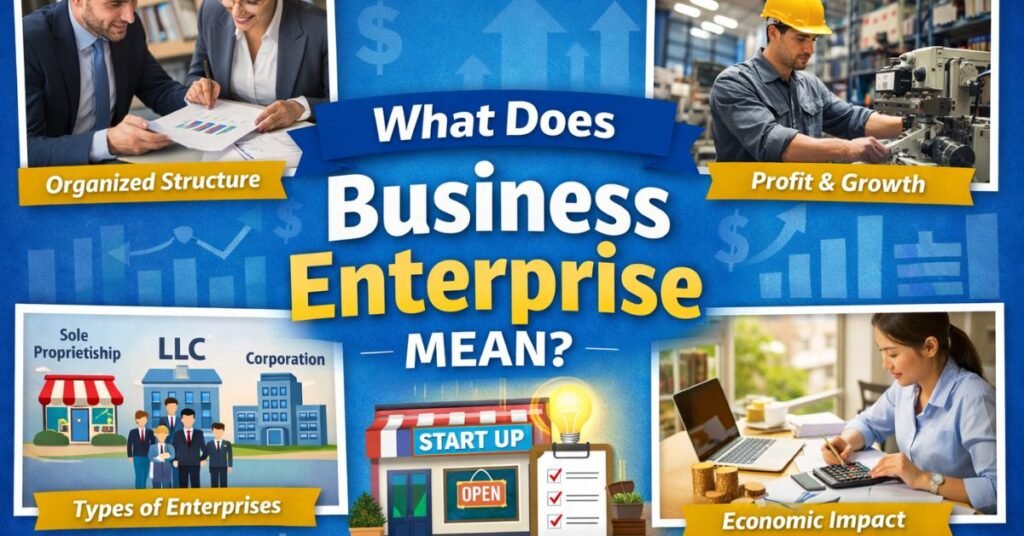
If you’ve ever filled out a loan application, read a government policy, or explored starting your own company, you’ve probably come across the phrase “business enterprise.” And maybe you paused for a second and thought: Wait… what does business enterprise mean exactly? Is it just another word for business? Or something bigger?
You’re not alone.
The term sounds formal. Slightly corporate. Almost intimidating. But in reality, it’s one of the most important concepts in commerce — whether you’re a freelancer working from your kitchen table, a startup founder chasing funding, or a seasoned executive running a multi-branch organization.
In this comprehensive guide, we’re going to unpack exactly what business enterprise means — in plain English. No jargon. No textbook fluff. Just practical, real-world clarity.
By the end, you’ll understand:
- The true definition of a business enterprise
- How it differs from a regular “business”
- The different types of enterprises (small, medium, large)
- Why governments and investors use the term
- How to start your own enterprise step-by-step
- Common mistakes people make
- Tools, structures, and smart decisions to build a sustainable enterprise
Let’s start at the foundation.
What Does Business Enterprise Mean? (Simple Definition)

At its core, a business enterprise is an organized activity or entity that provides goods or services with the goal of earning profit.
Here’s a featured snippet-style definition:
A business enterprise is a legally recognized organization or activity that produces and sells goods or services to customers in order to generate income or profit.
Now let’s break that down.
It has three core ingredients:
- Organized structure
- Economic activity (selling goods or services)
- Profit motive (earning revenue)
If you bake cupcakes for fun and give them to friends, that’s a hobby.
If you bake cupcakes, brand them, price them, and sell them regularly — congratulations — that’s a business enterprise.
But here’s where it gets interesting.
The word “enterprise” usually implies something more structured, strategic, and scalable than a casual side hustle. It suggests systems, planning, operations, and long-term vision.
Think of it this way:
- A “business” can be small and informal.
- A “business enterprise” implies organization, sustainability, and growth intent.
In many legal and economic contexts, “enterprise” refers to the entity itself — not just the activity.
Business vs. Business Enterprise: Is There a Difference?
In everyday conversation, people use “business” and “business enterprise” interchangeably. And in many cases, that’s fine.
But technically speaking, there’s a subtle distinction.
A business is any activity that involves buying and selling goods or services.
A business enterprise refers to the structured organization behind that activity.
Let’s use an analogy.
Imagine a restaurant.
- Cooking and serving food = business activity
- The registered company, staff structure, management system, suppliers, brand identity, accounting system = business enterprise
An enterprise is the full system that makes the business function consistently and legally.
This distinction becomes important in:
- Taxation
- Government policy
- Investment
- Economic development
- Legal compliance
For example, when governments talk about “small and medium enterprises (SMEs),” they’re referring to formally recognized business entities, not casual income activities.
Key Characteristics of a Business Enterprise

To truly understand what business enterprise means, you need to look at its defining features.
Here are the core characteristics:
Organized structure
An enterprise has defined roles, responsibilities, and systems. Even a one-person enterprise has structure — marketing, sales, finance, operations.
Economic activity
It produces goods or services people are willing to pay for.
Profit objective
While nonprofits can be enterprises, traditional business enterprises aim to generate profit or surplus.
Risk-bearing
Every enterprise involves financial risk — investments, expenses, and uncertainty.
Legal recognition
Most enterprises are registered under a legal framework (sole proprietorship, partnership, corporation, etc.).
Continuity
Unlike temporary projects, enterprises are designed for ongoing operation.
When these elements come together, you don’t just have a side gig — you have a business enterprise.
Types of Business Enterprises
Not all enterprises are created equal. They differ in size, ownership, and purpose.
Let’s explore the most common classifications.
Based on Ownership Structure
Sole Proprietorship
Owned and operated by one person. Simple to set up, full control, but personal liability risk.
Partnership
Two or more individuals share ownership, profits, and responsibilities.
Corporation
A legally separate entity from its owners. Offers limited liability and easier capital raising.
Limited Liability Company (LLC)
Hybrid structure combining flexibility and liability protection.
Cooperative
Owned and operated by members for mutual benefit.
Each structure affects taxation, liability, funding opportunities, and governance.
Based on Size
Governments classify enterprises by employee count or revenue:
Micro enterprise
Small-scale, often fewer than 10 employees.
Small enterprise
Usually up to 50 employees.
Medium enterprise
Up to 250 employees (varies by country).
Large enterprise
250+ employees and substantial revenue.
This classification matters for:
- Tax benefits
- Grants
- Loans
- Policy incentives
Why the Term “Business Enterprise” Matters in the Real World
You might wonder — why not just say “business”?
Here’s why the term matters:
Government Programs
When applying for SME loans or grants, eligibility is based on enterprise classification.
Investors and Banks
Financial institutions assess enterprise structure, not just sales activity.
Legal Protection
Enterprise registration protects your assets and establishes credibility.
Scaling and Growth
An enterprise mindset focuses on systems and long-term strategy.
Economic Impact
Policymakers analyze enterprise growth to measure economic health.
In short, “enterprise” signals seriousness, structure, and sustainability.
Benefits of Running a Business Enterprise
Let’s move beyond definitions and talk real-life benefits.
Financial Independence
A structured enterprise creates predictable revenue streams. Instead of relying solely on employment income, you build asset-based income.
Scalability
Enterprises can expand — more locations, products, staff, markets.
Asset Creation
A business enterprise can be sold. That means you’re building something with equity value.
Employment Generation
You create jobs and contribute to your local economy.
Personal Freedom
Yes, entrepreneurship is demanding — but it gives you autonomy over decisions and direction.
Real-World Use Cases of Business Enterprises
To truly understand what business enterprise means, let’s look at practical examples.
Freelancer to Enterprise
A freelance graphic designer registers a company, hires subcontractors, develops systems — now it’s a design enterprise.
E-commerce Store
Someone selling products online through structured inventory, branding, and logistics.
Manufacturing Company
Produces goods at scale with supply chains and workforce.
Service Firm
Consulting, accounting, marketing agencies operating under structured models.
Tech Startup
Develops software with investment backing and operational teams.
Different industries. Same enterprise foundation.
Step-by-Step Guide: How to Start a Business Enterprise
Let’s get practical.
If you want to build your own enterprise, follow this structured process.
Step 1: Identify a Profitable Idea
Solve a real problem. Validate demand before investing heavily.
Step 2: Conduct Market Research
Understand competitors, pricing models, customer needs.
Step 3: Choose Legal Structure
Consult a professional if needed. Consider liability, tax, scalability.
Step 4: Register Your Enterprise
Obtain licenses, permits, and tax identification numbers.
Step 5: Create a Business Plan
Outline operations, marketing, revenue projections.
Step 6: Secure Funding
Self-funding, loans, investors, grants.
Step 7: Build Systems
Accounting, marketing, operations, customer service.
Step 8: Launch and Iterate
Start lean. Improve based on feedback.
Pro Tip: Systems build enterprises. Hustle starts businesses.
Tools, Comparisons & Recommendations
Building an enterprise requires tools.
Accounting
Free: Wave
Paid: QuickBooks, Xero
Project Management
Free: Trello
Paid: Asana, Monday.com
Marketing
Free: Canva
Paid: HubSpot
E-commerce
Shopify vs WooCommerce comparison
Shopify: easier setup, monthly cost
WooCommerce: flexible, requires technical management
Choose tools based on scalability, not just price.
Common Mistakes in Building a Business Enterprise
Underestimating Legal Structure
Fix: Get professional advice early.
Mixing Personal and Business Finances
Fix: Open separate bank accounts.
No Clear Value Proposition
Fix: Define exactly who you serve and why.
Poor Cash Flow Management
Fix: Forecast monthly expenses and revenue.
Scaling Too Fast
Fix: Build stable systems before expansion.
Ignoring Compliance
Fix: Stay updated with tax and regulatory requirements.
Enterprise vs Entrepreneurship: Are They the Same?
Entrepreneurship is the act of creating and running a new business.
A business enterprise is the structured entity that results from entrepreneurship.
One is the mindset and process.
The other is the operational outcome.
The Role of Business Enterprises in the Economy
Business enterprises drive:
Innovation
Employment
Tax revenue
Infrastructure development
Economic growth
In most countries, SMEs make up over 90% of total enterprises — showing how vital they are to economic ecosystems.
Conclusion
So, what does business enterprise mean?
It means more than just selling something. It means creating an organized, structured, legally recognized system designed to generate value and profit over time.
A business enterprise is about sustainability. Systems. Growth. Strategy.
Whether you’re launching a small side hustle or building a scalable company, understanding the enterprise concept changes how you think — and how you build.
If you’re serious about long-term success, don’t just start a business.
Build an enterprise.
Now I’d love to hear from you — are you running a business already, or planning to start one?
FAQs
What is the simple definition of business enterprise?
A business enterprise is an organized entity that produces and sells goods or services to earn profit.
Is a small shop a business enterprise?
Yes, if it is organized and operates regularly with the intention of earning profit.
What are the main types of business enterprises?
Sole proprietorship, partnership, corporation, LLC, cooperative.
Why is enterprise important in business?
It implies structure, legal recognition, scalability, and sustainability.
Can a freelancer be considered a business enterprise?
Yes, if they operate in a structured, profit-oriented manner.