
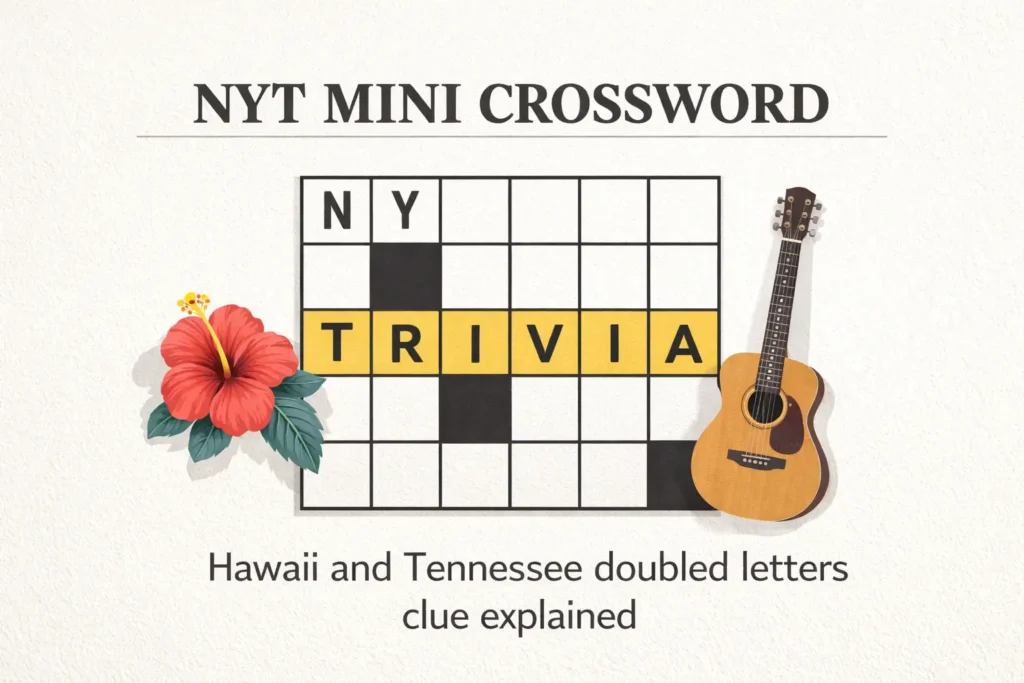
The NYT Mini Crossword often disguises simple answers behind clever phrasing, and this clue is a textbook example. At first glance, the sentence reads like a straightforward geography question. However, seasoned solvers know that when a clue appears to state a fact rather than ask a question, it’s usually doing something more subtle.
The clue doesn’t include question marks, blanks, or prompts such as “Which state…” or “Name the state…”. Instead, it presents a complete, declarative sentence. This structural choice is intentional and acts as the first hint that the answer will not be a proper noun like “Hawaii” or “Tennessee.”
The six-letter length of the answer space further narrows the possibilities. Most U.S. states won’t fit, but abstract nouns like fact, detail, or trivia suddenly come into play. When solvers connect the content of the statement with the nature of crossword clues, the answer becomes clear.
Why “TRIVIA” Is the Correct Answer (Expanded)
This clue works because it operates on a meta level—a common but powerful crossword technique. Instead of asking for data, it asks you to classify the data.
The information about Hawaii and Tennessee:
- Is accurate
- Is unusual
- Is memorable
- Is not practically necessary
That combination defines trivia perfectly.
In crossword logic, clues often fall into one of three categories:
- Literal – asking directly for a thing
- Descriptive – hinting at a thing
- Categorical – asking what kind of thing something is
This clue is firmly in category three.
The “aha” moment comes when solvers realize the puzzle isn’t testing geography knowledge at all. It’s testing interpretive thinking. This approach is particularly popular in the Mini Crossword, where constructors aim to surprise without overwhelming solvers.
The NYT Mini Crossword Logic Behind It (Expanded)
New York Times crossword constructors are masters of misdirection. One of their favorite techniques is presenting information that looks important—but isn’t the answer itself.
In this case:
- The states are examples, not answers
- The doubled letters are details, not the solution
- The real answer is the label for the information
This is similar to clues that list examples and expect answers like:
- “Category”
- “Fact”
- “Joke”
- “Myth”
- “Trivia”
Once solvers recognize this pattern, they start spotting it everywhere. That recognition is one of the biggest milestones in becoming a confident crossword solver.
Verifying the Clue’s Accuracy: Do Only Hawaii and Tennessee End With Doubled Letters? (Expanded)
Crossword clues are almost always fact-checked, and this one holds up under scrutiny.
When you scan all 50 U.S. state names carefully, you’ll notice:
- Several contain double letters in the middle
- A few end with vowels
- Only two end with repeated identical letters
Hawaii
The name “Hawaii” ends in ii, a feature rooted in the Hawaiian language. Hawaiian words commonly end in vowels, and the repetition reflects pronunciation rather than English spelling conventions.
Tennessee
“Tennessee” ends in ee, a result of its Cherokee linguistic origins and English transliteration practices. The spelling emphasizes the long “e” sound at the end of the name.
No other U.S. state matches this pattern. That specificity makes the fact crossword-worthy.
Why This Makes Great Crossword Material (Expanded)
Crossword puzzles thrive on exceptions, not rules. Facts that break patterns are far more interesting than those that follow them.
This clue succeeds because it:
- Highlights an anomaly
- Is easy to explain once revealed
- Encourages learning without frustration
It also rewards solvers who enjoy:
- Language patterns
- Spelling quirks
- Geography trivia
For constructors, it’s ideal: short, accurate, clever, and memorable.
A Closer Look at Orthographic Quirks (Expanded)
Orthography—the study of spelling—plays a huge role in crossword construction. Puzzles don’t just test what words mean, but how they look.
Endings like:
- “ii”
- “ee”
- “oo”
- “ss”
stand out visually, which makes them valuable puzzle elements. Constructors often scan word lists for unusual letter sequences because they add texture and variety to grids.
In this case, the doubled letters at the end of the words are especially striking. That’s why this fact feels puzzle-ready—it’s visually distinctive, not just conceptually interesting.
More Fun U.S. State Name Trivia (Expanded)
State names are a goldmine for crossword trivia. They combine geography, linguistics, history, and spelling quirks—all things crossword constructors love.
Maine: The Only One-Syllable State (Expanded)
“Maine” stands alone among all 50 states. Every other state name has at least two syllables, which makes Maine uniquely useful in crossword grids when space is tight.
This fact frequently appears in:
- Crossword clues
- Trivia quizzes
- Linguistics discussions
States That Start and End With the Same Letter (Expanded)
Alabama, Alaska, Arizona, and Ohio form a neat little group. These symmetry-based facts are especially popular in themed puzzles, where patterns matter more than definitions.
Constructors often rely on these patterns to create satisfying “aha” moments.
Hawaii’s Other Oddities (Expanded)
Hawaii’s spelling quirks go beyond doubled letters. Its heavy vowel usage and lack of certain consonants make it stand out in English.
Facts like these are rarely useful—but that’s exactly what makes them trivia.
The Letter “Q” and U.S. States (Expanded)
The absence of the letter Q across all U.S. state names is one of those facts that sounds made up—until you check.
Crosswords love negative facts like this because they:
- Surprise solvers
- Feel counterintuitive
- Are easy to verify
Longest and Most Complex State Names (Expanded)
Length-based trivia plays well in puzzles, especially when constructors need to fill long slots.
“West Virginia” stands out for having multiple words, while names like “Massachusetts” push letter limits and challenge solvers’ spelling confidence.
Why the NYT Mini Crossword Loves This Kind of Clue (Expanded)
The Mini Crossword is designed to be:
- Approachable for beginners
- Clever enough for veterans
- Finished in under five minutes
Clues like this strike that balance perfectly. They don’t require memorization or obscure knowledge—just careful reading and logical thinking.
That’s why solvers often remember Mini clues long after finishing the puzzle.
Tips for Solving Future NYT Mini Crossword Puzzles (Expanded)
Look for Meta-Clues (Expanded)
If a clue feels like a statement, not a question, pause. Ask yourself whether the puzzle wants:
- A category
- A description
- A label
This habit alone can dramatically improve solving speed.
Use the Grid to Your Advantage (Expanded)
Because the Mini grid is small, letters overlap heavily. One strong answer can unlock half the puzzle. Don’t be afraid to skip a clue and come back once you have crossing letters.
Think About Wordplay (Expanded)
NYT crosswords are famous for rewarding flexible thinking. If your first interpretation doesn’t work, try a second—and a third.
Often, the simplest reading is the wrong one.
Final Thoughts (Expanded)
This clue about Hawaii and Tennessee captures everything that makes crosswords fun: curiosity, cleverness, and clarity once explained.
The answer—TRIVIA—is more than correct. It reflects the spirit of crossword puzzles themselves: learning something delightful you didn’t know you didn’t need.
Keep spotting clues like this, and you’ll not only solve faster—you’ll enjoy the journey more. 🧩✨

Adrian Cole is a seasoned content creator specializing in artificial intelligence, emerging technologies, and digital innovation. With a strong passion for breaking down complex technical concepts into clear, practical insights, Adrian helps readers understand how AI is shaping businesses, products, and everyday life. His work focuses on real-world applications of machine learning, automation, SaaS tools, and future tech trends, making advanced technology accessible to both professionals and curious learners. Adrian is known for his balanced, experience-driven approach that blends technical accuracy with human-centered storytelling.