
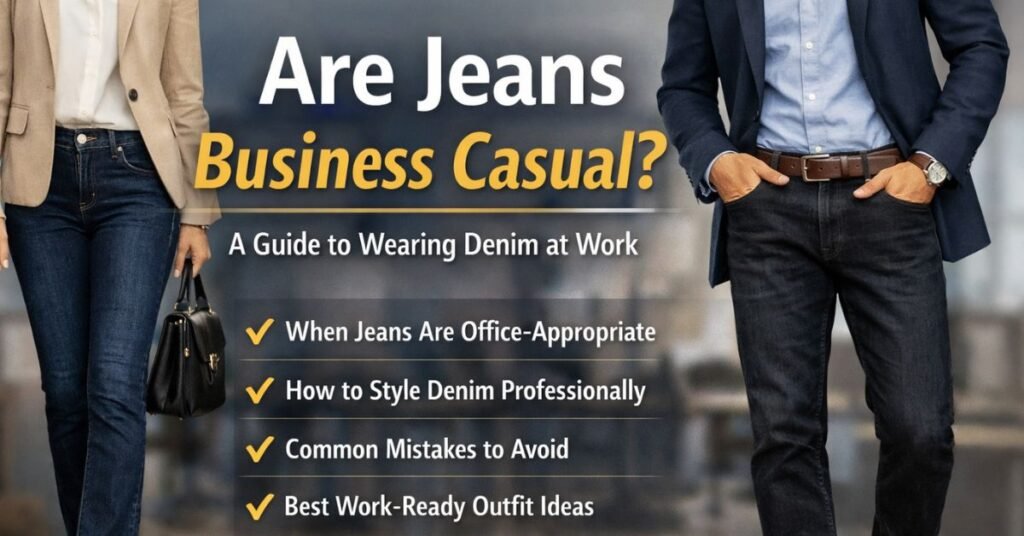
If you’ve ever stood in front of your closet on a Monday morning wondering, “Are jeans business casual?”—you’re definitely not alone. Dress codes have become blurrier than ever. Offices mix startup energy with corporate expectations, remote work reshapes norms, and suddenly the line between “too casual” and “perfectly professional” feels confusing.
The truth is simple but nuanced: yes, jeans can be business casual—but only when styled, fitted, and chosen correctly. And that small word “correctly” is where most people get stuck.
This guide breaks everything down in clear, practical terms. You’ll learn what business casual really means today, when denim is appropriate, which styles look polished instead of sloppy, and exactly how to build work-ready outfits around jeans. By the end, you won’t just know the rules—you’ll know how to bend them with confidence.
Understanding What Business Casual Really Means Today
Before deciding whether jeans fit the dress code, we need to unpack what business casual actually means—because the definition has changed dramatically over the past decade.
Traditionally, business casual described clothing that sat between formal office wear and relaxed weekend outfits. Think slacks instead of suits, button-downs instead of T-shirts, loafers instead of sneakers. Denim was usually excluded because it symbolized leisure rather than professionalism.
But modern workplaces aren’t static. Tech companies normalized hoodies and sneakers. Creative agencies embraced personal style. Even conservative industries relaxed policies after remote work shifted expectations. As a result, business casual has become less about specific garments and more about overall presentation.
Today, most employers evaluate three key factors:
- Neatness and structure
- Professional impression
- Appropriateness for the workplace culture
If jeans meet those criteria, they often pass the business casual test.
This shift explains why one office allows dark denim daily while another restricts jeans to Fridays. The phrase “business casual” is no longer universal—it’s contextual. Understanding your environment matters just as much as choosing the right outfit.
So… Are Jeans Business Casual? The Short Answer Explained
Let’s answer the core question directly: are jeans business casual?
Yes—when they are:
- Dark-washed or black
- Well-fitted (not baggy or skin-tight)
- Free of rips, distressing, or fading
- Styled with polished, work-appropriate pieces
No—when they are:
- Torn, frayed, or heavily distressed
- Extremely tight or saggy
- Light-washed, acid-washed, or overly trendy
- Paired with casual items like graphic tees or flip-flops
Think of jeans as a neutral canvas. The denim itself isn’t automatically casual—the styling determines the professionalism.
A dark, tailored pair worn with a blazer and leather shoes can look sharper than wrinkled dress pants with sneakers. Context transforms the garment.
This is why blanket statements like “jeans aren’t professional” feel outdated. Modern dress codes care more about intention and polish than strict fabric categories.
The Evolution of Denim in Professional Settings
Denim didn’t start in boardrooms. It began as durable workwear for miners and laborers in the 19th century—clothing built for toughness, not meetings. Over time, jeans became symbols of rebellion, youth culture, and casual freedom.
For decades, that cultural association kept denim out of professional environments. Wearing jeans to the office once signaled disrespect or lack of seriousness.
Then workplace culture shifted.
Three major changes pushed denim into business casual territory:
First, Silicon Valley disrupted dress norms. When billion-dollar founders wore jeans to investor meetings, professionalism became linked to performance rather than clothing.
Second, remote work blurred boundaries. Employees accustomed to comfort expected similar flexibility when returning to offices.
Third, generational turnover introduced new expectations. Younger professionals value authenticity and practicality over rigid formality.
The result? Denim slowly transitioned from forbidden to acceptable—at least in many industries.
Yet acceptance isn’t universal. Finance, law, and government still lean conservative. Creative, tech, and marketing roles are far more flexible. Knowing where your workplace sits on that spectrum is essential.
When Jeans Absolutely Work in a Business Casual Environment
There are clear scenarios where wearing jeans is not only acceptable but completely normal.
Casual office cultures top the list. Startups, digital agencies, and creative teams often treat dark denim as standard daily wear. In these spaces, jeans paired with smart layers look perfectly professional.
Casual Fridays are another obvious moment. Even traditional companies frequently allow denim at the end of the week. The key is keeping the rest of the outfit polished so the look reads intentional rather than lazy.
Client-free workdays also provide flexibility. If you’re not meeting external partners or senior leadership, dark jeans with structured pieces usually pass unnoticed.
Travel days and conferences can allow jeans too—especially in industries where comfort and mobility matter. Many professionals choose sleek black denim instead of trousers for long flights or event days.
The common thread across all these situations is balance. Jeans succeed when the rest of the outfit communicates competence and professionalism.
Situations Where Jeans May Not Be Appropriate
Just as important as knowing when jeans work is recognizing when they don’t.
Formal meetings remain the biggest caution zone. Presentations to executives, high-stakes client pitches, or interviews typically call for more traditional attire. Even perfect denim can feel slightly underdressed in these moments.
Conservative industries also maintain stricter norms. Banking, law, insurance, and government offices often interpret business casual more formally than creative sectors. In these environments, jeans might only appear on designated casual days—if at all.
Ceremonial or public-facing events present another risk. Conferences, award ceremonies, and networking receptions usually reward slightly elevated dressing. Trousers or tailored skirts offer safer choices.
Finally, company culture always overrides general advice. If leadership never wears jeans, that silence communicates a rule more clearly than any handbook.
Reading the room matters more than any fashion guideline.
Choosing the Right Jeans for Work
Not all denim is created equal. The difference between casual jeans and business casual jeans comes down to subtle details.
Color is the first and most critical factor. Dark indigo, navy, charcoal, and black denim look structured and refined. Light blue or faded washes instantly feel more relaxed.
Fit comes next. Tailored silhouettes—straight, slim, or gently tapered—appear intentional and polished. Baggy, low-rise, or ultra-skinny extremes rarely look professional.
Fabric quality also plays a role. Thicker denim with minimal stretch holds shape better and resembles traditional trousers from a distance.
Equally important is condition. Work-appropriate jeans should be:
- Clean and wrinkle-free
- Free from holes or distressing
- Properly hemmed
- Structured at the waistband
Think of them as “denim trousers” rather than weekend jeans. That mental shift helps guide better choices.
How to Style Jeans So They Look Professional
Styling is where business casual denim truly comes to life.
Start with structured tops. Button-down shirts, blouses, knit polos, and fine sweaters instantly elevate jeans. These pieces create visual balance between casual and professional.
Layering adds polish. Blazers, tailored cardigans, and lightweight jackets transform denim into office-ready outfits. A blazer alone can shift the entire impression from relaxed to refined.
Footwear matters more than most people realize. Leather loafers, ankle boots, brogues, and minimalist dress sneakers maintain professionalism. Flip-flops, running shoes, and overly chunky sneakers undo it.
Accessories should stay intentional and simple. Leather belts, classic watches, and understated jewelry complete the look without distraction.
The easiest formula to remember:
Dark jeans + structured top + tailored layer + polished shoes = business casual success.
Step-by-Step Guide to Wearing Jeans at Work Confidently
If you want a clear process, follow this simple step-by-step approach.
Step one: Check your workplace culture. Observe what managers and respected colleagues wear. Their choices reveal the real dress code.
Step two: Choose dark, clean, well-fitted jeans. Avoid distressing, fading, or experimental cuts.
Step three: Pair them with professional basics. Think button-downs, blouses, sweaters, or knit polos.
Step four: Add structure through layering. A blazer or tailored cardigan instantly signals intention.
Step five: Finish with polished footwear and minimal accessories.
Step six: Do a mirror test. Ask yourself: would this outfit feel appropriate in an unexpected meeting with leadership? If yes, you’re set.
This method removes guesswork and builds consistent confidence.
Comparing Jeans to Other Business Casual Bottoms
Understanding how jeans stack up against alternatives helps clarify their role.
Dress pants remain the safest option. They communicate professionalism instantly and work across nearly all industries.
Chinos offer a middle ground. Slightly relaxed but still structured, they’re widely accepted in business casual settings.
Tailored skirts and dresses provide versatility, especially in warmer climates or formal offices.
Jeans sit at the most casual end of the business casual spectrum. That doesn’t make them wrong—it just means styling and context matter more.
Think of workplace bottoms like a spectrum:
Formal → dress pants
Balanced → chinos
Relaxed professional → dark jeans
Choosing where to land depends on environment and occasion.
Tools and Smart Shopping Tips for Work-Ready Denim
Finding the right jeans becomes easier with a strategic approach.
Start by identifying reliable brands known for clean, structured denim rather than trend-driven distressing. Look for consistent sizing, durable fabric, and minimal branding.
Tailoring is an underrated tool. A simple hem or waist adjustment can transform average jeans into perfectly fitted workwear.
When comparing budget vs. premium denim:
Affordable options often work well for occasional wear but may fade faster.
Mid-range jeans usually balance durability and price.
Premium denim offers superior fabric and longevity, making sense for frequent office use.
Owning two or three high-quality pairs often works better than rotating many mediocre ones.
Common Mistakes People Make with Business Casual Jeans
Even when jeans are allowed, small missteps can undermine professionalism.
One of the biggest mistakes is choosing overly distressed denim. Rips, fraying, and fading instantly signal casual wear.
Another issue is poor fit. Jeans that sag, bunch, or squeeze distract from an otherwise polished outfit.
Pairing jeans with overly casual tops—like hoodies or graphic tees—creates imbalance. The entire outfit slides toward weekend territory.
Ignoring footwear is another frequent error. Athletic sneakers can downgrade even the best denim.
Finally, assuming all offices share the same rules leads to awkward moments. Context always wins.
Avoiding these mistakes keeps denim working in your favor.
Real-Life Outfit Ideas That Always Work
Sometimes examples make everything clearer.
For a classic professional look:
Dark slim jeans, white button-down shirt, navy blazer, brown leather loafers.
For a smart casual office:
Black jeans, fine knit sweater, tailored coat, ankle boots.
For a creative workplace:
Dark straight-leg jeans, minimal tee, structured blazer, clean leather sneakers.
For cooler weather:
Indigo jeans, turtleneck sweater, wool blazer, Chelsea boots.
Each outfit balances comfort and credibility—exactly what business casual aims to achieve.
Conclusion: Confidence Matters More Than Fabric
So, are jeans business casual?
Yes—when chosen thoughtfully, styled intentionally, and worn in the right environment.
Modern workplaces care less about rigid clothing rules and more about professionalism, respect, and presentation. Dark, well-fitted denim paired with structured pieces easily meets those expectations in many offices today.
The real takeaway isn’t just about jeans. It’s about understanding context, reading culture, and dressing with quiet confidence.
Once you master that balance, getting dressed for work becomes simpler—and far less stressful.
FAQs
Are dark jeans considered business casual?
Yes. Dark, clean, well-fitted jeans without distressing are widely accepted in many business casual workplaces.
Can you wear black jeans to the office?
Black jeans are often the safest denim choice because they resemble dress pants and look more formal.
Are ripped jeans ever appropriate for business casual?
Generally no. Distressing makes jeans appear too casual for professional environments.
What shoes should you wear with business casual jeans?
Loafers, ankle boots, brogues, and minimalist leather sneakers work best.
Do all offices allow jeans in business casual dress codes?
No. Acceptance varies by industry, company culture, and occasion.






На данном портале есть возможность встретить много полезных статей.
Здесь размещены самые разные заметки на актуальные вопросы.
Любой гость сможет изучить немало полезного и расширить свой понимание.
Материалы периодически пополняются, дабы посетители всегда располагали доступ к наиболее актуальной базе.
https://sakhaday.ru/news/psihologicheskiy-test-po-kartinke-chto-vy-uvideli-pervym-4
На нашем веб-сайте вы сможете почерпнуть огромное количество увлекательных публикаций.
На страницах ресурса доступны различные исследования на животрепещущие направления.
Всякий пользователь сможет изучить много нового и пополнить свой понимание.
Статьи периодически обновляются, дабы пользователи всегда располагали возможность к самой свежей базе.
https://sakhaday.ru/news/kabachki-kak-gruzdi-po-vkusu-ne-otlichish-recept-zakrutki-na-zimu
Утепление выполняет ключевую роль в удержании тепла внутри дома.
Качественная защита помогает заметно уменьшить расходы на обогрев и охлаждение зданий.
https://fsfr-vkr.ru/read-full/2353-ustoychivost-k-ognyu-kak-mbo-zashchishchaet-konstruktsii-ot-pozharov.html
Кроме того, изоляция препятствует появление влаги, плесени и промерзания конструкций.
Следовательно, грамотная изоляция создаёт энергоэффективность и благоприятный климат в здании.
Утепление играет ключевую функцию в поддержании комфортной температуры внутри здания.
Надёжная изоляция позволяет значительно уменьшить расходы на обогрев и охлаждение помещений.
https://shambhala-center.ru/info-bulletin/2026-09-23-primenenie-kauchukovoy-izolyatsii-v-morskoy-otrasli-zashchita-ot-korrozii-i-mekhanicheskikh-povrezhdeniy.htm
Более того, утепление защищает от образование конденсата, грибка и промерзания стен.
В итоге, правильная изоляция гарантирует экономию ресурсов и уютный микроклимат в доме.
Тут сайте можно получить интересную информацию.
https://sorrybabushka.ru/interesting/518-otzyvy-realnykh-igrokov-o-randx-casino-plyusy-problemy-rekomendatsii.html
На данном веб-сайте можно отыскать нужную информацию.
https://rosotels.ru/detail/2026-07-16-ukraina-i-devyat-evropeyskikh-gosudarstv-obedinyayutsya-v-antiballisticheskuyu-koalitsiyu-posledstviya-dlya-rossii.htm
Readers manga titles can conveniently unblocked manga to explore favorite stories. The catalog offers science fiction, allowing every reader can find a favorite genre. Latest episodes help readers follow the story
More useful tips at the link how to open a company in montenegro
Zodpovědné hraní je považováno za princip, který má za cíl zachovat sázení jakožto způsob zábavy, ne jako zdroj závislosti.
To předpokládá stanovení vlastních hranic na čas a sázky, stejně jako identifikaci raných signálů rizikového sázení.
https://my-qazaqstan.forumotion.me/t1440-mostbet-%D0%BF%D0%BB%D0%B0%D1%82%D1%84%D0%BE%D1%80%D0%BC%D0%B0-%D0%BA%D0%BE%D1%82%D0%BE%D1%80%D0%B0%D1%8F-%D1%80%D0%B0%D0%B4%D1%83%D0%B5%D1%82-%D0%B8%D0%B3%D1%80%D0%BE%D0%BA%D0%BE%D0%B2-%D1%83%D0%B6%D0%B5-%D0%B1%D0%BE%D0%BB%D1%8C%D1%88%D0%B5-%D0%B4%D0%B5%D1%81%D1%8F%D1%82%D0%B8-%D0%BB%D0%B5%D1%82#2235
V konečném důsledku podporuje uvědomělá volby a pomáhá účastníkům zachovat kontrolu nad svým hazardem.
Smyslem těchto zásad je podpořit mentální rovnováhu a ekonomickou jistotu jednotlivého účastníka.
Find convenient https://conversionweb.github.io/conversion for checking calculation results. Convert temperature, area, and distance in a convenient online format. Using the converter, you can avoid errors when converting values. Select the desired category and perform the conversion.
Receive https://sportsserbia.website.yandexcloud.net for fans and sports enthusiasts. Compare tournament results. Study the latest sports news. Championship tables reflect changes in the tournament race. Choose the sport you’re interested in and find out the latest results.
Stay informed ports website yandexcloud with live data updates. Learn team statistics. Read match analysis. Team rankings reflect changes in the championship. Follow your favorite teams without having to search for information on different resources.
Гончарный круг https://goncharnaya-masterskaya-moskva.ru
Your 77007 Guide https://77007guide.com is a go-to resource for clear, easy-to-read explanations of everyday topics. Explore articles on finance, health, technology, culture, and more. We break down complex terms and ideas into simple answers, so you can learn something new and make informed decisions quickly.
Не знаете, где создать вишлист? https://medium.com/@coger.dirk/сервисы-вишлистов-в-россии-сравнение-и-выбор-f94c0fcd14e2 Собрали топ сервисов и приложений 2026 года: с поддержкой любых магазинов, бронированием подарков и удобными общими списками. Выбирайте платформу под свою задачу — от семейных праздников до корпоративных регистров.
Найдите для себя натуральную косметику https://musco.ru для создания собственной системы ухода. В линейке можно найти продукты для личного ухода. Изучайте доступные косметические решения. Сравнивайте индивидуальные потребности. Выберите продукты для своей косметички с учетом своих предпочтений.
выбор картины для интерьера: На практике выбор картины для интерьера начинается с комнаты, в которой вы будете видеть работу каждый день.
Обратитесь в профильном роспромтест отзывы для сертификации товаров и оборудования. Консультанты разъяснят какие документы необходимы. На этапе первичной консультации подбирается подходящая схема оценки соответствия. Оставьте заявку для подготовки к процедуре сертификации.
Рассмотрите варианты производство одежды сертификация для легального обращения продукции. Консультанты объяснят какие документы необходимы. При оценке конкретной товарной группы уточняют перечень документов. Запросите расчет стоимости с учетом категории товара и требований законодательства.
ai nude generator remove clothes from photo ai
Нужны скины? https://lis-skins.cc по выгодным ценам — большой выбор популярных предметов для Counter-Strike 2. Найдите редкие ножи, перчатки, оружие и другие скины для игры. Быстрая покупка, удобный каталог и актуальные цены на скины CS2.
Нужны скины? tradeit обменивайте скины CS2, Rust, Dota 2 и TF2 быстро и выгодно! Удобный обмен игровыми предметами, широкий выбор скинов, выгодные предложения и безопасные сделки. Покупайте, продавайте и обменивайте скины на одной платформе.
Закажите организованное складские услуги москва при необходимости временного размещения товара. Складское хранение дает возможность сократить нагрузку на складскую инфраструктуру. На складе принимают товарные запасы. В зависимости от условий могут выполняться комплектация заказов. Для дистрибьютора это удобный способ обеспечить размещение товара до дальнейшей отгрузки.
где купить дакимакуру https://podushka-dakimakura.ru
The strongest way to evaluate google ads agency near me is to look beyond rankings and compare process, transparency, specialization, and account control. E-commerce brands should ask about feed health, profit data, product segmentation, Shopping structure, and performance by product category. The final decision should match business model, internal resources, budget, sales process, and the level of support required.
The strongest evaluation of where to buy tiktok likes focuses on service terms, review patterns, customer support, payment protection, and compatibility with platform policies. Claims about real users deserve scrutiny because labels alone do not prove genuine interest, watch time, comments, or future engagement. A cautious comparison protects the account owner from sharing sensitive information or purchasing a package that does not match the goal.
Selecting best dating sites for men becomes easier when every option is assessed using the same criteria for safety, usability, matching, and subscription value. Free access can be tested first to see whether suitable profiles are active nearby and whether basic communication is actually available. The final recommendation should reflect specific needs rather than assuming every person wants the same audience or features.
Watching films in a cinema is far more enjoyable than viewing them at home.
The large display and surround audio provide a deeply theatrical atmosphere.
movies to watch
Viewers can fully concentrate on the film free from notifications like household chores.
Additionally, the communal experience of reacting as a crowd renders the film far more memorable.
Оцените выбор щетки для регулярного технического обслуживания. В подборке можно найти запасные комплектующие. При выборе учитывайте характеристики оригинальной детали. Подбирайте комплектующие по характеристикам для надежной работы оборудования.
вскрытие замков в санкт-петербурге изготовление ключей работаем в санкт-петербурге и ленинградской области аккуратно и без повреждений, а мастер приезжает очень быстро. чтобы вызвать специалиста, просто позвоните по телефону на сайте. ознакомьтесь с типами замков, с которыми мы работаем и ценами на их вскрытие. расчёт производится только окончанию всех работ.
ceiling medallions – https://stavrosdecor.com/products/relief-decoration/ceiling-sockets/
Visit instagram story viewer it is а web viewer for public Instagram profiles a free service, and your visit will never show up in view counts or story audience statistics it is a free service, and your visit will never show up in view counts or story audience statistics. You can also access hidden profile analytics typically tracked by the platform—such as engagement rate, average likes, posting frequency, and individual post performance—all in real-time based on public data.
Посетите сайт https://remont-konditsionerov.ru и вы найдете обслуживание кондиционеровв Москве для дома и для бизнеса, с полным пакетом документов. При необходимости – срочный выезд. А также ремонт, диагностика, установка и заправка кондиционеров. Подробнее об услугах на сайте.
Посетите сайт https://kramarovskiyonair.ru и вы найдете выпуски новостей от Ильи Крамаровского: новости, свежие, мировые события. Все четко и по делу, в том числе политика. Крамаровский в Эфире – выбирайте площадку для просмотра по душе. Крамаровский Пояснит спокойно и бевз воды.
FlexGate builds payment core banking software infrastructure for companies that want to run their own payment business. The platform covers white label payment gateways, payment orchestration, core banking, PayFac and card issuing. Fintech startups, PSPs and banks use it to launch faster instead of building from scratch.
теплосчетчики поверка отопление поверка теплосчетчиков в москве цена