
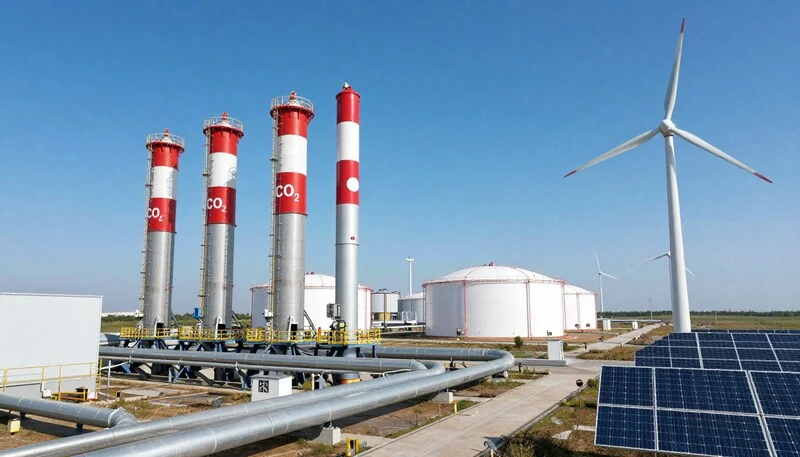
Carbon Capture, Utilization, and Storage (CCUS) represents a critical suite of technologies for mitigating climate change and achieving net-zero emissions targets. As global industries face mounting pressure to reduce their carbon footprint, carbon capture systems have emerged as essential tools for decarbonizing sectors where emissions are difficult or impossible to eliminate through electrification alone. From power generation and cement production to steel manufacturing and chemical plants, CCUS technologies capture carbon dioxide (CO₂) at the source or directly from the atmosphere, preventing it from contributing to global warming. This comprehensive guide explores the fundamental technologies, real-world applications, economic considerations, and future trajectory of carbon capture as a climate solution.
Why Carbon Capture Technology is Essential for Climate Goals
The Intergovernmental Panel on Climate Change (IPCC) has consistently identified carbon capture as an indispensable component of nearly all pathways to limit global warming to 1.5°C or 2°C above pre-industrial levels. According to climate models aligned with the Paris Agreement, achieving deep decarbonization by mid-century requires not only transitioning to renewable energy but also addressing emissions from hard-to-abate industrial sectors. Industries such as cement, steel, and chemicals account for approximately 20% of global greenhouse gas emissions—sectors where process emissions are inherent to production and cannot be eliminated through renewable electricity alone.
Carbon capture enables these industries to continue operating while dramatically reducing their climate impact. Moreover, when combined with sustainable biomass energy or direct air capture, CCUS can achieve negative emissions, actively removing historical CO₂ from the atmosphere. This dual capability—both reducing current emissions and reversing past damage—makes carbon capture technology a cornerstone of comprehensive climate strategies aimed at achieving net-zero and eventually net-negative emissions globally.
The Dual Role: Reducing and Removing Emissions
Carbon Capture Technology serve two distinct but complementary functions in the fight against climate change. Point-source capture focuses on preventing emissions at industrial facilities, power plants, and manufacturing sites where CO₂ concentrations are high and capture is most economically feasible. This approach reduces the flow of new emissions into the atmosphere, helping industries transition toward low-carbon operations while maintaining economic viability.
Carbon removal technologies, by contrast, address the stock problem of atmospheric CO₂ that has accumulated over decades of industrial activity. Direct Air Capture (DAC) systems pull CO₂ directly from ambient air regardless of concentration, while Bioenergy with Carbon Capture and Storage (BECCS) captures emissions from burning sustainably grown biomass that absorbed CO₂ during its growth. These removal technologies generate negative emissions, effectively reversing past pollution. Together, point-source capture and carbon removal create a comprehensive strategy: reducing new emissions while simultaneously drawing down the atmospheric carbon legacy that continues to drive climate change.
How Carbon Capture Works: The Four Core Technologies Explained
Carbon capture technologies are classified based on where and how CO₂ separation occurs within industrial processes and combustion systems. Each approach offers distinct advantages for specific applications, determined by factors such as CO₂ concentration in the gas stream, facility design, and economic considerations. The four main categories—post-combustion, pre-combustion, oxy-fuel combustion, and direct capture—encompass the full spectrum of capture strategies currently deployed or under development worldwide.
Post-Combustion Capture: The Retrofittable Solution
Post-combustion capture represents the most mature and widely implemented approach to carbon capture, particularly suited for retrofitting existing power plants and industrial facilities. This method extracts CO₂ from flue gas—the mixture of gases produced after fuel combustion that typically contains 3-15% CO₂, along with nitrogen, water vapor, and other compounds. The key advantage of post-combustion systems is their ability to be added to existing infrastructure without requiring fundamental changes to combustion processes, making them attractive for aging coal and natural gas power plants seeking to extend their operational life while reducing emissions.
The most common post-combustion technology employs amine scrubbing, a chemical absorption process where flue gas passes through towers containing liquid solvents—typically monoethanolamine (MEA) or similar amine compounds. These solvents selectively bind with CO₂ molecules through a reversible chemical reaction. The CO₂-rich solvent is then heated in a separate vessel called a regenerator or stripper, where temperatures of 100-140°C release the captured CO₂ as a concentrated stream while regenerating the solvent for reuse. This cyclic process can achieve capture rates of 85-95%, though it requires significant energy input—typically reducing a power plant’s net electrical output by 15-30% due to the steam required for solvent regeneration.
Beyond amine scrubbing, alternative post-combustion technologies under development include solid sorbents (such as metal-organic frameworks), membrane separation systems, and cryogenic separation. These emerging approaches aim to reduce the energy penalty and operating costs that currently limit widespread deployment. Post-combustion capture remains particularly relevant for cement and steel plants, where process emissions mix with combustion emissions in flue gas streams, and for existing fossil fuel power infrastructure where full replacement with renewables faces technical or economic barriers.
Pre-Combustion Capture: Hydrogen and Syngas Pathway
Pre-combustion capture takes a fundamentally different approach by processing fuel before combustion to separate CO₂ upfront while producing hydrogen-rich fuel gas. This method is primarily employed in integrated gasification combined cycle (IGCC) power plants and industrial facilities producing hydrogen for ammonia synthesis, refining, or other chemical processes. The process begins with gasification or steam methane reforming, where solid fuels like coal or gaseous fuels like natural gas react with oxygen and steam at high temperatures to produce synthesis gas (syngas)—a mixture of carbon monoxide (CO) and hydrogen (H₂).
The syngas then undergoes the water-gas shift reaction, where carbon monoxide reacts with steam over a catalyst to produce additional hydrogen and CO₂. This reaction shifts the CO/H₂ balance toward hydrogen while converting carbon to CO₂, creating a gas stream with CO₂ concentrations of 15-40%—significantly higher than post-combustion flue gas. At these elevated concentrations and pressures (typically 20-70 bar), CO₂ separation becomes more efficient and less energy-intensive. Physical absorption solvents such as Selexol or Rectisol can capture the CO₂, leaving behind a hydrogen-rich fuel stream that burns cleanly to produce only water vapor.
Pre-combustion capture has gained particular attention in the context of blue hydrogen production—hydrogen produced from fossil fuels with carbon capture, positioning it as a lower-carbon alternative to conventional gray hydrogen. Fertilizer manufacturers using the Haber-Bosch process for ammonia production are well-suited to pre-combustion capture, as they already produce hydrogen from natural gas and can readily integrate CO₂ separation. While pre-combustion systems require more complex and capital-intensive front-end processing compared to post-combustion retrofits, they offer higher capture efficiencies and lower energy penalties per ton of CO₂ captured, making them economically favorable for new-build facilities and hydrogen-focused applications.
Oxy-Fuel Combustion: Simplifying with Pure Oxygen
Oxy-fuel combustion eliminates nitrogen from the combustion process entirely by burning fuel in pure or near-pure oxygen rather than air, which contains 78% nitrogen. This approach produces flue gas consisting primarily of CO₂ and water vapor, with CO₂ concentrations exceeding 80% after water condensation. By avoiding the dilution effect of nitrogen, oxy-fuel systems dramatically simplify CO₂ capture—the resulting high-purity CO₂ stream requires minimal additional separation, primarily just dehydration and compression for transport and storage.
The technical challenge of oxy-fuel combustion lies in producing the oxygen itself. Air separation units (ASUs) use cryogenic distillation to separate oxygen from nitrogen, a process that consumes substantial energy—typically 15-20% of the power plant’s gross output. However, this energy penalty is comparable to or slightly lower than the penalty incurred by post-combustion amine scrubbing, while producing a much purer CO₂ stream that reduces downstream processing costs. Oxy-fuel combustion also requires modifications to boiler design, as burning in pure oxygen creates much higher flame temperatures that could damage equipment designed for air combustion. To moderate temperatures, recirculated flue gas is mixed with the oxygen to dilute combustion conditions.
Currently, oxy-fuel technology remains in the pilot and demonstration phase for power generation, with projects such as the Callide Oxyfuel Project in Australia and various demonstration plants in Europe and Asia testing technical feasibility and economic viability. The cement industry has shown particular interest in oxy-fuel approaches, as cement kilns already operate at extremely high temperatures and could benefit from the simplified CO₂ recovery. While oxy-fuel combustion offers elegant simplicity in CO₂ capture, widespread commercial deployment awaits further cost reductions in oxygen production and proven long-term operational reliability at industrial scale.
Direct Capture: From Industrial Processes and Air
Direct capture encompasses two distinct categories that share the characteristic of capturing relatively pure or highly accessible CO₂ streams without combustion modification. These approaches represent both the easiest and most challenging ends of the carbon capture spectrum, from inherent process emissions requiring minimal separation to atmospheric CO₂ demanding sophisticated removal technologies.
Inherent Process Capture (High-Purity Streams)
Many industrial processes naturally generate CO₂ as a byproduct in concentrated, relatively pure streams that require minimal processing for capture. Ethanol fermentation facilities produce CO₂ at concentrations exceeding 98% as yeast metabolizes sugars, making capture straightforward and economically attractive—several U.S. ethanol plants already capture and sell this CO₂ for industrial use or are adding permanent geological storage. Natural gas processing facilities routinely separate naturally occurring CO₂ from methane to meet pipeline specifications, creating opportunities to capture and store what would otherwise be vented.
Hydrogen production from steam methane reforming generates concentrated CO₂ streams during the process, making ammonia and fertilizer plants prime candidates for cost-effective capture. Similarly, emerging cement manufacturing processes that separate calcium carbonate calcination (where limestone releases CO₂) from clinker sintering could enable capture from nearly pure CO₂ streams. These inherent process capture opportunities often represent the lowest-cost carbon capture applications, with avoided costs of $15-40 per ton of CO₂, significantly below other capture methods. Their deployment serves as crucial early-stage proof of concept while generating revenue or reducing costs for operators, helping to build the infrastructure and regulatory frameworks needed for broader CCUS deployment.
Direct Air Capture (DAC)
Direct Air Capture (DAC) represents the most technologically ambitious and economically challenging form of carbon capture, extracting CO₂ directly from ambient air where concentrations are approximately 420 parts per million (0.042%)—roughly 300 times lower than typical flue gas concentrations. This extreme dilution creates enormous thermodynamic and economic barriers, as massive volumes of air must be processed to capture meaningful amounts of CO₂. However, DAC offers unique advantages: it can be deployed anywhere globally regardless of proximity to emission sources, it addresses diffuse emissions from transportation and agriculture that cannot be captured at point sources, and it provides the only pathway to reducing absolute atmospheric CO₂ concentrations beyond merely slowing the rate of increase.
Two main DAC approaches are currently under development. Liquid solvent systems use large air contactors—essentially giant fans pulling air through chemical solutions that bind CO₂—followed by heating to release the captured CO₂. Companies like Carbon Engineering employ alkaline hydroxide solutions that react with atmospheric CO₂, then regenerate the solvents using high-temperature natural gas or hydrogen combustion. Solid sorbent systems, pioneered by companies like Climeworks, use materials that physically or chemically adsorb CO₂ at ambient temperatures, then release it when heated to moderate temperatures (80-120°C) using renewable electricity or waste heat. Solid sorbent systems generally require less energy than liquid systems but must cycle between adsorption and desorption phases, creating capacity constraints.
Current DAC costs range from $400-$1,000 per ton of CO₂ captured, though developers project costs could fall to $100-200 per ton with technological maturation and scale deployment. The energy requirements are substantial—capturing one ton of CO₂ requires 1.5-2.5 megawatt-hours of energy in the most efficient current systems, meaning DAC only delivers net climate benefits when powered by zero-carbon energy sources. Despite these challenges, DAC fills a critical gap in climate solutions by providing permanent carbon dioxide removal (CDR) to offset irreducible emissions and eventually achieve net-negative emissions. The technology has attracted significant investment and policy support, including enhanced 45Q tax credits offering up to $180 per ton for DAC with permanent storage in the United States.
Comparing Carbon Capture Technologies: A Decision Framework
Selecting the appropriate carbon capture technology depends on multiple factors including CO₂ concentration, facility design, operational constraints, and economic considerations. The following comparison provides a decision framework for understanding how each approach aligns with different industrial contexts and strategic objectives.
| Technology | CO₂ Input Concentration | Typical Capture Rate | Technology Readiness (TRL) | Primary Applications | Key Advantages |
| Post-Combustion | 3-15% CO₂ | 85-95% | TRL 8-9 (Commercial) | Coal/gas power plants, cement, steel | Retrofittable to existing facilities; proven at scale |
| Pre-Combustion | 15-40% CO₂ | 90-95% | TRL 7-8 (Demonstration) | Blue hydrogen, ammonia/fertilizer, IGCC power | Higher CO₂ concentration reduces separation costs; produces clean H₂ fuel |
| Oxy-Fuel Combustion | >80% CO₂ | >95% | TRL 6-7 (Pilot/Demo) | Coal power, cement kilns, future applications | Near-pure CO₂ stream; minimal downstream processing |
| Inherent Process | >95% CO₂ | >99% | TRL 9 (Mature) | Ethanol plants, natural gas processing, H₂ production | Lowest cost capture ($15-40/ton); minimal processing required |
| Direct Air Capture | 0.042% CO₂ | Variable (per pass) | TRL 5-6 (Pilot) | Carbon dioxide removal (CDR); negative emissions | Location-independent; addresses diffuse emissions; enables net-negative |
When evaluating which technology to deploy, decision-makers should prioritize based on CO₂ concentration in available gas streams, with higher concentrations generally offering lower costs per ton captured. Facilities with existing infrastructure favor post-combustion retrofits, while new builds can optimize for pre-combustion or oxy-fuel systems. Industries producing inherent process CO₂ should prioritize those opportunities first as low-hanging fruit. Direct Air Capture, despite current high costs, becomes essential for achieving net-zero in sectors with unavoidable diffuse emissions and for long-term atmospheric CO₂ drawdown beyond mid-century.
From Capture to Closure: Transport, Storage & Utilization
Capturing CO₂ represents only the first step in the CCUS value chain. Once separated and concentrated, the captured carbon dioxide must be transported to utilization sites or permanent storage locations, then either converted into valuable products or securely sequestered for millennia. This downstream infrastructure—pipelines, storage reservoirs, monitoring systems, and utilization facilities—determines the ultimate climate benefit and economic viability of carbon capture projects.
Transporting CO₂: Pipelines, Ships & Trucks
The United States operates over 5,000 miles of CO₂ pipelines, primarily serving enhanced oil recovery operations in Texas and the Midwest, providing proven precedent for safe CO₂ transport at scale. Pipelines remain the most cost-effective method for moving large volumes over moderate distances, typically transporting CO₂ in a supercritical state—a dense, fluid-like phase achieved by maintaining pressure above 73 atmospheres and temperature above 31°C. Supercritical CO₂ combines liquid-like density with gas-like flow properties, reducing pumping energy and enabling economical transport through standard steel pipelines with corrosion-resistant linings or coatings.
For CO₂ sources located far from storage sites or utilization facilities, maritime shipping offers flexibility. Liquefied CO₂ (LCO₂) carriers, similar to LNG tankers but operating at different temperature and pressure specifications, can transport captured CO₂ across oceans to optimal storage locations. Norway’s Northern Lights project, for example, plans to receive CO₂ by ship from multiple European industrial sources for offshore geological storage in the North Sea. Truck transport serves niche applications—small-scale emitters, early-stage projects, or utilization sites requiring modest volumes—though costs per ton-mile significantly exceed pipeline and ship transport. Building the backbone CO₂ transport infrastructure represents a major barrier to widespread CCUS deployment, requiring coordinated planning, regulatory frameworks, and often public investment to overcome the chicken-and-egg problem where capture projects await transport infrastructure while pipeline developers seek committed CO₂ volumes.
Geological Storage: The Long-Term Solution
Permanent geological storage of CO₂ leverages the same subsurface formations that have trapped oil, natural gas, and brine for millions of years, providing high confidence in long-term containment. Deep saline aquifers—porous rock formations saturated with brine at depths exceeding 800 meters—offer the largest storage potential globally, estimated at 10,000+ gigatons of CO₂ capacity, enough to store several centuries of global emissions. These formations exist in sedimentary basins worldwide, often near major industrial emission sources. Depleted oil and gas fields provide another proven storage option, with well-characterized geology, existing infrastructure, and the added benefit of enhanced oil recovery that can offset project costs while permanently storing the majority of injected CO₂.
Successful geological storage requires careful site selection based on multiple criteria. The reservoir rock must have sufficient porosity and permeability to accept injected CO₂ at required rates without creating excessive pressure that could fracture the formation. A caprock—an overlying layer of impermeable shale or salt—must provide an effective seal preventing upward migration. Site characterization includes seismic surveys to map subsurface structures, core sampling to measure rock properties, and modeling to predict CO₂ plume behavior over centuries. Once injection begins, comprehensive monitoring ensures the CO₂ remains contained: surface monitoring detects any seepage, downhole pressure sensors track injection operations, and periodic seismic surveys image the CO₂ plume’s movement and verify it remains within the target formation.
The primary risks associated with geological storage—leakage through abandoned wells, caprock fracturing, induced seismicity, and brine displacement—are manageable through proper site selection, well construction standards, and operational protocols. Decades of experience with natural CO₂ storage, acid gas injection, and enhanced oil recovery demonstrate that geological containment can be highly effective with failure rates below 1% when best practices are followed. Regulatory frameworks such as the U.S. EPA’s Underground Injection Control Class VI permits establish stringent requirements for site characterization, monitoring, and long-term stewardship, including financial assurance for post-injection monitoring extending 50 years or more. As public acceptance grows and regulations mature, geological storage capacity constraints appear surmountable, with storage potential vastly exceeding projected CCUS deployment through 2050 in most regions.
Carbon Utilization: Creating Value from CO₂
Carbon utilization transforms CO₂ from a waste product into a feedstock for producing chemicals, fuels, and materials, creating economic value that can improve CCUS project economics while avoiding emissions. However, utilization pathways vary dramatically in their climate impact, permanence, and scalability. Enhanced Oil Recovery (EOR)—injecting CO₂ to mobilize residual oil in depleted fields—has driven most commercial CO₂ utilization historically, creating revenue that subsidizes capture costs. While EOR stores a portion of injected CO₂ permanently (typically 30-60%, with the remainder recycled), the produced oil generates new emissions when combusted, creating complex climate accounting that must consider the full lifecycle and counterfactual scenarios.
More climate-aligned utilization pathways are emerging across multiple sectors. CO₂-derived fuels—including sustainable aviation fuel (SAF), methanol, and synthetic natural gas—use captured carbon as a chemical building block, though these applications only delay emissions rather than permanently removing CO₂ from the cycle. The fuels provide climate benefits primarily when displacing fossil alternatives and powered by renewable energy, creating circular carbon flows rather than net removal. Concrete and building materials offer more permanent storage: technologies like CarbonCure inject CO₂ into concrete during mixing, where it mineralizes into calcium carbonate, permanently sequestering the carbon while improving concrete strength. Mineralization approaches can potentially store gigatons annually if scaled, though they require significant energy and industrial capacity.
The chemical industry explores using CO₂ to produce polymers, plastics, and industrial chemicals, converting it into products with years or decades of useful life before eventual degradation or incineration releases the carbon. While these applications create economic value and reduce reliance on fossil feedstocks, they generally provide climate benefits measured in decades rather than the millennial timescales of geological storage. The total addressable market for carbon utilization products likely amounts to several hundred million tons of CO₂ annually at most—valuable but insufficient to absorb the billions of tons requiring permanent disposal. Therefore, utilization should be viewed as complementary to geological storage rather than a substitute, offering economic incentives that accelerate deployment while the bulk of captured CO₂ requires permanent sequestration to achieve deep decarbonization goals.
Carbon Capture in Action: Global Projects & Lessons Learned
As of 2026, approximately 45 commercial-scale carbon capture facilities operate globally, collectively capturing over 50 million tons of CO₂ annually. These pioneering projects span multiple industries and geographies, providing critical operational experience, technical validation, and lessons learned that inform next-generation deployment. Three flagship projects exemplify different aspects of CCUS implementation, from offshore saline storage to coal power retrofits to industrial-scale pre-combustion capture.
Case Study: The Sleipner Project (Offshore Norway)
Launched in 1996, the Sleipner CO₂ storage project pioneered large-scale geological sequestration and remains the longest-running saline aquifer storage operation globally. Located in the North Sea, the project captures CO₂ naturally present in produced natural gas from the Sleipner gas field—approximately 9% CO₂ concentration that must be reduced to meet sales gas specifications. Rather than venting this CO₂ to the atmosphere, operator Equinor (formerly Statoil) reinjects approximately one million tons annually into the Utsira Formation, a deep saline aquifer located 800-1,000 meters below the seabed and well-separated from the productive gas reservoir above.
The project was motivated by Norway’s offshore carbon tax introduced in 1991, making CO₂ venting economically uncompetitive compared to capture and storage. Technology employed includes conventional amine scrubbing for CO₂ separation followed by compression and injection through a dedicated well. The Utsira Formation’s enormous storage capacity, high permeability, and excellent caprock seal provided ideal conditions for safe sequestration. Over nearly three decades of operation, Sleipner has stored over 25 million tons of CO₂ with comprehensive monitoring—including repeated seismic surveys—confirming the CO₂ plume behaves as predicted, spreading laterally through the reservoir with no evidence of leakage. Sleipner’s success provided proof of concept for saline aquifer storage, informing regulatory frameworks worldwide and demonstrating that large-scale geological storage can operate safely and reliably over decadal timescales.
Case Study: Boundary Dam (Saskatchewan, Canada)
The Boundary Dam 3 Carbon Capture Project, launched in 2014, represents the world’s first commercial-scale post-combustion capture system retrofit to a coal-fired power plant. Saskatchewan Power Corporation (SaskPower) invested approximately $1.4 billion CAD to add carbon capture to one 110-megawatt unit of the Boundary Dam power station, capturing up to 90% of CO₂ from the flue gas—approximately one million tons per year at design capacity. The captured CO₂ is transported by pipeline to nearby oil fields for enhanced oil recovery, generating revenue that partially offsets operating costs, with the remainder injected into deep saline formations for permanent storage.
The project employs Shell’s CANSOLV amine-based capture technology, which circulates solvent through an absorber tower where it captures CO₂ from flue gas, then releases it in a regenerator using steam extracted from the power plant. Early operations encountered significant technical challenges including equipment reliability issues, solvent degradation, and lower-than-expected capacity factors, with the facility operating at 60-70% of design capacity in initial years. These challenges provided valuable lessons about the importance of system integration, solvent management, and operational procedures for first-of-a-kind facilities. Despite setbacks, Boundary Dam has captured over 5 million tons of CO₂ cumulatively through 2025, demonstrating technical feasibility of retrofitting existing coal plants while revealing the operational complexities and costs that must be addressed to make such retrofits economically viable at scale without substantial policy support.
Case Study: The Quest Project (Alberta, Canada)
Shell’s Quest Carbon Capture and Storage Project, operational since 2015, demonstrates industrial-scale pre-combustion capture integrated with hydrogen production. The facility captures CO₂ from Shell’s Scotford Upgrader, where natural gas and refinery off-gases undergo steam methane reforming to produce hydrogen used in upgrading bitumen from oil sands into synthetic crude oil. The project captures approximately one million tons of CO₂ annually—about 35% of total upgrader emissions—using amine scrubbing to separate CO₂ from the hydrogen-rich syngas stream before combustion.
Captured CO₂ is compressed to supercritical state and transported via a 65-kilometer pipeline to injection wells accessing the Basal Cambrian Sands formation, a deep saline aquifer located over 2 kilometers underground. The project received substantial government support, with federal and provincial contributions covering approximately two-thirds of the $1.35 billion CAD capital cost, reflecting its role as a technology demonstration and public-good infrastructure. Quest has consistently met or exceeded its capture targets, storing over 8 million tons of CO₂ through early 2026 with impeccable safety and environmental performance. The project’s success helped validate pre-combustion capture for hydrogen production applications, provided operational data supporting regulatory approval of saline aquifer storage, and demonstrated that CCUS can integrate seamlessly with existing industrial operations when properly designed. Quest’s high capture efficiency and operational reliability contrast with early challenges at Boundary Dam, highlighting how pre-combustion systems benefit from higher CO₂ concentrations and established industrial gas processing experience.
The Economics and Policy Driving Deployment
Carbon capture remains more expensive than many alternative decarbonization options, creating an economic barrier that has slowed deployment despite technical readiness. The levelized cost of captured CO₂ varies widely by application, ranging from $15-40 per ton for high-purity process streams to $60-120 per ton for post-combustion capture from power plants and industrial facilities, up to $400-1,000 per ton for direct air capture with current technologies. These costs stem from multiple factors: the energy penalty of capture processes (typically reducing net electrical output by 15-30% for power plants), capital costs of capture equipment and CO₂ compression, ongoing operating expenses for solvents and maintenance, and downstream transport and storage infrastructure.
The energy penalty deserves particular attention as it creates a paradoxical challenge: capturing emissions from fossil fuel power plants requires consuming additional fuel, reducing efficiency and potentially increasing fuel costs and electricity prices. This efficiency loss translates to higher costs per megawatt-hour of delivered electricity, making CCUS-equipped plants less competitive against renewable alternatives in regions with favorable wind and solar resources. For industrial emitters like cement and steel plants, the energy penalty and capital costs must be absorbed through higher product prices or offset through carbon pricing mechanisms, policy incentives, or voluntary corporate commitments. The fundamental economic challenge is that CO₂ has negative value unless strong policy creates a cost for emissions or revenue for capture, making CCUS deployment heavily dependent on government intervention.
Key Policy Incentives: 45Q and the Inflation Reduction Act
The United States has emerged as the global leader in CCUS policy support, primarily through the Section 45Q tax credit significantly expanded by the Inflation Reduction Act of 2022. This federal incentive provides direct payments or tax credits based on tons of CO₂ captured and either utilized or permanently stored, with rates varying by application type and disposal method. For industrial facilities and power plants capturing CO₂ for geological storage, the credit provides $85 per ton, with a $60 per ton credit for utilization in EOR or other applications where permanent storage is partial. Direct Air Capture receives enhanced support at $180 per ton for permanent storage and $130 per ton for utilization, reflecting its higher costs and climate value as carbon dioxide removal rather than merely avoided emissions.
The Inflation Reduction Act’s reforms dramatically improved 45Q’s effectiveness by introducing direct pay provisions, allowing tax-exempt entities and new projects without tax liability to receive cash payments rather than waiting to monetize credits against future profits. The law also extended the credit availability through 2032 for projects beginning construction, removed the cap on total credits per facility, and streamlined qualification requirements. These changes triggered a surge in project announcements, with over 150 CCUS projects in various stages of development across the United States as of early 2026, representing potential capture capacity exceeding 200 million tons annually if all proceed to operation. The 45Q credit effectively makes many industrial capture projects economically viable, covering 40-70% of capture costs depending on technology and application, though transport and storage infrastructure gaps remain bottlenecks in some regions.
Beyond the United States, carbon capture incentives vary widely. The European Union’s Innovation Fund provides capital grants for pioneering CCUS projects, while individual member states implement national support schemes. The UK’s CCUS Infrastructure Fund aims to establish industrial capture clusters, and Canada offers investment tax credits and direct funding through programs like the Strategic Innovation Fund. Norway’s offshore carbon tax, which motivated the Sleipner project, continues to incentivize capture in the oil and gas sector. Many countries now incorporate CCUS into their long-term climate plans and net-zero strategies, though translating commitments into operational policy mechanisms that drive deployment remains uneven globally. The International Energy Agency estimates that current policy support and announced projects put CCUS on track to capture approximately 350-450 million tons of CO₂ annually by 2030—substantial growth but still well below the billions of tons needed for deep decarbonization pathways aligned with limiting warming to 1.5-2°C.
The Future Cost Curve: Innovation and Scale
Cost reductions through technological innovation and economies of scale represent critical enablers for widespread CCUS deployment. Research and development efforts focus on multiple fronts: advanced solvents and sorbents with lower regeneration energy requirements, membrane technologies offering continuous separation without thermal cycling, modular capture units that reduce capital costs through factory fabrication, and process integration approaches that utilize waste heat to minimize energy penalties. Novel materials such as metal-organic frameworks (MOFs) and enzyme-enhanced systems show promise in laboratory settings, though commercial readiness remains years away for most emerging technologies.
Learning-by-doing effects from deployment at scale historically drive dramatic cost reductions in energy technologies—solar photovoltaics and wind turbines experienced 80-90% cost declines over three decades as cumulative deployment grew exponentially. Industry analyses project similar learning rates for carbon capture could reduce costs by 30-50% as deployment scales from tens of millions to hundreds of millions of tons annually. Shared CO₂ transport and storage infrastructure, standardized equipment designs, workforce experience, and supply chain optimization all contribute to projected cost curves. Direct air capture, starting from the highest baseline costs, shows the greatest potential for dramatic reductions, with developers targeting $100-150 per ton by 2035 through second- and third-generation system designs, though achieving such costs depends on significant deployment enabling learning and scale economies.
The ultimate CCUS cost trajectory remains uncertain and dependent on multiple factors including sustained policy support, carbon price levels, fossil fuel prices, renewable energy costs, and competing decarbonization technologies. In scenarios where renewables and efficiency measures provide low-cost emissions reductions, CCUS may remain confined to niche applications where few alternatives exist—hard-to-abate industrial processes and carbon dioxide removal. Conversely, if renewable deployment faces constraints or storage and transmission bottlenecks emerge, broader CCUS deployment for power generation and other applications may prove cost-competitive, particularly for existing assets. What appears certain is that achieving global net-zero emissions by mid-century requires deploying carbon capture at vastly greater scale than today, capturing billions rather than millions of tons annually, making cost reduction through innovation and scale an imperative rather than merely a goal.
FAQs
Is carbon capture technology proven and safe?
Yes, carbon capture is a proven technology with decades of operational history in specific industrial applications. CO₂ separation processes like amine scrubbing have been used in natural gas processing and chemical production since the 1970s. Geological CO₂ storage has operated successfully at commercial scale since 1996 with projects like Sleipner in Norway, which has safely stored over 25 million tons with comprehensive monitoring showing no leakage. The technology’s safety record is strong when projects follow best practices for site selection, well construction, and monitoring. However, each application context presents unique challenges, and first-of-a-kind implementations at new facility types or scales typically encounter operational issues requiring refinement. The technology is proven but continues evolving to improve reliability and reduce costs.
What is the main drawback of carbon capture?
The primary drawbacks are high cost and significant energy consumption. Capturing CO₂ requires substantial energy—typically reducing a power plant’s net electrical output by 15-30%—which increases operating costs and can raise electricity prices. Capital costs for retrofit installations range from hundreds of millions to over a billion dollars depending on scale. For industrial facilities, these costs must be passed through to product prices or offset through policy support. The energy penalty creates a paradox where capturing emissions from fossil fuel plants requires burning additional fuel, potentially undermining climate benefits if not carefully accounted for. Additionally, CCUS requires extensive infrastructure for CO₂ transport and storage that is lacking in most regions, creating barriers to deployment even where capture is economically viable.
Can carbon capture make a power plant emissions-free?
Carbon capture can achieve very low emissions but not absolute zero. Commercial post-combustion systems typically capture 85-95% of CO₂ from flue gas, leaving 5-15% uncaptured along with other emissions from the facility including methane leakage (for natural gas plants), equipment operation, and the energy consumed by the capture process itself. Pre-combustion and oxy-fuel systems can achieve higher capture rates exceeding 95%, approaching but never reaching 100% capture. When lifecycle emissions from fuel extraction, transport, and processing are included, even plants with 90%+ capture rates still have a carbon footprint. Terms like net-zero or low-carbon are more accurate descriptors than emissions-free. That said, CCUS-equipped fossil plants can achieve emission intensities comparable to or lower than some renewable technologies when lifecycle impacts are fully accounted, though they cannot reach the near-zero emissions of wind and solar generation.
What’s the difference between CCS and CCUS?
CCS (Carbon Capture and Storage) refers specifically to capturing CO₂ and permanently storing it in geological formations, with no use of the carbon beyond disposal. CCUS (Carbon Capture, Utilization, and Storage) is the broader term encompassing both permanent storage and utilization pathways where captured CO₂ becomes feedstock for producing fuels, chemicals, building materials, or other products. The U appended to CCS reflects growing interest in creating economic value from captured carbon to improve project economics. However, utilization pathways vary dramatically in climate benefit—some provide permanent carbon sequestration (like mineralization in concrete), while others merely delay emissions (like CO₂-derived fuels). In practice, CCUS has become the more common umbrella term, with distinction made between utilization with permanent storage versus utilization with eventual re-emission.
Is carbon capture just a way to extend the life of fossil fuels?
This criticism reflects legitimate concern about carbon capture potentially delaying the transition to renewable energy and extending fossil fuel dependence. Some environmental advocates worry that CCUS provides a lifeline to coal and gas industries that should be rapidly phased out rather than sustained through carbon capture. These concerns have merit—CCUS should not serve as justification for building new fossil fuel plants when renewables provide cleaner alternatives, and capture rates below 90% still result in substantial emissions. However, the complete picture is more nuanced. First, hard-to-abate industrial sectors like cement, steel, and chemicals have few near-term alternatives to CCUS for deep decarbonization. Second, existing fossil infrastructure represents trillions in sunk capital that may operate for decades; retrofitting with capture provides an emissions reduction pathway during the transition period. Third, CCUS enables negative emissions through BECCS and DAC, which climate models indicate are necessary for limiting warming to 1.5°C. The appropriate role for CCUS is as a complementary tool—essential for specific applications—rather than a substitute for renewable energy deployment and efficiency measures that should proceed as rapidly as possible.
Carbon capture technology stands at a critical juncture in 2026. The technical foundations are proven, policy support has strengthened dramatically, and project pipelines are growing. Yet significant barriers remain: costs must decrease, infrastructure must expand, public acceptance must grow, and deployment must scale by orders of magnitude to meet climate goals. The path forward requires parallel action on multiple fronts—continued innovation to reduce costs and improve performance, sustained policy support to bridge economic gaps until learning effects take hold, strategic infrastructure investment in shared transport and storage networks, and honest accounting of where CCUS provides the best emissions reduction value versus alternative approaches. As the global community pursues ambitious net-zero targets, carbon capture technologies—from retrofitted industrial facilities to direct air capture—will play an essential role alongside renewable energy, efficiency, electrification, and other climate solutions in the comprehensive portfolio needed to stabilize the climate.

Adrian Cole is a seasoned content creator specializing in artificial intelligence, emerging technologies, and digital innovation. With a strong passion for breaking down complex technical concepts into clear, practical insights, Adrian helps readers understand how AI is shaping businesses, products, and everyday life. His work focuses on real-world applications of machine learning, automation, SaaS tools, and future tech trends, making advanced technology accessible to both professionals and curious learners. Adrian is known for his balanced, experience-driven approach that blends technical accuracy with human-centered storytelling.