
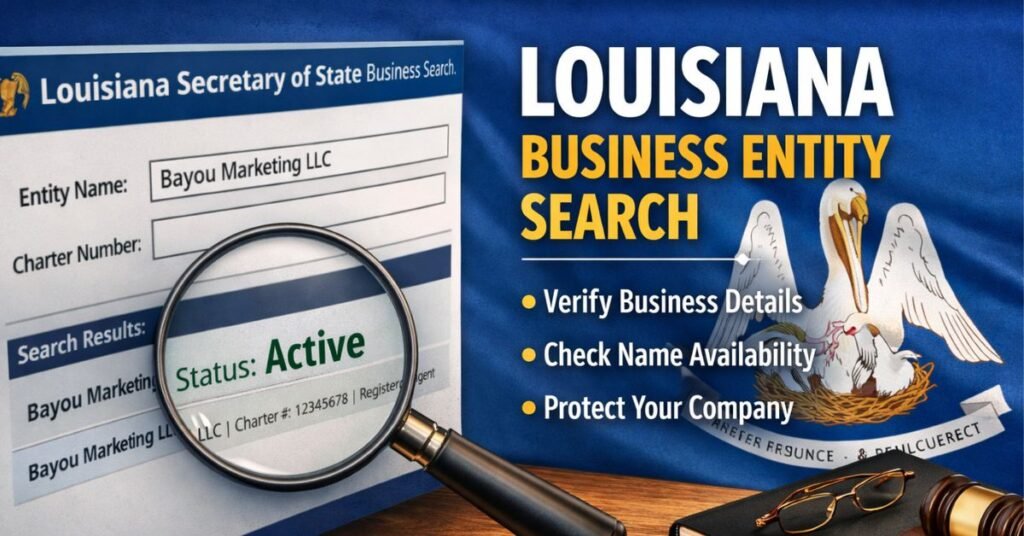
If you’ve ever tried to confirm whether a company is real, active, or trustworthy, you already understand why a louisiana business entity search matters. Maybe you were about to sign a contract, launch a partnership, or simply check if your dream business name was still available. Then you hit that moment of uncertainty: How do I actually verify a business in Louisiana—and what should I be looking for once I find it?
I’ve been in that exact situation more times than I can count. From helping small startups register their first LLC to researching vendors before major marketing deals, I’ve learned that one quick database lookup can save thousands of dollars, months of frustration, and a whole lot of stress. Yet surprisingly, many people still skip this step—or use the search tool incorrectly—because the process feels confusing at first glance.
This guide changes that.
By the time you finish reading, you’ll know:
- What a Louisiana business entity search really is (in plain English)
- When and why you should use it
- The exact step-by-step process to run a search correctly
- Tools, tips, and expert shortcuts most guides never mention
- Common mistakes that can lead to costly legal or financial problems
Whether you’re forming an LLC, researching competitors, checking contractor legitimacy, or protecting your brand name, this is the practical, real-world walkthrough you actually need.
Let’s start with the basics.
What a Louisiana business entity search actually means in real life
At its core, a Louisiana business entity search is simply a public database lookup that lets you see official information about companies registered in the state of Louisiana. Think of it like a digital filing cabinet maintained by the Secretary of State. Every LLC, corporation, partnership, or registered trade name leaves a paper trail there, and the search tool is your key to opening the drawer.
But here’s where people often misunderstand the concept. This isn’t just about checking whether a name is taken. It’s about transparency and verification.
When you run a search, you can usually see:
- Whether a business is active, dissolved, or inactive
- The official formation date
- Registered agent details
- Filing history and status
- Sometimes addresses and officers
That information tells a story. A company formed last week looks very different from one operating continuously for ten years. A business with repeated status changes may signal instability. A dissolved entity obviously can’t legally operate.
I like to compare it to checking a car’s history report before buying it. You wouldn’t hand over cash without confirming ownership and accident history. A business entity search works the same way—it protects you from hidden surprises.
For entrepreneurs, it also prevents heartbreak. Imagine designing branding, building a website, and printing merchandise—only to discover someone already owns the name. A five-minute search could have prevented that.
So while the term sounds technical, the purpose is deeply practical: confidence, clarity, and protection.
Why this search matters more than most people realize
Many new business owners assume entity searches are just a bureaucratic formality. In reality, they’re one of the most powerful free risk-reduction tools available.
Let’s break down why.
First, legal protection.
Operating under a name already registered by another entity can lead to forced rebranding, legal disputes, or trademark conflicts. Even small local conflicts can cost thousands in attorney fees.
Second, financial safety.
Before hiring a contractor, signing a vendor agreement, or investing in a company, verifying the entity’s status helps confirm legitimacy. Fraudulent or dissolved businesses often appear convincing online—but the state database rarely lies.
Third, competitive intelligence.
Smart entrepreneurs use entity searches to analyze competitors, discover new market entrants, and track naming trends in their industry. It’s like quiet market research hiding in plain sight.
Fourth, compliance.
If you already own a Louisiana business, periodic searches help confirm:
- Your status is still active
- Annual filings were processed correctly
- No administrative dissolution occurred
Missing a filing deadline can quietly shut down your legal protections. Many owners don’t realize this until it’s too late.
Finally, branding strategy.
Before you fall in love with a business name, the search ensures availability—not just legally, but practically. Seeing similar names in the same industry might push you toward something more distinctive.
In short, this single search supports legal security, smart decision-making, and long-term business health. That’s a lot of value for a tool that takes minutes to use.
Who should use a Louisiana business entity search (and when)
You don’t need to be a lawyer or accountant to benefit from this. In fact, the people who gain the most are often everyday entrepreneurs and consumers making important decisions.
Here are the groups who should absolutely use it.
New entrepreneurs forming an LLC or corporation
Before filing formation documents, you must confirm your desired name is distinguishable. This search is the first step in starting legally.
Freelancers and side-hustlers scaling into real businesses
Once money starts flowing, legitimacy matters. Checking name availability and registration status protects your brand as you grow.
Investors and partners
Never invest in or partner with a company without verifying its legal existence and standing. This simple habit prevents expensive mistakes.
Consumers hiring contractors or service providers
Whether it’s construction, consulting, or marketing, confirming a company is properly registered adds a layer of trust.
Researchers and journalists
Entity searches reveal ownership structures, formation timelines, and corporate relationships useful for investigations or reporting.
Existing business owners
Running an occasional search on your own company ensures filings remain current and no administrative issues slipped through.
Timing matters too. The best moments to perform a search include:
- Before choosing a business name
- Before signing a major contract
- Before investing money
- Before launching branding or marketing
- During annual compliance checks
Think of it like checking the weather before a long trip. You can skip it—but you probably shouldn’t.
Step-by-step: how to run a Louisiana business entity search correctly
Let’s walk through the exact process in a clear, beginner-friendly way. Even if you’ve never done this before, you’ll be able to complete a search in minutes.
Step 1: Go to the Louisiana Secretary of State business search page
This is the official database. Always use the state site rather than random third-party directories, which may contain outdated or incomplete information.
Step 2: Choose your search method
You can typically search by:
- Business name
- Charter number
- Trade name
Name searches are the most common starting point.
Step 3: Enter the name carefully
Small spelling differences matter. Try:
- Exact spelling
- Partial words
- Variations without punctuation
For example, searching “Bayou Marketing Group LLC” and “Bayou Marketing” may produce different results.
Step 4: Review the results list
Look for:
- Active vs inactive status
- Formation date
- Similar names
If multiple similar entities appear, your desired name may not be distinguishable enough.
Step 5: Open the entity details page
Here you’ll find the most useful information:
- Registered agent
- Principal office address
- Filing history
- Current standing
This page is the real goldmine.
Step 6: Confirm name availability or legitimacy
Depending on your goal:
- Entrepreneurs check if the name is free
- Investors confirm the company is active
- Consumers verify legitimacy
Step 7: Save or print records
Keeping a screenshot or PDF can help with legal records or due diligence documentation.
That’s it. Simple, fast, and incredibly valuable.
Tools, alternatives, and expert recommendations
While the official Louisiana database is the primary resource, experienced professionals often combine multiple tools for deeper insight.
Free tools worth using
The state entity search should always be step one. Beyond that:
- Trademark databases help confirm brand protection
- Domain name searches ensure web availability
- Local parish records sometimes reveal additional filings
Paid tools that add value
Premium business research platforms can provide:
- Ownership networks
- Financial indicators
- Litigation history
- Credit risk data
These are especially useful for investors or large contracts.
Pros of free tools:
- No cost
- Official accuracy
- Fast access
Cons:
- Limited background data
- No financial insights
- Manual searching required
Pros of paid tools:
- Deeper intelligence
- Risk analysis
- Time savings
Cons:
- Subscription fees
- Sometimes unnecessary for small decisions
My practical advice:
Use free official searches for name checks and legitimacy.
Use paid research only for major financial or legal decisions.
That balance keeps costs low while maintaining strong due diligence.
Common mistakes people make (and how to avoid them)
After years of helping entrepreneurs, I’ve seen the same errors repeat again and again. The frustrating part is that each one is completely preventable.
Mistake 1: Assuming a name is available without searching
People fall in love with a name, build branding, then discover it’s taken. Always search first—before anything else.
Mistake 2: Only checking exact matches
Similar names can still be rejected during registration. Look for variations, plurals, and abbreviations.
Mistake 3: Ignoring entity status
An inactive or dissolved company name may still create confusion or legal issues. Status matters.
Mistake 4: Using outdated third-party websites
Only the official state database guarantees accuracy.
Mistake 5: Forgetting trademark conflicts
State registration doesn’t override federal trademarks. Always double-check trademarks separately.
Mistake 6: Skipping annual compliance checks
Existing owners sometimes assume everything is fine—until administrative dissolution happens.
The fix for all of these is simple:
Adopt a habit of routine verification.
Five minutes of searching can prevent months of damage.
Conclusion: a small search that creates massive peace of mind
A Louisiana business entity search might sound like a minor administrative task, but in real life, it’s one of the smartest protective moves you can make.
It safeguards your brand before launch.
It verifies legitimacy before money changes hands.
It keeps your own business compliant and active.
And it provides quiet confidence in decisions that truly matter.
The best part?
It’s fast, free, and available anytime.
So before your next contract, partnership, investment, or business launch, take a moment to run the search. Future you will be grateful you did.
And if you’ve never tried it before, now you know exactly how.
FAQs
What is a Louisiana business entity search used for?
It helps verify company registration, status, name availability, and official filing details within the state.
Is the Louisiana business entity search free?
Yes, the official Secretary of State database is publicly accessible at no cost.
Can I check if my LLC name is available in Louisiana?
Absolutely. Name searches are one of the primary uses of the database before filing formation documents.
Does an inactive business name become automatically available?
Not always. Additional rules and waiting periods may apply, so further verification is recommended.
Is a state entity search the same as a trademark search?
No. State registration and federal trademarks are separate systems. Both should be checked.